

Hey there! As a supplier of Corundum Castables, I often get asked about the age - old question: When should I choose monolithic Corundum Castables and when precast ones? Well, let's dive right into it and break down the scenarios where each option shines.
Understanding the Basics
First off, let's quickly go over what these two types of Corundum Castables are. Monolithic Corundum Castables are basically a type of refractory material that comes in a dry mix. You add water, mix it up, and then it can be poured, gunned, or troweled into place. It's a flexible option that can be shaped on - site according to your specific needs.
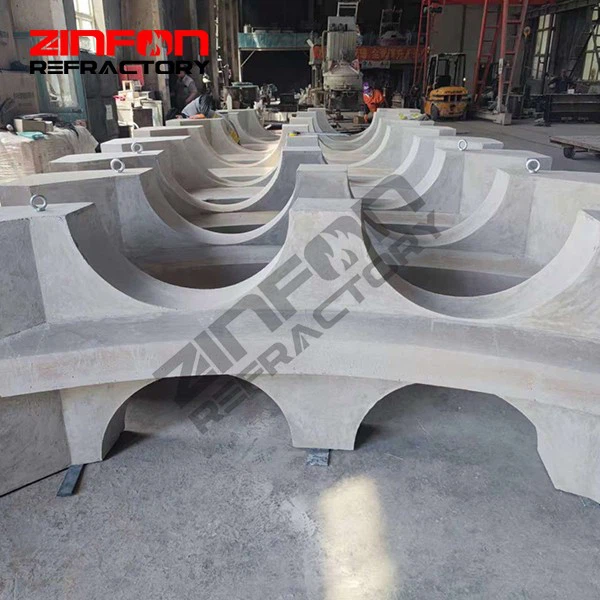
On the other hand, precast Corundum Castables, like the Refractory Precast Block, are pre - made in a factory. They come in set shapes and sizes, and all you have to do is install them at your site.
When to Choose Monolithic Corundum Castables
Custom Shapes and Complex Designs
One of the biggest advantages of monolithic Corundum Castables is their ability to adapt to custom shapes. If you're working on a project with unique geometries, like a curved furnace wall or a complex - shaped ladle, monolithic castables are your best bet. You can pour the mixture into a custom - made mold on - site, and it will take on the exact shape you need. This flexibility is a game - changer for projects that require non - standard designs.
For example, let's say you're building a small, specialized foundry with a unique furnace design. The curves and angles of the furnace are so specific that it would be nearly impossible to find precast blocks that fit perfectly. In this case, monolithic Corundum Castables allow you to create a seamless, custom - fit lining that will perform optimally.
On - Site Repairs
Another great scenario for monolithic Corundum Castables is on - site repairs. If you have an existing refractory lining that has suffered damage, you can use monolithic castables to patch it up. Since you can mix and apply the material right at the site, it's a quick and efficient way to fix minor cracks or holes.
Imagine a large industrial kiln that has a small crack in the lining. Instead of replacing an entire precast block, you can simply mix up some monolithic Corundum Castables, pour it into the crack, and let it dry. This not only saves time but also reduces costs associated with replacing large precast components.
Cost - Effective for Small - Scale Projects
For small - scale projects, monolithic Corundum Castables can be more cost - effective. You only need to purchase the amount of material you actually need, and there's no need to invest in expensive precast molds or pay for the manufacturing and shipping of precast blocks. If you're working on a DIY project or a small - business installation, monolithic castables offer a budget - friendly option.

When to Choose Precast Corundum Castables
Large - Scale Projects with Standard Designs
When you're dealing with large - scale projects that have standard designs, precast Corundum Castables are the way to go. Since they are mass - produced in a factory, you can get a large quantity of identical blocks quickly. This is great for projects like building a large industrial furnace with a standard rectangular or cylindrical shape.
The manufacturing process of precast blocks also ensures a high level of quality control. Each block is made under controlled conditions, which means they have consistent properties and performance. This consistency is crucial for large - scale projects where any variation in the refractory material could lead to problems down the line.
Time - Sensitive Projects
If you're on a tight schedule, precast Corundum Castables can save you a lot of time. The installation process is much faster compared to using monolithic castables. You don't have to wait for the mixture to be mixed, poured, and cured on - site. Instead, you can simply transport the precast blocks to the site and start installing them right away.
For instance, if you're building a new steel plant and need to get the furnaces up and running as soon as possible, precast blocks can significantly reduce the construction time. This allows you to start production earlier and start generating revenue.
High - Temperature and High - Stress Applications
Precast Corundum Castables are often better suited for high - temperature and high - stress applications. The factory - made blocks are designed to withstand extreme conditions, and they can be engineered with specific properties to handle the demands of these environments.
In a steel - making furnace, for example, the temperatures can reach extremely high levels, and the refractory lining is under constant stress from the molten metal. Precast Corundum Castables can be formulated to have high thermal shock resistance and excellent abrasion resistance, ensuring a long - lasting and reliable lining.
Making the Right Choice
So, how do you decide which option is right for your project? Well, it all comes down to a few key factors:
Project Requirements
First, consider the specific requirements of your project. Think about the shape, size, and design of the structure you're building or repairing. If it's a custom - shaped or small - scale project, monolithic Corundum Castables might be the better choice. But if it's a large - scale, standard - design project, precast blocks could be more suitable.
Budget
Your budget is also an important factor. Monolithic castables are generally more cost - effective for small projects, while precast blocks might be worth the investment for large - scale, high - performance applications. Make sure to get quotes for both options and compare the costs, including material, labor, and installation.
Time Constraints
If you're working on a time - sensitive project, precast Corundum Castables can save you a lot of time. However, if you have more flexibility in your schedule, monolithic castables might be a viable option, especially if you need custom shapes.
Conclusion
In conclusion, both monolithic Corundum Castables and precast ones have their own unique advantages. As a supplier, I'm here to help you make the right choice for your project. Whether you need a custom - fit lining for a small - scale project or a high - performance solution for a large industrial furnace, we've got you covered.
If you're still unsure which option is best for you, or if you have any questions about our Corundum Castables, don't hesitate to reach out. We're always happy to have a chat and help you find the perfect refractory solution for your needs. Let's work together to ensure your project is a success!
References
- "Refractory Materials Handbook" - A comprehensive guide on different types of refractory materials and their applications.
- Industry reports on the latest trends in Corundum Castables and precast refractory products.