





Introduction
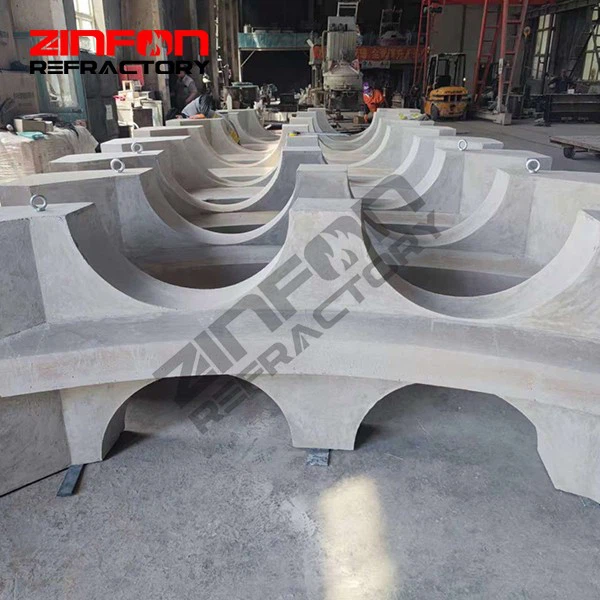
Refractory prefabricated parts belong to the category of monolithic refractory materials and are also known as castable prefabricated blocks or monolithic refractory prefabricated blocks. They are produced by mixing well-prepared castables and casting them into desired shapes using molds. Featuring diverse shapes and superior performance, they offer more flexible applications compared to shaped refractory products.
Their main applications span industries such as metallurgy, petrochemical, construction, and power:
Metallurgical industry: Used for maintenance and reinforcement of high-temperature equipment such as steelmaking furnaces, smelting furnaces, converters, and electric furnaces.
Petrochemical industry: Applied to repair and reinforce equipment including petrochemical plants, storage tanks, and heat exchangers.
Construction industry: Suitable for fireproofing and high-temperature reinforcement of structures in high-rise buildings, including fireproof partition walls, elevator shafts, and ventilation ducts.
Power industry: Used for maintenance and reinforcement of equipment such as power plant boilers, steam turbines, and gas turbines.

Classification

By binding agent: Includes aluminate cement, water glass, aluminum phosphate, clay-bonded, and low-cement prefabricated blocks.
By aggregate type: Divided into clay, high-alumina, silicon carbide, corundum, and other prefabricated components.
By weight: Prefabricated components range from tens of kilograms to several tons and are classified as large, medium, or small units.
By reinforcement: Divided into ordinary precast blocks, steel-reinforced precast blocks, and anchor-reinforced precast blocks, among others.
Advantage
Convenient construction: Prefabricated blocks are pre-cast, cured, and dried at the manufacturing site. On-site installation requires only mechanical lifting, significantly shortening the construction period and saving labor and energy.
Superior performance: Compared to monolithic refractories cast on-site, they provide precise dimensions and consistent performance. Unlike fired refractory bricks, they do not require kiln firing, saving energy, improving yield, and reducing production costs.
Excellent thermal insulation: Prefabricated blocks are larger than refractory bricks and use mortise-and-tenon joints to eliminate straight-through seams. This design enhances thermal insulation, effectively reducing furnace heat loss and energy consumption.
High adaptability: Not limited by the shape of the application site, these blocks can be custom-made to match different kiln sections, enabling customized refractory shapes.
Zinfon Refractory Technology Co.,Ltd.
We provide one-stop services from technical consultation to design, production, and after-sales support.


Process
Batching:
According to application requirements and material specifications, refractory aggregates, powders, binders, and additives are proportioned and mixed in specific ratios.
Mixing:
Pre-measured raw materials are dry blended in a forced-action mixer, then water or liquid binders are added for wet mixing, usually for 3–5 minutes to ensure thorough homogenization.
Forming:
The mixed materials are transferred into prefabricated molds. Common forming methods include vibration casting, vibration pressing, and ramming. For vibration casting, the mold is secured on a vibrating table; the mixture is poured in and vibrated until the surface is uniform and air bubbles are released.
Curing:
After forming, the precast blocks are cured in a temperature- and humidity-controlled environment for at least 3 days. Alternatively, steam curing can be applied with a heating rate of 10–15°C/h and cooling rate not exceeding 40°C/h.
Demolding and Inspection:
After curing, blocks are tapped with a small hammer to assess curing completeness by sound resonance. Demolding proceeds only after confirming adequate hardness. Dimensional accuracy and surface quality are inspected.


Application
Steelmaking and Ironmaking Equipment
Application areas: Blast furnace body, hearth, taphole trench, converter lining, furnace hood, electric furnace wall, furnace bottom, etc.
Functions:
High-alumina or silicon carbide precast blocks used in blast furnace taphole trenches resist iron melt erosion and high temperatures, extending service life.
Converter linings made from magnesia-carbon or corundum precast blocks withstand extreme temperature fluctuations (1500–1700°C) and molten steel scouring, reducing steel leakage risks.

Non-Ferrous Metal Smelting
Application areas: Furnace walls and hearths of copper/aluminum smelting furnaces, electrolytic cell linings.
Features:
Silicon carbide precast blocks are ideal for aluminum electrolytic cell bottoms due to their resistance to aluminum liquid erosion and low thermal conductivity, minimizing heat loss.
Corundum precast blocks are suitable for copper melting furnaces, effectively resisting slag corrosion.
Petrochemical Industry
Application areas: Cracker furnace tube supports, reactor linings, heating furnace walls, and furnace roofs.
Material requirements:
Cracking furnaces operating at 1000–1200°C use low-cement corundum precast blocks balancing high-temperature resistance and flue gas corrosion resistance.
Heating furnace roofs use lightweight insulating precast blocks (e.g., mullite) to reduce heat loss and save 10%–15% energy.
Power and Environmental Protection Equipment
Application areas: Circulating Fluidized Bed (CFB) boilers, cyclone separators, and waste incinerator linings.
Features:
CFB boilers operating at 850–950°C with sulfide exposure use wear-resistant, sulfur-resistant silicon carbide–corundum composite precast blocks.
Waste incinerators utilize high-alumina precast blocks to resist chlorine corrosion and fly ash erosion.
Cement and Glass Kilns
Application areas:
Cement kiln linings (decomposition and firing zones)
Glass kiln side walls (regenerators and melting sections)
Material selection:
Cement kiln firing zones (1450–1600°C) use magnesia-chromite or spinel precast blocks resistant to alkaline slag erosion.
Glass kiln regenerators use zirconia-corundum precast blocks to prevent glass melt vapor penetration and high-temperature scouring.
Ceramic Sintering Kilns
Application areas: Tunnel kiln car decks, shuttle kiln linings.
Advantages: Prefabricated blocks can be custom-shaped to kiln cars. Mortise-and-tenon joints minimize gaps, preventing kiln gas leakage and improving sintering uniformity.
Industrial Kiln Peripheral Protection
Application areas: Furnace exterior insulation, chimney linings.
Features: Lightweight insulating precast blocks (e.g., alumina hollow-ball bricks) with thermal conductivity <0.2 W/(m·K) keep furnace outer walls below 60°C, preventing burns and heat loss.
Non-Ferrous Metal Processing Equipment
Application areas: Zinc smelting furnace liquid transport troughs, lead refining furnace siphon channels.
Materials: Silicon carbide precast blocks are preferred for zinc trough linings due to their resistance to zinc liquid penetration and abrasion, extending service life 2–3 times compared to traditional materials.


Hot Tags: refractory precast block, China refractory precast block manufacturers, suppliers, factory, Refractory for Oil Shale Retort, refractory for heat dissipation, refractory for autoclaves, refractory for flame resistance, refractory for emergency response, High Temperature Mechanical Industry