


Performance Comparison Between Monolithic Refractories and Shaped Refractory Products
The market share of unshaped refractories in the global refractory industry has continued to increase. This trend is mainly due to improvements in the performance of new products and the adoption of new construction technologies. This paper briefly introduces the research and development of advanced refractory castables, compares the properties of unshaped refractories with those of comparable shaped refractory products, and discusses the application of unshaped refractories as alternatives to shaped products in various high-temperature industrial fields.
01. Development of Advanced Refractory Castables
The successful development of castables suitable for highly corrosive environments has achieved a decisive breakthrough in the production and consumption of unshaped refractories.
The quality of unshaped refractories has been greatly improved through the adoption of new formulations, such as reducing cement content, adding microporous fillers, and applying high-efficiency dispersants. These advances have accelerated the development of new types of unshaped refractories, optimized material performance, and facilitated on-site construction.
Calcium aluminate cement (CAC) with an alumina content of 40%–80% was initially used as the hydraulic binder in refractory castables. However, since the early 1970s, cement containing approximately 70% Al₂O₃ has become the mainstream material in castable development. Meanwhile, the overall cement addition has continued to decrease, dropping from 15%–25% to a much lower level.
A series of new castables has been developed, including low-cement castables (LCC, CaO: 1%–2.5%), ultra-low-cement castables (ULCC, CaO: 0.2%–1%), and no-cement castables (NCC, CaO < 0.2%). These products effectively mitigate the adverse effects of calcium oxide, which tends to form anorthite and gehlenite in the CaO-Al₂O₃-SiO₂ ternary system.
The calcium magnesium aluminate (CMA) binder is an innovative bonding system that combines hydrated calcium aluminate with abundant magnesium aluminate spinel (MA) having a grain size similar to that used in alumina-magnesia castables. This optimized bonding design reduces the free magnesia content and silica fume dosage in alumina-magnesia castables, thereby enhancing the high-temperature mechanical properties, penetration resistance, and slag corrosion resistance of the finished castables.
A new type of hydraulic bonding system based on hydrated alumina (ρ-Al₂O₃) has been developed for no-cement castables. This system can react with water to form hydrated alumina gel.
For basic castables, forsterite bonding formed through the reaction between magnesium oxide and silica fume in the presence of water has been proven to be technically feasible.
Phosphate bonding is another widely adopted bonding method for refractory castables. Systems containing alumina or aluminum hydroxide can react with phosphoric acid or phosphates to form refractory aluminum phosphate (AlPO₄). Sol-gel-derived bonding is suitable for non-oxide systems such as SiC-based refractories.
The application of silica sol and alumina sol in refractory castables has attracted increasing attention, driven by the growing use of nanotechnology in refractory manufacturing. The formation of a nano-scale matrix enables precise control of pore size at the nanometer level, bringing revolutionary improvements to refractory properties. Specifically, it effectively enhances resistance to molten metal penetration, improves mechanical strength at both ambient and high temperatures, and increases toughness and thermal shock resistance.
In practical castable applications, replacing hydraulic binders with silica sol provides significant advantages and accelerates the drying and heating process of newly installed refractory linings. Anhydrous silica gel bonding is a type of chemical bonding, and free moisture can be completely removed below 100°C.
To improve the quality of castables, it is critical to optimize the matrix composition and achieve dense packing in order to reduce voids to the submicron range. The chemical composition of the matrix is also essential for minimizing the content of compounds that tend to form low-melting eutectic mixtures.
The rheological behavior of refractory castables is primarily affected by submicron particles. The incorporation of highly reactive silica fume optimizes the physical properties of mixtures and facilitates the development of new-generation castables. For alumina-based blends containing calcium aluminate cement (CAC), the silica dioxide content must be strictly limited when silica fume is not added, since even a small amount of SiO₂ can drastically degrade the high-temperature mechanical properties of castables. When silica fume is used as the finest matrix component, reactive alumina can also be incorporated, enabling the preparation of powders with unimodal or multimodal particle size distributions, even within the submicron range.
Efficient dispersants are another indispensable component of refractory castables. They enhance flowability and reduce water demand, thereby increasing bulk density, mechanical strength, and slag penetration resistance. High flowability can be achieved with extremely low water addition through the use of organic polymer dispersants such as polyacrylates, polyethylene glycols, polycarboxylate superplasticizers, and polyethylene glycol ethers. Well-dispersed mixtures with particle sizes controlled within the submicron range (q value: 0.20–0.25) require only approximately 4% water addition, making them suitable for pumping and shotcreting applications.
The addition of hardeners enables mixing operations over a wide temperature range of 5°C to 30°C. Setting accelerators, mainly lithium salts, are used at low temperatures, while retarders, including alkaline citrate, tartaric acid, and gluconic acid, are applied at higher temperatures to adjust the working and setting times.
To ensure the effectiveness of trace-level dispersants and hardeners (typically one ten-thousandth of the total weight), premixed dispersed alumina additives have been developed by blending functional agents with reactive alumina. Such additives feature low dosage and excellent dispersion performance.
To alleviate the drying sensitivity of unshaped refractories, organic fibers, generally polypropylene fibers, can be incorporated at a proportion of 0.05%. These fibers accelerate water evaporation through capillary action, reduce the risk of explosion during heating, and accelerate the drying and heating process of unshaped refractory linings. Steel fibers can improve thermal shock resistance by increasing tensile strength and preventing severe cracking. Nevertheless, steel fibers are prone to oxidation under high-temperature oxidizing atmospheres, which limits the service temperature and service life of castables.
Refractory aggregates form the skeletal structure of castables. A wide variety of refractory aggregates can be used individually or in combination to design castable formulations and achieve targeted chemical, mineralogical, and physical properties. As a result, the application range of castables has been greatly expanded. In addition to aluminosilicate and alumina raw materials, spinel (MgO·Al₂O₃), sintered or fused magnesia, cordierite, silicon carbide, fused silica, sialon, and dense lightweight calcium hexaluminate aggregates newly introduced for thermal insulation purposes are now widely used in refractory castables.
02. Globalization Trend of Refractory Materials Production
Similar bulk density can be achieved for both unshaped refractories and fired refractory products through the adoption of optimized technical processes. Nevertheless, they differ significantly in internal microstructure.
For refractory castables, the primary emphasis is placed on controlling the rheological properties of mixtures, which requires precise regulation of particle size distribution as well as the use of ultra-fine powders and even nanoparticles. A microporous structure is the most distinctive feature of unshaped refractories.
In dense fired bricks, the typical pore size ranges from 20 to 25 μm, while that of certain special products can be as small as 5 μm. By contrast, the median pore diameter of castables generally does not exceed 1–2 μm, even after firing. A comparison of the pore size distributions of two typical types of refractory castables and refractory bricks (clay bricks and high-alumina bricks) is shown in Figure 1.
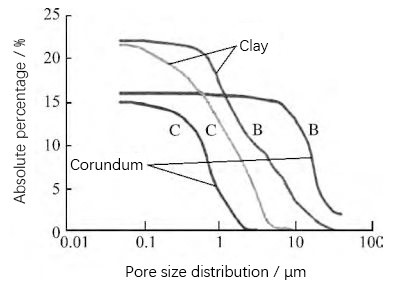
Corundum C (D50 = 0.7 μm), Corundum B (D50 = 18 μm), Clay C (D50 = 1.2 μm), and Clay B (D50 = 2.5 μm). These structural differences are also reflected in other physical properties.
The microporous structure can markedly enhance material strength and improve thermal shock resistance, which is verified by its superior resistance to crack initiation and propagation under sudden temperature changes. Meanwhile, such a microstructure reduces thermal radiation of the material at high temperatures. Compared with fired refractory products with identical chemical composition and equivalent porosity, the thermal conductivity of castables is reduced by 20%–30%, as illustrated in Figure 2.
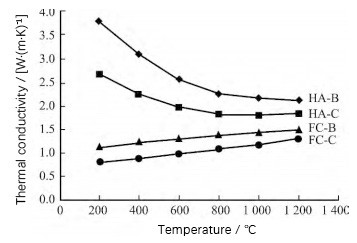
HA - High-alumina (B stands for refractory brick, C stands for castable); FC - Clay-based (B stands for refractory brick, C stands for castable).
The microporous structure of castables helps hinder slag penetration into materials in corrosive environments and improves their resistance to erosion by molten substances, especially slag and molten metal. Unlike fired refractory products, castables exhibit excellent plasticity. That is, refractory linings can release internal stress through self-deformation without structural damage. In this regard, phosphate-bonded castables demonstrate particularly outstanding performance (Figure 3).
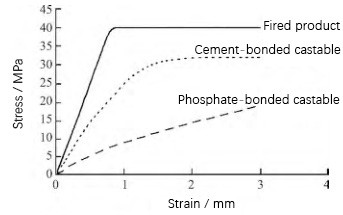
Certain issues may arise when applying unshaped refractory linings, which rarely occur with shaped refractory products. It should be noted that manufacturers supply unshaped refractories in semi-finished forms such as dry mixes, which require on-site processing to form complete refractory linings. Failure to strictly follow the manufacturer's instructions during mixing, including proper wetting of materials and standard construction procedures, can easily lead to various defects.
During the construction of unshaped refractories, it is essential to allow sufficient time for heating and drying and to adopt an appropriate temperature to ensure complete dehydration of binders. For traditional hydraulically bonded castables, strength reduction at medium temperatures must be taken into account. Within the temperature range of 250°C to 600°C, hydraulic bonding gradually decomposes before ceramic bonding is fully formed. In addition, matrix shrinkage tends to occur at high temperatures; therefore, castables are required to possess excellent volume stability.
03. Application Comparison between Unshaped Refractories and Shaped Refractory Products
The market share of unshaped refractories continues to grow in nearly all application fields. Nevertheless, certain sectors are still dominated exclusively by shaped refractories, among which functional refractories serve as a typical representative. Shaped refractory products hold a leading position in this field. For instance, functional refractories are used to control molten steel flow during continuous casting. In other fields where high-performance unshaped refractories have not yet been developed, shaped products remain the first choice.
Shaped refractories are preferentially adopted in most applications requiring alkaline refractory linings, such as dolomite bricks, magnesia bricks, magnesia-carbon bricks, and magnesia-chrome bricks. Typical applications include converter linings, slag line bricks for ladles, electric furnace walls, the firing and transition zones of cement rotary kilns, as well as furnace linings for non-ferrous metal smelting of copper, lead, zinc, and other metals. Traditional usage habits play a decisive role; hence, shaped products are still widely used for linings of furnaces designed in conventional configurations.
In recent years, unshaped refractories have not only been used for constructing new refractory linings but also extensively applied in the repair and maintenance of in-service refractory linings. They support various construction techniques, including vibratory casting, self-flow casting, gunning, ramming, and injection. Some of these construction methods have become and will remain the mainstream approaches for applying unshaped refractories.
Traditionally, unshaped refractories are used for alkaline furnace bottoms of conventional electric arc furnaces, taphole clay, blast furnace troughs, and various repair materials. In some cases, complex-shaped refractory components have been replaced by unshaped refractories, forming composite refractory linings, with waste incinerators being a typical example.
Unshaped refractories can form seamless linings that maintain a fixed shape during service. A typical example of the expanded application of castables is the development of unshaped refractory linings for steel ladles.
In principle, steel ladle linings can be classified into unshaped refractory linings or shaped products, which are made from high-alumina (neutral) or alkaline raw materials. Unshaped linings prepared from castables are mainly limited to high-alumina materials, while shaped products can be either neutral or alkaline. Extensive research has been carried out to develop alkaline castables; however, there have been no successful practical applications of such castables in steel ladles so far. The core problem lies in the easy hydration of magnesia, which requires the selection of innovative binders.
For shaped magnesia bricks, carbon is incorporated into the formulation to offset drawbacks such as a high thermal expansion coefficient and poor slag corrosion resistance. However, the reasonable effective dosage of carbon in magnesia castables has not yet been finalized, which restricts the large-scale popularization and application of MgO-C castables.
Nevertheless, with the development of high-performance low-cement and ultra-low-cement castables, unshaped linings have gained increasingly important applications in steel ladles. High-alumina castables and ladle lining repair technologies have been widely promoted. After the first service of newly built ladles, the damaged inner lining can be removed mechanically, and a new layer of castable can be poured onto the worn surface. This operation can be repeated multiple times.
Compared with full lining replacement, this partial repair method consumes only 40%–50% of the original refractory materials, saving 50%–60% of lining raw materials in total.
The advantages of adopting unshaped refractories as ladle linings over brick linings are summarized as follows: lower labor costs and shorter construction time, higher utilization rates of steel ladles, fewer standby ladles required, and further reduction in refractory consumption and overall operating costs.
Unshaped refractories play a vital role in kiln and furnace maintenance, as they enable large-scale repairs within the shortest shutdown time and, in some cases, even allow in-service maintenance. Systematic lining repair can effectively extend the service life of industrial furnaces. A typical example is the maintenance of alkaline MgO-C brick linings in oxygen-blown converters. Regular gunning with alkaline mixtures, combined with precise slag formation control and slag splashing protection, can prolong lining service life to over 20,000 heats and reduce refractory consumption to below 1 kilogram per ton of steel.
When choosing between unshaped refractory linings and traditional brick linings, the advantages of rapid construction enabled by new binders, as well as the shortened drying and heating cycles of unshaped refractories, become decisive factors. In most cases, raw materials account for up to 60% of the final product cost due to their decisive impact on overall performance, which rules out the use of low-cost inferior raw materials. From this perspective, given the dominant proportion of high-quality raw materials in unshaped refractories, their application delivers tangible and reliable economic benefits. Continuous quality upgrading, together with faster and simpler construction methods, further improves economic efficiency.
It is foreseeable that the market share gap between unshaped and shaped refractories will continue to widen. In-depth research and development of new types of unshaped refractories, innovative construction technologies, and precast refractory techniques will further sustain this development trend.