

Low Cement Castable (LCC) is a key material in various high - temperature industrial applications, including steelmaking, cement production, and non - ferrous metal smelting. As a supplier of Low Cement Castable, I've been frequently asked about the optimal mixing time for this product. In this blog, I'll delve into the factors that influence the mixing time and try to determine the ideal duration for achieving the best performance of LCC.
The Importance of Mixing in Low Cement Castable
Mixing is a crucial step in the application of Low Cement Castable. Proper mixing ensures that all the components, such as aggregates, binders, and additives, are uniformly distributed throughout the mixture. This uniformity is essential for achieving consistent physical and chemical properties of the castable, which in turn affects its strength, durability, and resistance to high - temperature environments.
If the mixing time is too short, the components may not be fully combined. Aggregates may remain segregated from the binder, leading to weak spots in the final castable structure. On the other hand, over - mixing can also have negative effects. It may cause excessive breakdown of the aggregates, leading to a change in the particle size distribution and potentially reducing the castable's strength and workability.
Factors Affecting the Mixing Time
1. Composition of the Low Cement Castable
The composition of LCC plays a significant role in determining the mixing time. Different types of aggregates, binders, and additives have different physical and chemical properties. For example, if the castable contains fine - grained additives, more time may be required to ensure their uniform dispersion. Aggregates with irregular shapes may also need longer mixing to be properly coated with the binder.
2. Mixing Equipment
The type and capacity of the mixing equipment can greatly influence the mixing time. High - speed mixers can generally achieve a uniform mixture in a shorter time compared to low - speed ones. The size of the mixer also matters. Larger mixers may require more time to ensure that all the material in the mixer is thoroughly mixed.
3. Water Content
The amount of water added during the mixing process affects the consistency of the mixture and, consequently, the mixing time. If too little water is added, the mixture may be too dry and difficult to mix, requiring a longer mixing time. Conversely, if too much water is added, the mixture may become too fluid, and over - mixing can occur more easily.
Determining the Optimal Mixing Time
To determine the optimal mixing time, a series of tests can be conducted. These tests typically involve preparing samples of the Low Cement Castable with different mixing times and then evaluating their properties.
Laboratory Testing
In a laboratory setting, samples can be prepared using a standardized mixing procedure. The samples are then tested for properties such as compressive strength, density, and porosity. By comparing the results of samples with different mixing times, the optimal mixing time can be identified as the one that produces the best combination of these properties.
Field Experience
Field experience also provides valuable insights into the optimal mixing time. By observing the performance of LCC in real - world applications, we can gather data on how different mixing times affect the castable's installation and long - term performance. For example, if a castable with a certain mixing time shows better resistance to thermal shock and erosion in a steel furnace, it can be considered a good indication of the optimal mixing time for that particular application.
General Guidelines for Mixing Time
Based on our experience as a Low Cement Castable supplier, the following general guidelines can be provided for mixing time:
Small - scale Mixing
For small - scale mixing, such as in a laboratory or for small repair jobs, a mixing time of 3 - 5 minutes is often sufficient. This allows for the basic dispersion of the components, especially when using a high - speed mixer.

Large - scale Mixing
In large - scale industrial applications, where large quantities of LCC are being mixed, the mixing time may range from 5 - 10 minutes. This longer time is necessary to ensure that all the material in the large mixer is thoroughly mixed.
It's important to note that these are just general guidelines, and the optimal mixing time may vary depending on the specific composition of the castable, the mixing equipment, and the application requirements.
The Role of Refractory Precast Block
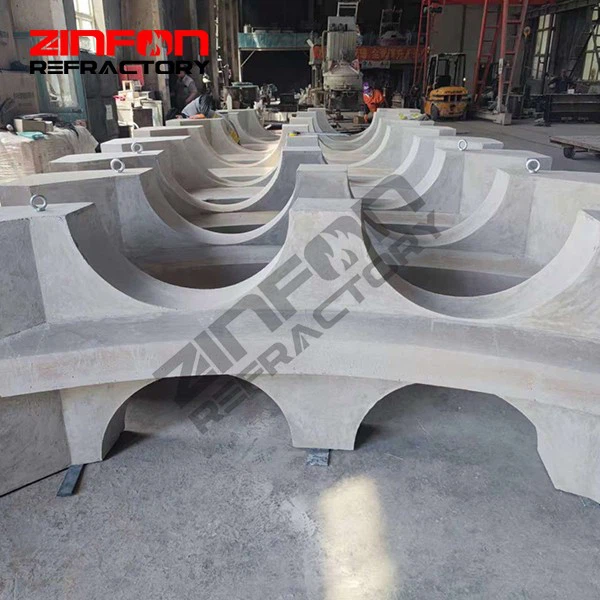
In some cases, Refractory Precast Block can be used in combination with Low Cement Castable. Precast blocks are pre - fabricated refractory products that can be installed more quickly than castables in some situations. They are made using a similar refractory material as LCC and can provide additional support and insulation in high - temperature environments.
When using precast blocks and LCC together, the mixing time of the castable may also be affected. For example, if the castable is used to fill the joints between precast blocks, the mixing time may need to be adjusted to ensure proper bonding and sealing.
Conclusion
Determining the optimal mixing time for Low Cement Castable is a complex process that involves considering multiple factors, including the composition of the castable, the mixing equipment, and the water content. Through laboratory testing and field experience, we can identify the mixing time that produces the best performance of the castable in terms of strength, durability, and resistance to high - temperature environments.
As a supplier of Low Cement Castable, we are committed to providing our customers with the best products and technical support. If you have any questions about the mixing time or other aspects of our Low Cement Castable, please feel free to contact us for further discussion and potential procurement. We look forward to working with you to meet your high - temperature application needs.
References
- "Refractories Handbook", Edited by various experts in the refractory industry.
- Research papers on the properties and applications of Low Cement Castable published in international refractory journals.