


Damage Mechanism, Current New Technology and Development Trend of Refractories for Steelmaking Converter
Converter steelmaking is one of the most widely used steelmaking processes in the world. It has become the mainstream method due to its high efficiency, short smelting cycle, low production cost, and adaptability to producing a wide variety of steel grades.
Statistics show that converter steelmaking accounts for more than 70% of the world's total crude steel production. In China, this proportion exceeds 90%, as shown in Figure 1.
According to the China Iron and Steel Association, by 2017, China had a total of 547 steelmaking converters with a total production capacity of 688.91 million tons.
In terms of equipment scale, 14 converters had capacities of 300 tons and above, and converters with capacities of 100 tons and above accounted for over 60% of the total. As the country continues to strengthen the elimination of outdated production capacity, steelmaking converters in China are expected to further develop toward large-scale designs.

In recent years, great progress has been made in converter steelmaking technology. Top-bottom combined blowing technology and slide gate slag stopping technology have been successively developed. In particular, the application of top-bottom combined blowing technology has significantly shortened smelting time, made the composition and temperature of molten steel more uniform, reduced the contents of sulfur, phosphorus, and nitrogen in molten steel, and improved metal yield.
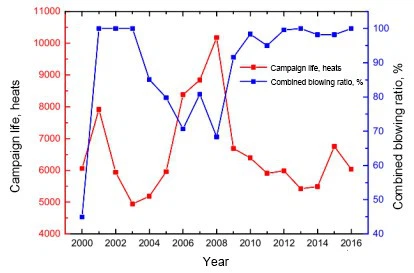
However, with the increase in the combined blowing ratio of converters, the converter campaign life has obviously decreased, as shown in Figure 2. To extend the converter service life, regular maintenance is carried out, including repairing the front and back large lining surfaces with self-flowing repair materials and gunning the trunnion areas and other parts. Proper and timely gunning using this maintenance method can increase the lining service life to over 8,000 heats.
Slag splashing is widely applied as another mainstream maintenance technology. Light-burned magnesia pellets or dolomite materials are added to the furnace to increase the melting point and viscosity of the slag. High-pressure nitrogen is then used to splash the slag onto the furnace lining, enabling the lining life to reach more than 20,000 heats. Nevertheless, this method consumes a large amount of nitrogen and causes substantial heat loss; because slag splashing is required for every heat, it reduces steelmaking efficiency.
In addition, the bottom gas permeable elements (purging bricks) of converters have a short service life, which adversely affects the combined blowing effect.
Sliding nozzle slag stopping technology has become a new mainstream development due to its outstanding advantages, such as reducing molten steel rephosphorization, improving alloy yield, lowering inclusions in steel, and enhancing molten steel cleanliness. Even so, the sliding nozzle system, especially the slag stopping slide plate, is prone to damage, and its service life still needs further improvement.
In the context of new smelting technologies, refractory materials for steelmaking converters face many technical challenges, which have attracted great attention from researchers. Extensive research and exploration have been carried out to meet the new performance demands of converter refractories, and a number of new refractory technologies have emerged accordingly.
Main Types and Smelting Processes of Steelmaking Converters
Converters can be classified into acid converters and basic converters according to the properties of their lining refractory materials.
Based on the gas injection position in the furnace, they are divided into bottom-blown converters, top-blown converters, side-blown converters, and top-bottom combined blowing converters.
According to the type of blowing gas, converters are classified as air converters and oxygen converters.
Basic oxygen top-blown converters and top-bottom combined blowing converters have become the most widely used steelmaking equipment due to their rapid production cycle, large output, high single-heat capacity, low cost, and lower investment requirements.
Converters are mainly used to produce carbon steel, alloy steel, and other steel grades.
The schematic diagram of the converter steelmaking process is shown in Figure 3.

Converter Steelmaking Raw Materials and Process
Converter steelmaking uses molten iron, scrap steel, and ferroalloys as the main raw materials, with a small amount of quicklime added. Air or oxygen is blown into the furnace to oxidize impurities such as silicon, manganese, phosphorus, sulfur, and carbon. A large amount of heat is released during the oxidation process (1 wt% silicon can raise the temperature of pig iron by 200 ℃), enabling the furnace to reach a sufficiently high temperature without external energy input. Relying on the inherent heat of the molten iron and the heat generated by chemical reactions among its components, the steelmaking process is completed entirely within the converter.
Refractory Materials for Steelmaking Converters and Their Damage Mechanisms
The main refractory material used for the lining of steelmaking converters is magnesia-carbon brick (MgO-C brick); a small amount of high-purity magnesia brick and fired magnesia-dolomite brick is also used. The unshaped refractory materials used include magnesia-silica (MgO-SiO₂), magnesia-carbon (MgO-C), magnesia-calcia (MgO-CaO), and high-purity magnesia series.

During the smelting process of converter steel, the furnace lining is eroded due to severe mechanical, physical, and chemical stresses.
The converter combined blowing process installs purging bricks at the bottom of the converter, through which oxygen, carbon dioxide, argon, or nitrogen is blown into the furnace. This enhances molten bath stirring, optimizes smelting reactions, shortens the steelmaking cycle, improves molten steel quality, and reduces steelmaking costs.
However, combined blowing also accelerates the erosion of furnace lining refractories, and different parts of the converter suffer erosion under their respective service conditions.
(1) Erosion by Scouring or Mechanical Impact
Operations such as charging scrap steel and pouring molten iron directly impact the main lining sections of the converter, causing severe impact, abrasion, and scouring of the lining. These actions are a primary factor in the erosion of lining refractories.
Physical erosion also includes scouring caused by furnace gas flow on the lining, furnace hood, and other refractory components during smelting, the dissolution and scouring of the lining by molten steel and slag, and the melting loss of the lining induced by high-temperature reactions in the smelting process.
(2) Oxidation and Chemical Corrosion
Oxidation is one of the dominant causes of erosion in magnesia-carbon bricks used in converter linings. In this process, the carbon component in the bricks is oxidized by oxygen-containing substances, such as high-temperature oxidizing gas, iron oxide, oxygen, and magnesium oxide, leading to structural loosening and embrittlement of the refractory material.
FeO+C(s)=Fe+CO(g) (1)
O2(g)+2C(s)=2CO(g) (2)
MgO(s)+C(s)=Mg(g)+CO(g) (3)
The iron oxide in the slag reacts with graphite, tar, or resin on the hot face of the brick lining, while oxygen attacks the graphite or binder on the cold face. In both cases, the strength of the bricks decreases, and the refractory material is eroded by the scouring action of gas and molten metal.
Chemical reactions between iron oxide (FeO) or acidic components in the slag (such as SiO₂) and CaO as well as MgO are expressed as follows:
FeO+MgO=FeO·MgO (4)
SiO2+2MgO=2MgO·SiO2 (5)
CaO+SiO2+MgO=CaO·MgO·SiO2 (6)
All of the above reactions convert the furnace lining into molten slag, eventually leading to damage of the refractory materials.
(3) Thermal Shock Spalling
The working environment of gas supply components is characterized by high pressure and a high flow rate (pressure above 1 MPa, flow rate of 0.15–0.2 m³·min⁻¹·t⁻¹). The damage mechanism includes spalling, as well as scouring and abrasion caused by thermal stress concentration.
(4) Abrasion, Melting Loss, and Spalling
During converter tapping, the sliding nozzle and slide plates are subjected to:
Scouring by high-temperature molten steel and slag,
Corrosion and penetration by strongly alkaline slag, and
Severe thermal shock under intermittent high temperatures (~1600 ℃).
In addition, the slide plates experience abrasion from steel slag during the slag retaining operation.
Therefore, the main forms of damage include scouring and erosion by high-temperature molten steel and slag, high-temperature oxidation, galling and abrasion on sliding surfaces, and thermal shock.
The future technical optimization directions for refractory materials of steelmaking converters are as follows:
(1)Develop high-performance, low-carbon magnesia-carbon bricks with excellent wear resistance and thermal shock resistance.
(2)Develop fast-sintering, pollution-free hot repair materials and long-service-life gunning materials.
(3)Develop long-life combined-blowing gas supply components and optimize the structure and layout of furnace bottom tuyeres to meet the requirements of advanced steelmaking technologies, including top-bottom combined blowing, low-oxygen tapping, bottom powder injection, bottom oxygen supply, and bottom CO₂ blowing.
(4)Improve the performance and structure of slag-stopping slide plates, extend their service life, and reduce the frequency of daily replacement.
New Technologies of Refractories for Steelmaking Converters
3.1 Development and Application of High-Performance Lining Bricks
Magnesia-carbon bricks are widely used as converter lining bricks due to their excellent slag corrosion resistance, thermal shock resistance, spalling resistance, abrasion resistance, and high-temperature stability. However, magnesia-carbon bricks are prone to oxidation, which deteriorates their thermal shock resistance and corrosion resistance. For this reason, extensive research and exploration have been carried out by researchers. The key technical highlights are reflected in the following aspects:
Application of New Composite Antioxidants with Oxidation Resistance and Self-Repairing Performance
Metal aluminum powder, silicon powder, or Al–Si composite powder is adopted as antioxidants for magnesia-carbon bricks. In-situ reactions occur during heat treatment or high-temperature service, forming highly corrosion-resistant phases such as SiC and AlN, which significantly improve the comprehensive properties of low-carbon magnesia-carbon materials.
Preparation and Application of Low-Dimensional Graphitized Carbon
This involves the addition and use of various pre-synthesized nanocarbon materials, such as nano carbon black and nano graphite-oxide composite powders, as well as the in-situ synthesis of low-dimensional graphitized carbon. Appropriate inorganic or organic compounds of transition elements (Fe, Co, Ni) are selected as catalysts. Gases such as CO, C₂H₂, and CH₄, generated from the cracking of phenolic resin, react under the catalysis of transition metals to form low-dimensional graphitized carbon, including carbon nanotubes and carbon nanofibers.
The development and application of these new technologies enable MgO-C bricks to maintain excellent corrosion resistance and thermal shock resistance.
Different parts of a converter impose distinct performance requirements on the magnesia-carbon (MgO-C) bricks used. To meet these different requirements, Shinagawa Refractories of Japan has developed a series of MgO-C bricks designed for the performance demands of various converter zones. Their basic properties and typical characteristics are listed in Table 2.
Microstructural analysis of used MgO-C bricks reveals that their damage is mainly caused by slag corrosion and erosion. Japanese researchers found that limiting the diffusion rate of gaseous magnesium (Mg(g)) in MgO-C bricks at high temperatures can effectively reduce the rate of brick damage.
Slag corrosion test results show that, with the increase in apparent porosity of MgO-C bricks heat-treated at 1500 ℃, the corrosion index rises in a nearly linear trend (see Figure 4). Based on these findings, dense-structured MgO-C bricks (Sample B, see Table 2) were fabricated by adjusting the antioxidant dosage, raw material particle gradation, and production process parameters.


MgO-C bricks in the charging zone of a converter are frequently subjected to mechanical impact from scrap steel raw materials, which easily initiates cracks and causes crack propagation, eventually leading to lining damage.
Different types of MgO-C bricks exhibit significant differences in creep resistance, as shown in Figure 5, resulting in variations in their thermal shock resistance and mechanical impact resistance.
Researchers from Shinagawa Refractories Japan found that MgO-C bricks (HS) with high-temperature flexural strength cannot effectively prevent damage development, whereas MgO-C bricks with high fracture energy (fracture toughness) can significantly inhibit crack propagation.
Accordingly, two new types of MgO-C bricks have been developed: matrix-reinforced MgO-C bricks (MR) and carbon bond-reinforced MgO-C bricks (CB). Their properties are listed in Table 2.
Both new grades possess much higher fracture energy (MR: 0.40 kJ; CB: 0.49 kJ, compared with only 0.26 kJ for HS bricks). Crack propagation is restrained after mechanical impact, and both grades show better slag corrosion resistance than the HS grade. Among them, the carbon bond-reinforced MgO-C bricks deliver superior corrosion resistance.

The service life of magnesia-carbon bricks for converter tap holes is usually restricted by carbon oxidation, thermal shock spalling, and abrasion caused by molten steel flow. Therefore, the development of low-carbon magnesia-carbon bricks with excellent wear resistance and thermal shock resistance is an inevitable trend.
Researchers from the No. 2 Steelmaking Plant of Taiyuan Iron and Steel (TISCO) used fused magnesia with a mass ratio of m(CaO):m(SiO2)≥2 and high-purity flake graphite (carbon mass fraction ≥ 98%) as the main raw materials. Al, Mg-Al alloy, Si, \ceB4C, and \ceCaB6 were used as antioxidants, and thermosetting phenolic resin was used as the binder to prepare high-quality low-carbon MgO-C bricks. The relevant properties are listed in Table 3.
When the newly developed low-carbon MgO-C bricks were applied to steelmaking converters, the campaign life was steadily maintained at 500–700 heats, which is a substantial improvement compared with the 300–400 heats of imported low-carbon MgO-C bricks.

3.2 Development and Application of Unshaped Refractories
As the use of scrap steel increases in steelmaking and new top–bottom combined blowing technology is applied, the service conditions of converters have become harsher, accelerating the damage of refractory materials. To prolong the service life of converters, higher performance requirements have been set for refractories in different converter zones.
The development of new unshaped refractories and the application of relining and repair technologies have made rapid progress. These technologies can greatly extend the overall service life of the furnace lining without interrupting normal production. As a result, the lining campaign life can exceed 8,000 heats and even reach more than 20,000 heats.
At present:
Hot repair masses are widely used to maintain the charging side, furnace bottom, and tapping side of converters.
Gunning mixes are applied for the maintenance of the molten pool, rounded corners, and trunnion areas.
Grouting materials are used for joint filling during tap hole replacement and routine maintenance of the tap hole zone.
Common hot repair masses mainly include MgO–SiO₂ series (also known as water-based repair mass), MgO–C series, and MgO–CaO series. Typical gunning mixes are mainly MgO series, MgO–CaO series, and MgO–Cr₂O₃ series.
According to different binder systems, these unshaped refractories can be classified into:
Anhydrous repair materials, bonded mainly by pitch, coal tar, pitch powder, and phenolic resin.
Water-based repair materials, bonded through MgO–SiO₂–H₂O or phosphate bonding.
Repair materials with different binder systems have their own advantages and disadvantages, as shown in Table 4.
In view of the existing shortcomings and practical application requirements of current repair materials, researchers have carried out extensive studies and developed advanced repair masses and gunning mixes with better overall properties.

At present, the conventional converter lining repair mass used for on-site maintenance mainly uses organic substances such as coal tar, pitch (approximately 8%–15% by weight), and resin as binders. These materials inevitably have inherent shortcomings, including excessively long sintering times, high porosity, and poor compactness after the burnout of organic components, leading to poor slag corrosion resistance, low strength, short service life, and serious environmental pollution in workshops.
By using high-purity magnesia powder (w(MgO) = 97.02%) and medium-grade magnesia particles (w(MgO) = 94.80%) as the main raw materials, and ultrafine silica powder (w(SiO₂) = 96.0%) as the binder, a new long-life, carbon-free, eco-friendly converter lining repair mass has been developed.
The eco-friendly water-based converter lining repair mass produces no harmful gases during sintering, ensuring safety and environmental friendliness. Using a wet self-flow casting method, the product exhibits excellent high-temperature spreadability. After high-temperature sintering, ceramic bonding is formed, achieving a dense structure, good oxidation resistance, and scouring resistance, with a bulk density of up to 2.83 g·cm⁻³.
It has been applied in multiple converter steelmaking plants. On-site application generates no smoke or dust; compared with conventional carbon-based repair mass, its sintering time is reduced by more than 50%, and its service life is extended by 2–3 times.

Due to continuous mechanical impact and slag erosion, the refractories at the furnace bottom, trunnions, and the two large lining surfaces of oxygen top-blown converters are prone to damage. It is necessary to regularly repair the trunnion and slag line areas using the gunning method.
At present, magnesia-based gunning mixes are widely used for converters in China. To overcome their shortcomings, such as poor erosion resistance, weak scouring resistance, and short service life, a new magnesia-carbon-based converter gunning mix has been developed.
The raw materials of the gunning mix mainly include:
Magnesia (3–0 mm, w(MgO) = 95.2%)
Carbon (3–0 mm, w(C) = 94.2%)
Pitch A (fixed carbon 46.2%, softening point 140–160 ℃)
Pitch B (fixed carbon 43.5%, softening point 100–120 ℃)
Functional additives
Carbon and Pitch B were blended in different proportions as the carbon source of the gunning mix, with the fixed carbon content controlled at approximately 5–7%.
Experimental results show that Pitch B has a larger particle size, resulting in a slower heating and carbonization rate, but achieving a higher final degree of carbonization, which enhances the adhesion performance of the gunning mix.
The gunning mix with a carbon-to-pitch mass ratio of 7:2 exhibits the optimal comprehensive performance, with high fired strength and excellent corrosion resistance.
Application results indicate that the new magnesia-carbon gunning mix for converters has a low rebound rate, good adhesion, and high sintered strength. While the service life of conventional magnesia gunning mix is only 7–8 heats, the new magnesia-carbon gunning mix reaches 10–13 heats, an increase of more than 30%, greatly reducing the frequency of converter maintenance.
To address slag adhesion on the slag-bonded surface of the converter mouth and furnace hood, a slag adhesion-resistant gunning mix has been developed, mainly using recycled spent magnesia-carbon bricks as the primary raw material.
Application results show that the developed anti-sticking slag gunning mix possesses good construction performance. Using semi-dry gunning, a complete and uniform isolating coating layer can be formed on the surface of the converter mouth, with a coating thickness of 35–50 mm and a spraying adhesion rate above 80%. A single gunning operation per shift is sufficient to achieve slag isolation.
The bonding strength of the thick gunning layer itself and its interface with the base surface is appropriately low, which reduces the difficulty of peeling and cleaning adhered slag, lowers cleaning frequency and time, and effectively improves the efficiency of converter mouth slag cleaning, thereby shortening non-production downtime. Without altering the existing production process, the overall production capacity of the converter can be improved.
Shinagawa Refractories of Japan has developed a fast-hardening MgO-C-based hot repair material for converters, whose properties are listed in Table 6.
The developed carbon-bonded MgO-C gunning mix maintains excellent adhesion even when sprayed onto the brick surface at temperatures above 1300 °C following slag drainage. It enables ultra-high-temperature construction, greatly shortens the hardening time, and effectively improves hot repair efficiency while reducing overall maintenance time.

3.3 Top–Bottom Combined Blowing Technology
The converter combined blowing process uses bottom-blown gas to stir the molten bath, bringing the steel–slag reaction closer to thermodynamic equilibrium. This prevents over-oxidation of molten steel and improves both metal yield and molten steel quality.
Converter bottom gas supply elements are mainly divided into two categories: nozzle-type and brick-type. Brick-type gas supply elements have become the mainstream due to their stable performance. They are further classified into diffused type, annular gap type, and straight through-hole type.
Diffused purging bricks suffer from high gas bypass resistance and short service life. Annular gap purging bricks feature a relatively dense structure and longer service life than diffused bricks and have been widely applied with good practical results; nevertheless, their stability is far inferior to that of straight through-hole purging bricks. Accordingly, straight through-hole purging bricks represent the future mainstream for gas supply elements. Optimizing their layout at the bottom of the molten bath is critical for achieving favorable metallurgical effects via bottom blowing.
The widely adopted straight through-hole gas supply element, called the Multiple Hole Plug (MHP), was originally developed by Nippon Kokan (NKK) of Japan. It offers several advantages: low gas supply resistance, a wide adjustable range of gas flow rates, excellent airtightness, and minimal air leakage. In addition, the embedded metal tubes reinforce the refractory brick, effectively inhibiting spalling and cracking.
To optimize the performance of gas supply elements, the service life has been greatly extended and better matched with the converter campaign life by adjusting the raw material proportions of refractory aggregates and applying special treatment to the internal stainless steel tubes.
Zhang Yueming prepared high-performance MgO-C gas supply elements using isostatic pressing. The main raw materials were high-purity fused magnesia (w(MgO)≥97%) and natural flake graphite (w(C)≥98%), with Al, Si powder, and \ceB4C (total dosage < 6%) as composite antioxidants. Thermosetting pitch-modified resin was used as a binder, and an appropriate amount of pitch powder was incorporated.
The fabricated MgO-C gas supply elements exhibit significantly improved oxidation resistance, fracture toughness, and thermal shock resistance, along with good airtightness. The erosion rate reaches 0.28 mm/heat, and the maximum service life reaches 2,113 heats.
To reduce the carburization rate and extend the service life of stainless steel tubes, a surface coating method using α-Al2O3/ALCH slurry was adopted. The mass ratio of α-Al2O3 to ALCH is controlled above 3/7, with a coating thickness of over 1 mm, forming a dense protective isolation layer with stable thermal performance and strong resistance to carbon penetration.
Large internal and external temperature differences in refractory bricks for converter gas supply elements create steep temperature gradients. Moreover, the temperature drops sharply after tapping, subjecting purging bricks to severe thermal shock. The resultant thermal stress initiates and propagates internal cracks, leading to intermittent spalling of the refractory brick.
Researchers from Shinagawa Refractories found that most cracks in purging bricks are parallel to the hot face, and damage caused by thermal spalling is far more severe than that induced by molten steel erosion and abrasion.
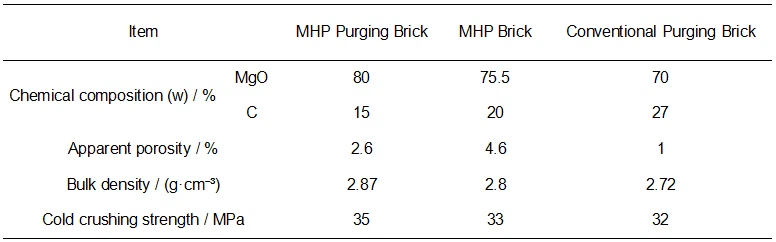
Based on a thorough investigation of purging brick damage mechanisms, high-performance purging bricks with high fracture toughness and excellent thermal shock resistance were developed, with detailed properties listed in Table 7.
First, improving material toughness inhibits crack initiation and propagation, greatly reducing spalling damage. Second, increasing the overall size of the purging brick extends the propagation distance of cracks to the spalling surface, further suppressing spalling. When applied in a 220 t converter, the wear rate is reduced by approximately 40% compared with conventional purging bricks, spalling damage is significantly alleviated, and the converter has operated steadily for over 4,000 heats without replacement of purging bricks.
3.4 Sliding Plate Slag Stopping Technology
Converter sliding plate slag stopping technology is an emerging process that has developed rapidly in recent years. It mainly consists of three parts: the sliding plate slag stopping system, the infrared slag detection system, and the hydraulic drive system. Combining infrared slag detection with PLC control technology enables automatic slag detection and blocking. At present, it represents the most advanced and effective method for slag retention during converter tapping.
Sliding nozzle slag stopping technology offers several advantages, including reducing molten steel rephosphorization, improving alloy yield, lowering inclusions in steel, enhancing molten steel cleanliness, mitigating ladle slag adhesion, and extending ladle service life.
The inner nozzle at the converter tap hole is connected to the end of the tap hole brick and mounted above the upper sliding plate, while the outer nozzle is assembled below the lower sliding plate. During converter tapping, the inner and outer nozzles, together with the sliding plates, are subjected not only to scouring by high-temperature molten steel and slag but also to corrosion and penetration by strongly alkaline slag. Intermittent tapping subjects the plates to severe thermal shock at approximately 1600 ℃. In addition, frequent slag stopping operations cause abrasion and melting loss on the casting holes and sliding surfaces of the plates due to high-temperature molten steel and slag.
Therefore, the materials used for inner and outer nozzles and sliding plates must have excellent slag corrosion resistance, high-temperature oxidation resistance, and superior thermal shock resistance; sliding plate materials must also have good wear resistance.
At present, the outer nozzles for converter tap holes on the market are mainly made from three types of materials: unfired magnesia‑carbon, unfired alumina‑zirconia‑carbon, and zirconia-embedded core type. Among them, magnesia‑carbon nozzles dominate the market due to cost advantages, while alumina‑zirconia‑carbon nozzles exhibit slightly better performance. Nozzles with embedded zirconia inner cores are still under research and development, achieving a service life of more than 120 heats and approaching the service life of tap hole bricks.
Most unfired nozzles are treated by pitch impregnation to seal pores, improve bulk density, and enhance corrosion resistance, with service life ranging from 30 to 90 heats.

Slag stopping slide plates are among the most critical components in the application of sliding nozzle slag stopping technology.
At present, alumina‑zirconia‑carbon materials are mostly used for domestic slag stopping slide plates. As a flow-control slide plate material, they feature high strength, excellent thermal shock resistance, and outstanding scouring and corrosion resistance. However, under slag stopping service conditions, their service life is relatively low, with a stable performance of only about 10–14 heats.
To improve the comprehensive performance of slag stopping slide plates, researchers have adopted various approaches. Studies show that the introduction of expanded graphite and silicon powder can promote the in-situ formation of SiC whiskers in alumina‑carbon refractories. This enhances the toughness of the slide plates, improves their resistance to crack propagation, and consequently increases both thermal shock resistance and service life.
To meet the high service life requirement of 18–20 heats, or even more than 25 heats, as requested by steel enterprises, slide plate materials are being transformed from conventional reburned alumina‑zirconia‑carbon to a composite structure: the main body adopts alumina‑zirconia‑carbon, while the embedded layer uses zirconia-based materials.
There are three typical structural types:
Upper slide plate embedded with a zirconia ring matched with a lower slide plate embedded with a zirconia plate;
Upper slide plate embedded with a zirconia plate matched with a lower slide plate embedded with a zirconia plate;
Upper slide plate embedded with a zirconia ring matched with a lower slide plate with a zirconia plate embedded in the anti-slip zone of the slide.
When applied to 120–300 t converters for slag stopping during early and late tapping stages, the service life of embedded composite slide plates can be steadily maintained at no less than 15–18 heats. If other slag stopping methods are used in the early stage and slide plate slag stopping is applied only in the later stage, the service life can reach 20–25 heats.

The main limitation of sliding nozzle slag stopping technology lies in the relatively short service life of refractory components. To address this issue, Interstop, in cooperation with RHI, optimized the conventional steel tapping system and developed the new CG120 sliding nozzle for the tap hole of steelmaking converters.
Featuring an innovative structural design, the CG120 sliding nozzle system allows the inner slide plate to be replaced without removing the entire sliding nozzle assembly from the steel shell. This system improves the service efficiency of refractories and significantly shortens converter downtime. The service life of both the upper connecting component and the refractory component of the new CG sliding nozzle reaches 24.8 heats.
Researchers at Sinosteel Luoyang Institute of Refractories Research analyzed the damage mechanisms of converter slag stopping slide plates. They found that the upper slide plate, which is in direct contact with molten steel, is mainly damaged by corrosion and enlargement of the orifice, whereas the lower slide plate, exposed to ambient air, fails primarily due to thermal shock and crack propagation.
Accordingly, by adopting a design that embeds a zirconia ring in the upper slide plate and a zirconia plate in the lower slide plate, along with measures such as regulating phase composition and optimizing microstructure, the thermal shock resistance of both the zirconia ring and plate is effectively enhanced. The service life of slag stopping slide plates is stabilized at about 20 heats, greatly improving the cost-effectiveness of slide plate slag stopping technology. The three series of developed products can meet the requirements of different working conditions, with their specific properties listed in Table 10.

By continuously improving and optimizing the profile and embedded structure designs of sliding plates, the locking force against high-temperature expansion and deformation is enhanced, preventing the initiation and propagation of abnormal cracks and avoiding the formation of molten steel leakage channels. Meanwhile, the accuracy of the infrared slag detection system and the operational stability of the hydraulic drive cylinder are improved. By addressing deficiencies identified in practical applications, the operational safety and reliability of sliding plate slag stopping technology have been greatly enhanced.
Conclusion
The advancement of steelmaking technology drives the development of new refractory technologies for steelmaking converters. The refractories used in these technologies not only provide high-temperature structural stability, excellent spalling resistance, abrasion resistance, and slag corrosion resistance, but also reflect the principles of energy efficiency, long service life, low carbon emissions, and environmental friendliness.
The future development trends of refractories for steelmaking converters are summarized as follows:
Develop and promote high-performance magnesia-carbon refractories;
Advance and apply new environmentally friendly unshaped refractories and high-temperature repair technologies;
Develop composite-structured refractory materials, such as composite gas supply elements and composite sliding plates;
Research and develop lightweight, energy-efficient refractories with superior comprehensive high-temperature properties.