


Types, Properties and Applications of Common Binders for Refractory Materials
Part 1: Calcium Aluminate Cement
1. Mineral Compositions of Calcium Aluminate Cement
The main mineral phases in calcium aluminate cement include monocalcium aluminate (CA), dicalcium aluminate (CA₂), dodecacalcium heptaaluminate (C₁₂A₇), and anorthite (C₂AS). The variation of these mineral constituents during the firing of pure calcium aluminate cement is illustrated in Figure 1.
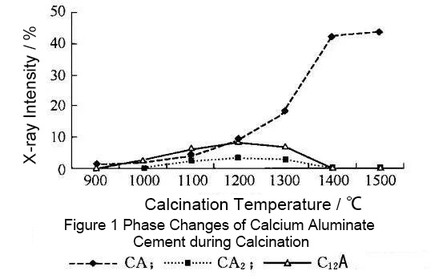
It can be seen from Figure 1 that CA serves as the predominant mineral phase in pure calcium aluminate cement, with minor amounts of CA₂ and C₁₂A₇ potentially present.
CA exhibits superior hydraulic activity, normal setting behavior, and rapid hardening capacity, acting as the primary contributor to cement strength. Cements with high CA content gain strength rapidly at early stages, while strength development becomes insignificant at later stages.
CA₂ undergoes slow hydration and hardening, resulting in low early strength but significant strength development at later stages. Excessive CA₂ content can impair the rapid hardening property of the cement.
C₁₂A₇ has a highly irregular coordination of aluminum and calcium atoms, and its crystal structure contains numerous cavities. It hydrates and sets extremely quickly but delivers lower strength compared with CA. Excessive C₁₂A₇ can lead to flash setting, reduced mechanical strength, and decreased heat resistance. Properly controlled trace amounts of C₁₂A₇ can accelerate setting and enhance early strength.
Anorthite (C₂AS) generally has no hydraulic property. However, if silica in high-alumina cement forms a CaO–Al₂O₃–SiO₂ glass phase, it can participate in the hydration reaction and further improve the overall cement performance.
2. Hydration of Calcium Aluminate Cement
Calcium aluminate cement begins to hydrate as soon as it is mixed with water. The processes of hydration, setting, hardening, and strength development are illustrated in Figure 2.
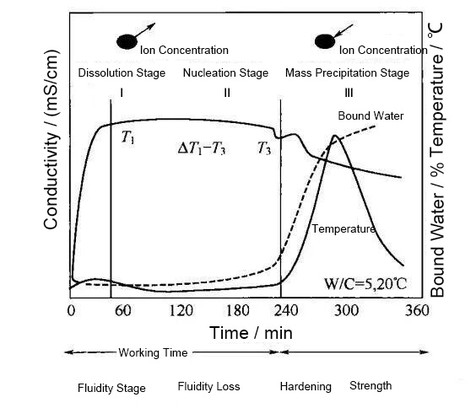
It can be observed from Figure 2 that cement minerals begin to dissolve in water upon contact. The concentration of ions such as Ca²⁺ and Al(OH)₄⁻ in the solution rises sharply, causing a rapid increase in electrical conductivity. Subsequently, the ions reach saturation, and no further increase in concentration occurs. Hydrate crystals gradually form, and the cement paste slowly stiffens.
In the following stage, vigorous hydration reactions occur. The temperature and bound water content of the paste rise, while ion concentrations decline, and the paste begins to harden and gain strength. The strength of calcium aluminate cement is primarily derived from various hydrated calcium aluminates (CₓAHᵧ) and alumina gel (AH₃).
3. Transformation of Hydrated Products of Calcium Aluminate Cement
The transformation patterns of hydration products at different temperatures are summarized in Table 1.
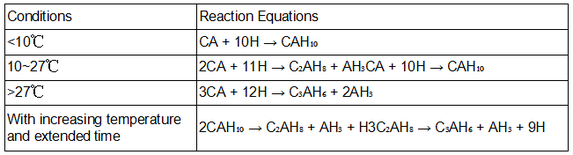
It can be seen from Table 1 that both CAH₁₀ and C₂AH₈ are metastable minerals. As the temperature rises and curing time increases, they transform into the stable C₃AH₆ phase. CAH₁₀ and C₂AH₈ exhibit hexagonal flaky crystals with densities of 1.72 g/cm³ and 1.95 g/cm³, respectively. C₃AH₆ belongs to the isometric crystal system and has a density of 2.52 g/cm³. This phase transformation leads to increased density and reduced water content in the hydrates. Volume shrinkage occurs accordingly, resulting in a sharp reduction in strength.
4. Phase Transformation of Calcium Aluminate Bond under Heating
Refractory cement undergoes complex structural changes when exposed to heat. According to Roesel's research, CAH₁₀, C₂AH₈, and C₃AH₆ remain stable at 0–20℃, 20–60℃, and 0–350℃, respectively. Between 200 and 350℃, AH₃ converts into Al₂O₃, and C₃AH₆ decomposes into CaO and C₁₂A₇. C₁₂A₇ then reacts with CaO to form CA at 600–1000℃. CA reacts with alumina to generate CA₂ at 1000–1300℃, and CA₂ further reacts with alumina to produce CA₆ at 1400–1600℃.
During this process, dehydration breaks the hydration bonds, while ceramic bonds have not yet formed, greatly weakening the cohesion of the material. Traditional refractory castables can lose over 50% of their strength after heat treatment at 1100℃, severely shortening their service life. Solid-phase reactions occurring above 1000℃ cause significant volume expansion. The volume changes during the transition from a hydrated structure to a ceramic structure result in a porous microstructure and low mechanical strength in conventional castables at medium temperatures.
Part 2: Phosphoric Acid and Phosphates
1. Properties and Preparation of Raw Materials
Phosphoric acid and aluminum dihydrogen phosphate are commonly used as binders in the refractory industry.
(1) Phosphoric Acid
Its chemical formula is H₃PO₄. Pure phosphoric acid is a colorless orthorhombic crystal, with a melting point of 42.35℃ and a boiling point of 213℃, corresponding to the loss of one water molecule. It converts into metaphosphoric acid at approximately 300℃. The relative density is 1.874 at 25℃, and it is highly deliquescent.
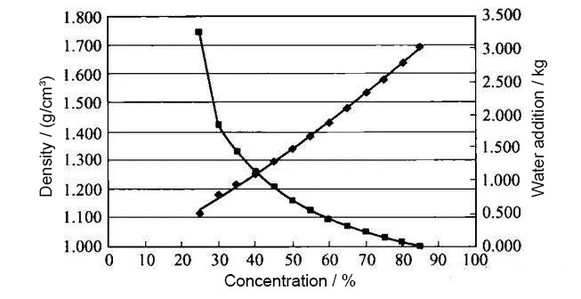
Commercial phosphoric acid is a colorless transparent liquid with a mass concentration of 85%, and its relative density reaches 1.6850 at 25℃. The density and concentration variation of 85% phosphoric acid after dilution with water are shown in Figure 3.
Phosphoric acid is a Class II corrosive inorganic acid. Its corrosiveness is weaker than that of sulfuric, hydrochloric, and nitric acids, but stronger than that of acetic and boric acids. It can corrode metals, releasing hydrogen gas, and reacts with alkalis, basic oxides, and inorganic salts.
High-concentration phosphoric acid may cause mild corrosive burns if it comes into contact with skin. Its fumes can irritate the eyes and respiratory tract, potentially causing coughing or bronchitis upon inhalation.
There are two main production methods: the thermal process and the wet process. In the thermal process, yellow phosphorus is burned to produce phosphorus pentoxide, which is then absorbed by water to obtain phosphoric acid.

The wet process produces phosphoric acid through the reaction between sulfuric acid and apatite.

Phosphoric acid reacts with aluminum hydroxide or alumina to sequentially form aluminum dihydrogen phosphate Al(H₂PO4)3, aluminum monohydrogen phosphate Al₂(HPO4)6, and aluminum orthophosphate AlPO4.

As hydrogen ions in phosphoric acid are replaced by aluminum ions, the molar ratio of Al₂O₃ to P₂O₅ in the reaction mixture increases gradually. The ratio is 1:3 for aluminum dihydrogen phosphate, 1:1.5 for aluminum monohydrogen phosphate, and 1:1 for normal aluminum phosphate. Aluminum phosphate exhibits good solubility at a 1:3 ratio, but its solubility drops sharply and can even become negligible when the ratio exceeds 1:1.5.
(2) Aluminum Dihydrogen Phosphate
With the chemical formula Al(H₂PO4)3, it occurs as a water-soluble white crystalline powder or as a colorless, odorless viscous liquid. It exhibits strong chemical bonds, excellent resistance to high temperature, thermal shock, and hot gas erosion, as well as superior infrared absorption and insulation performance.
To avoid precipitation during long-term storage, the Al₂O₃/P₂O₅ ratio is generally set at 1:3.2 during preparation. Aluminum hydroxide powder is placed into a plastic container, and boiling water is added to prepare a thick slurry. 85% phosphoric acid is then slowly added under continuous stirring until the reaction is complete. In low-temperature environments, the slurry is first heated, transferred into an acid-resistant vessel, and then mixed with phosphoric acid to obtain the finished product.
The feeding speed of phosphoric acid should be controlled to prevent a violent acid-base reaction and liquid overflow. The required dosage of phosphoric acid and aluminum hydroxide for different proportion formulations is listed in Table 2.
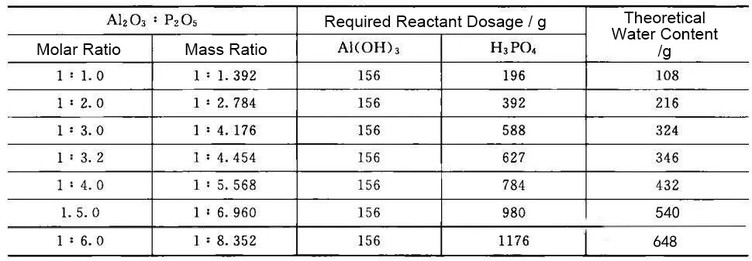
Table 2 shows the required amounts of pure phosphoric acid and aluminum hydroxide for preparing aluminum phosphate with different Al₂O₃:P₂O₅ ratios. If the phosphoric acid concentration is less than 100%, the listed acid dosage should be divided by the actual mass percentage of the acid to calculate the practical amount required. The fixed dosage of dry aluminum hydroxide used in the preparation is 156 grams.
2. Phase Transformation under Heating
Phosphate bonding is a type of thermosetting bond. Without hardening accelerators, such as cement, phosphoric acid can chemically bond with refractory materials only at elevated temperatures.
Phosphate bonding phases undergo complex chemical changes upon heating, which depend on temperature, the initial binder composition, and the composition and reactivity of the refractory materials. For instance, a mixture of phosphoric acid and industrial alumina forms variscite (AlPO₄·2H₂O) after heat treatment at 120℃ and remains unchanged at 200℃. It converts into berlinite (AlPO₄) at 350℃. Tridymite- and cristobalite-type AlPO₄ begin to form when the temperature exceeds 500℃.
Aluminum phosphate bonding phases can achieve long-term stability under atmospheric conditions only after heating above 500℃. Anhydrous AlPO₄ exists in multiple crystal forms, including tridymite, cristobalite, berlinite, and metastable crystals labeled A, B, C, D, and E. These metastable varieties tend to absorb moisture and soften. Insufficient heating temperatures and the use of coagulant additives can degrade the performance and service life of phosphate-bonded refractories.
Part 3: Water Glass
1. Basic Properties of Water Glass
Commonly known as sodium silicate, water glass has the chemical formula Na₂O•mSiO₂•nH2O. The symbol m represents the modulus, which is the molar ratio of silica to sodium oxide, while n specifies the water content of the water glass. Normally, its modulus ranges from 2.0 to 3.3, and its density ranges from 1.3 to 1.6 g/cm³. Figure 4 shows the phase diagram of the Na₂O-SiO₂ system related to water glass.
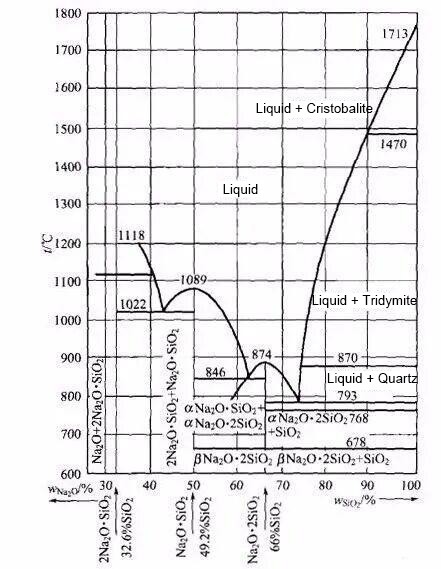
Generally, water glass with a higher modulus exhibits higher viscosity, faster hardening, and greater green strength, but has a shorter binder shelf life. For example, water glass with a modulus of 2.6–3.0 is used for small and medium-sized cores with short production cycles in the foundry industry. A modulus ranging from 2.3 to 2.6 is applied to medium-sized castings, while a modulus of 2.0–2.3 is selected for large castings requiring long production periods.
2. Composition Adjustment of Water Glass
Modulus adjustment is necessary when the water glass does not meet the required specifications. This includes reducing the modulus, increasing the modulus, or blending high- and low-modulus water glass to obtain products of medium modulus.
Sodium hydroxide is added to reduce the modulus. Prior to adjustment, the mass fractions of silica and sodium oxide in the water glass solution should be measured. When a certain mass of NaOH, denoted as x, is added to 100 grams of water glass, the modulus will decrease accordingly.

To raise the modulus of water glass, hydrochloric acid, ammonium chloride, or amorphous silica can be added. Amorphous silica is the preferred option. The addition of hydrochloric acid or ammonium chloride generates sodium chloride, an electrolyte which impairs the performance of water glass.
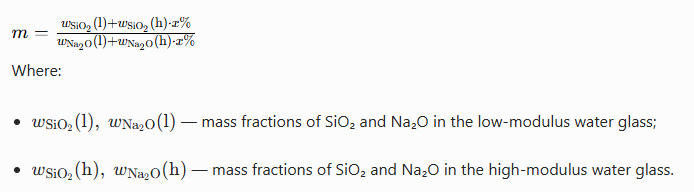
Water glass with a medium modulus can be blended using high-modulus and low-modulus raw materials to obtain the desired modulus. Suppose x grams of high-modulus water glass are added to 100 grams of low-modulus water glass; the final modulus can be calculated as follows:
If the density of purchased water glass does not meet the requirements, it can be adjusted by dilution with pure water or by concentrating it through heating.
3. Aging of Water Glass Solution
Water glass is a mixed solution of various sodium polysilicate hydrates, which maintain a dynamic equilibrium. The equilibrium state changes with temperature and storage time.
Aging refers to the spontaneous polymerization of silicic acid, especially in high-modulus water glass, which gradually reduces viscosity and bonding strength. Water glass first hydrolyzes into monosilicic acid, then condenses into disilicic acid, trisilicic acid, tetrasilicic acid, cyclotetrasilicic acid, and cubic octasilicic acid, and finally forms polycondensates. Continuous condensation alters its structure until non-hydrolyzable products are generated, marking the completion of aging.
For aged water glass with a modulus below 3.0, physical modification methods, including magnetic field treatment, ultrasonic vibration, reflux heating, and autoclave heating, can partially restore its properties. Chemical modification is also applicable. Adding polyacrylamide at a 0.2% mass fraction can effectively retard aging, delaying it by approximately two months for low-modulus water glass and about one month for high-modulus water glass.
4. Setting and Hardening of Water Glass
Water glass can be hardened by heating or chemically hardened using hardening accelerators. Common accelerators include sodium fluorosilicate, dicalcium silicate, ferrosilicon, and organic ester. Chemical solidification generally occurs in three stages: hydrolysis of sodium silicate, formation of silicic acid sol, and generation of silicic acid gel.
Part 4: Silica Sol
Common silica sol used for refractory production is prepared by removing sodium from water glass via the ion exchange method. Its composition is as follows: silica 20–30%, moisture 70–80%, and sodium oxide 0.4–0.5%. It has a relative density of 1.14–1.21 g/cm³, a colloidal particle size of 5–20 μm, and a shelf life of approximately one year. The key preparation techniques are as follows:
Raw materials
Water glass with a modulus of 2.2–3.7
Strong-acid styrene cation exchange resin
Strong-acid and weak-base styrene anion exchange resin
Production procedures
Dilute water glass to the target concentration with purified water.
Prepare a diluted hydrochloric acid solution.
Pass the diluted hydrochloric acid through the cation exchange column to hydrogenate the active groups of the resin, then rinse residual acid and chloride ions with distilled water.
Feed the diluted water glass into the cation exchange column at a steady flow rate to exchange sodium ions for hydrogen ions.
Pump the sodium-free silica sol into a weak-base anion exchange column to remove chloride ions and enhance solution stability.
Add a stabilizing agent.
Concentrate the solution under vacuum heating.
Silica sol serves as a high-grade binder for refractory materials. For shaped refractories, it increases product strength, lowers sintering temperature, and widens the sintering range. For unshaped refractories, it acts as an auxiliary binder. Proper compounding of silica sol and chemical additives can significantly reduce cement dosage without impairing setting speed or dry strength, thereby greatly improving the high-temperature performance of refractories. It is widely applied in low-cement refractory castables.