


What Grade of Bauxite Is Best for Refractory Materials in Cement Rotary Kilns
To alleviate the current supply–demand shortage of high-alumina resources in China, years of research by experts and scholars have shown that the development of homogenized bauxite is one of the optimal solutions.
60#, 70#, and 80# homogenized bauxite have uniform chemical composition, homogeneous microstructure, and stable performance. With mullite as the main crystalline phase, they exhibit a low linear change rate. Microscopically, the interlocking crystal structure endows the materials with excellent high-temperature strength and appropriate toughness. They are widely used in preheater hoods, grate coolers, tertiary air ducts, and calciner vessels of dry-process cement rotary kilns, as well as in key sections of other industrial thermal kilns in the ceramics, petrochemical, and related industries.
Since the production of homogenized bauxite can consume large quantities of bauxite fines, tailings, and low-grade ores, it has received strong policy support from the Chinese government. Consequently, research and engineering applications of homogenized bauxite in China have advanced rapidly in recent years, forming a relatively systematic product system.
A series of bauxite-based homogenized materials with alumina mass fractions ranging from 50% to 90% were synthesized using medium- and low-grade bauxite from Shanxi Province. This paper mainly investigates the application performance of 60%, 70%, and 80% alumina-grade homogenized materials in castables for cement rotary kilns.
Test
This experimental study investigates the application of 80-grade homogenized bauxite in high-wear and erosion-resistant castables for cement rotary kilns. In the formulation, coarse particles and fine powder of 80-grade homogenized bauxite account for 58% and 42% by mass, respectively, with the cement addition rate set at 6%.
The experiment also explores the application of 70-grade homogenized bauxite in mullite-based high-strength explosion-proof castables for cement kilns. The coarse particles and fine powder of 70-grade homogenized bauxite account for 66% and 34% by mass, respectively. The cement content of this castable is 4%, classifying it as a low-cement castable.
In addition, the application of 60-grade homogenized bauxite in wear-resistant ramming and coating materials for cement kilns was studied. The coarse particles and fine powder of 60-grade homogenized bauxite each account for 50% by mass, and the cement content of the ramming material is 10%.
All the above tests were carried out in sequence: weighing the raw materials according to the mix proportions, adding water, mixing, and shaping. After hardening, the specimens were demolded and subjected to wet curing for 24 hours. The standard specimen size was 40 mm × 40 mm × 160 mm. The specimens were then dried at 110 ℃ for 24 hours and heat-treated at 1100 ℃ for 3 hours, after which their room-temperature strength and other properties were tested.
The wear-resistance test specimens were sized 100 mm × 100 mm × 30 mm. After heat treatment at 1100 ℃ for 3 hours (or 540 ℃ for 3 hours for the ramming materials), the wear resistance of the working surface was tested in accordance with the national standard GB/T 18301, Test Method for Abrasion Resistance of Refractory Products at Room Temperature.
The thermal shock resistance specimens for the water-cooling test were sized 230 mm × 114 mm × 65 mm. After heat treatment at 1100 ℃ for 3 hours, thermal shock resistance was evaluated in accordance with YB/T 2206.2, Test Method for Thermal Shock Resistance of Refractory Castables (Water Quenching Method).
The physical properties of the bauxite-based homogenized materials with different grades used in the experiment are listed in Table 1.

Results Analysis and Discussion
2.1 Conventional Physical Properties of Various Specimens
The water addition (by mass) in all the above tests ranged from 6% to 7%. The castables exhibited excellent fluidity, and the ramming materials showed good workability. Table 2 presents the conventional physical properties of specimens prepared with different grades of homogenized bauxite.

The above test data show that the bulk density, room-temperature strength, and linear change rate after firing of all graded homogenized bauxite specimens fully meet industrial standard requirements. When homogenized bauxite is incorporated into refractory materials, it forms a strong bond with other refractory raw materials after high-temperature sintering. In particular, refractories composed of particles ≤1 mm and fine powder ≤0.088 mm demonstrate excellent sinterability, thereby achieving high strength. Meanwhile, homogenized bauxite features a uniform microstructure and stable performance, making it an easy-to-control refractory raw material for practical applications.
2.2 Thermal Shock Resistance and Abrasion Resistance
When 70-grade bauxite-based homogenized material was applied in mullite-based high-strength explosion-proof castables for cement kilns, the water-cooling thermal shock resistance exceeded 15 cycles.
An alumina content of approximately 70% (by mass) corresponds to the theoretical alumina composition of mullite in sintered bauxite, and mullite is well known for its excellent thermal shock resistance. This test effectively verifies this characteristic.
Figure 1 shows a specimen of mullite-based high-strength explosion-proof castable prepared with 70-grade homogenized bauxite after 15 water-cooling thermal shock cycles. The image indicates that the specimen remains intact, without obvious damage, after 15 cycles, confirming its outstanding thermal shock resistance.

When 80-grade bauxite-based homogenized material was applied in high wear- and erosion-resistant castables for cement kilns, the abrasion loss was 4.0 cm³ after heat treatment at 1100 ℃, while the enterprise standard requirement is ≤ 4.5 cm³. Its alkali resistance reaches Grade Ⅰ (as shown in Figure 2).
For 60-grade bauxite-based homogenized material used in wear-resistant ramming and coating materials for cement kilns, the abrasion loss was 5.9 cm³ after heat treatment at 540 ℃, with the enterprise standard requirement being ≤ 6.5 cm³. The appearance of the specimen after the abrasion test is shown in Figure 3.
As shown in Figure 2, no cracks appear in the 80-grade homogenized castable after alkali corrosion, indicating that it achieves Grade Ⅰ alkali resistance. Since alkaline environments are common inside cement kilns, testing this property is of great practical significance.
As shown in Figure 3, the 60-grade ramming material exhibits good wear resistance. From the worn surface, both the matrix and the aggregate are abraded simultaneously, indicating strong bonding between them. Notably, the specimen was only heat-treated at 540 ℃. It is remarkable that such excellent wear resistance is achieved without high-temperature sintering.
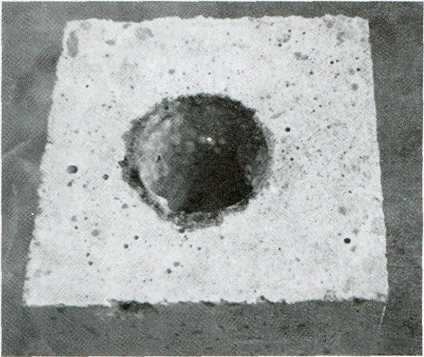

In terms of abrasion resistance among the three grades of refractory materials, the 80-grade homogenized castable performs the best, the 70-grade homogenized castable ranks in the middle, and the 60-grade wear-resistant ramming material is slightly inferior. Nevertheless, the 60-grade material has a lower bulk density. For the same volume of refractory material, less consumption is required, which reduces the weight of structural components. It is cost-effective and suitable for service conditions where abrasion resistance requirements are not extremely stringent.
Conclusions
(1) The 80-grade homogenized castable has an abrasion loss of ≤ 4.5 cm³ and achieves Grade I alkali resistance. It can be applied to parts inside cement rotary kilns exposed to high temperatures, severe abrasion, or alkali corrosion, such as elbows of tertiary air ducts, air valves, lower walls and throats of grate coolers, and top covers of kiln hoods.
(2) The 70-grade homogenized castable exhibits high strength and withstands more than 15 water-cooling thermal shock cycles at 1100 ℃. It is suitable for application in kiln hoods, grate coolers, calciner vessels, and other related areas.
(3) The 60-grade homogenized castable has an abrasion loss of ≤ 6.5 cm³ and can be used in waste heat power generation equipment and other components exposed to relatively severe wear conditions.