


Technical Renovation Project for Red Kiln Phenomenon in Rotary Kiln Burning Zone
Existing Problems
During the operation of a 5300 t/d clinker cement production line, a red-kiln phenomenon occurred in the burning zone of the rotary kiln after 7 months of operation.
Internal inspection revealed the following issues:
A large number of refractory bricks at the brick retaining ring at the kiln inlet were crushed due to extrusion, with some bricks partially falling off.
The thickness of refractory bricks in the burning zone and the sub-burning zone was reduced to about 80 mm due to coating erosion.
The wear of refractory bricks in the transition zone exceeded 40 mm.
The kiln had to be shut down to replace the refractory bricks in the burning zone and the sub-burning zone.
To extend the service life of the rotary kiln lining, technicians analyzed the application status of the refractory bricks, reviewed relevant data, developed solutions, and conducted repeated evaluations. Finally, based on the excellent properties of silicon-moisture bricks - high wear resistance, low thermal conductivity, high thermal shock resistance, and strong corrosion resistance - a renovation plan was formulated for the brick retaining ring at the kiln inlet and the internal refractory bricks of the rotary kiln.
01 Technical Renovation
(1) Crushing and Climbing of Magnesia-Alumina Spinel Refractory Bricks at the Brick Retaining Ring of the Rotary Kiln Inlet
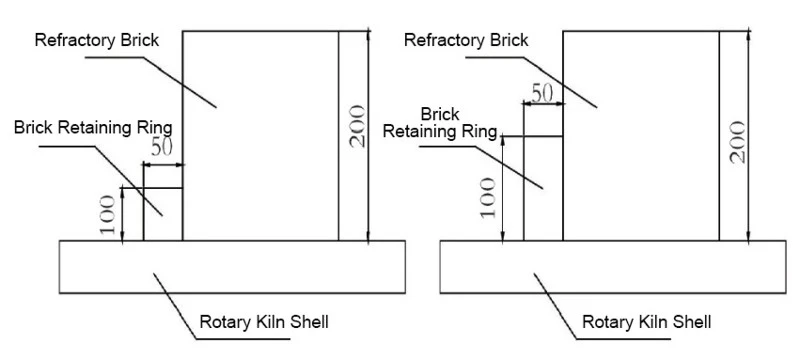
Research and analysis concluded that the originally designed brick retaining ring was only 50 mm in height. The refractory bricks at the retaining ring bore excessive pressure per unit area, resulting in cracking at the joint between the refractory bricks and the retaining ring, as well as climbing and collapse of the kiln bricks.
In response to the above issues, on-site technicians conducted demonstrations and increased the height of the brick retaining ring from 50 mm to 100 mm.
This change doubled the contact area between the refractory bricks and the retaining ring and reduced the pressure per unit area on the refractory bricks to half of the original value, thereby solving the problem of refractory brick crushing at the brick retaining ring of the rotary kiln.
By ensuring the integrity of the refractory bricks, climbing and collapse were eliminated. The renovated brick retaining ring is shown in Figure 1.
(2) Adjust the Application Positions and Types of Refractory Bricks in the Rotary Kiln
Based on an analysis of the technical properties of magnesia-alumina spinel bricks, magnesia-chrome bricks, spalling-resistant high-alumina bricks, and silicon-mullite bricks, silicon-mullite bricks feature outstanding wear resistance, low thermal conductivity, high thermal shock resistance, strong corrosion resistance, and low bulk density. They can meet the requirements of the cooling zone, sub-burning zone, and transition zone of the rotary kiln.
The physical and chemical indexes of silicon-mullite bricks are shown in Table 1.

After thorough evaluation, a plan was formulated to replace magnesia-alumina spinel bricks and spalling-resistant high-alumina bricks with silicon-mullite bricks. Meanwhile, the arrangement of different types of refractory bricks inside the rotary kiln was adjusted according to the characteristics of silicon-mullite bricks. The specific renovation plan is shown in Figure 2.
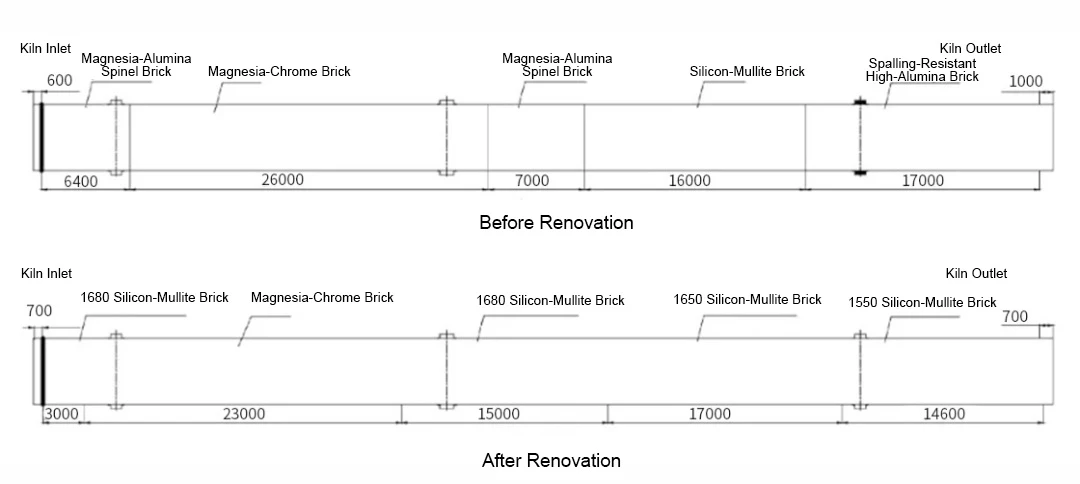
K17 corundum-based castable is applied at the kiln inlet hood within 0.7 m from the kiln mouth. AZM1680 silicon-mullite bricks are used from 0.7 m to 3.7 m. Magnesia-chrome bricks are rearranged in the section from 3.7 m to 26.7 m. AZM1680 silicon-mullite bricks are adopted from 26.7 m to 41.7 m. AZM1650 silicon-mullite bricks are used from 41.7 m to 58.7 m. AZM1550 silicon-mullite bricks are applied from 58.7 m to 73.3 m. K16 corundum-based castable is used from 73.3 m to 74 m.
In the above renovation scheme, magnesia-alumina spinel bricks in the cooling zone and sub-burning zone of the rotary kiln are replaced with AZM1680 silicon-mullite bricks. AZM1650 and AZM1550 silicon-mullite bricks are also used in the transition zone.
The kiln coating in the sub-burning zone is unstable and tends to peel off frequently, causing the refractory bricks to detach easily together with the kiln coating. Silicon-mullite bricks feature excellent thermal shock resistance and a low tendency to crack or spall, which helps extend the service life of the refractory lining.
Meanwhile, when applied in the transition zone, silicon-mullite bricks provide high refractoriness and outstanding wear resistance, reducing chemical attack and abrasion by materials in the transition zone and further improving the service life of the refractory bricks.
02 Renovation Effect
After the renovation of the lining of the 5300 t/d rotary kiln, the kiln operated continuously for 12 months without any red-kiln occurrence.
After shutdown inspection of the refractory bricks inside the kiln, it was found that the wear of the renovated refractory lining was very low. After 12 months of service, the AZM1680 silicon-mullite bricks remained in good overall condition, with a wear thickness of only 10–20 mm, and no brick breakage was observed at the brick retaining ring. Only a small portion of the magnesia-chrome bricks required patching, while most of them could still be used continuously. The wear of AZM1650 silicon-mullite bricks was about 10 mm, and the wear of AZM1550 silicon-mullite bricks was less than 1 mm.
After patching the magnesia-chrome bricks, the rotary kiln operated for another 4 months before the magnesia-chrome bricks in the burning zone were fully replaced.
The layout of refractory brick types before and after renovation is shown in Figure 2.
Compared with the pre-renovation condition, the service life of the refractory lining was extended by 6 months. The overhaul cycle of the rotary kiln lining was prolonged, allowing only two overhauls of the burning zone lining within 3 years, thus improving the operating rate of the rotary kiln.
Meanwhile, due to the low thermal conductivity of silicon-mullite bricks, the kiln shell temperature was reduced by 30–50 °C, resulting in lower fuel consumption.
03 Conclusion
This technical renovation has effectively solved the problems of refractory brick crushing and falling caused by extrusion by modifying the size of the brick retaining ring at the rotary kiln inlet, increasing its height, and enlarging the contact area between the refractory bricks and the retaining ring.
Replacing the originally designed magnesia-alumina spinel bricks and spalling-resistant high-alumina bricks with silicon-mullite bricks has effectively reduced the abrasion and corrosion of the refractory lining caused by materials and prolonged the service life of the refractory bricks.
By adjusting the positions of refractory bricks in the burning zone and sub-burning zone, the high thermal shock resistance of silicon-mullite bricks has reduced spalling of the refractory bricks caused by kiln coating peeling. Meanwhile, the low thermal conductivity of silicon-mullite bricks has reduced heat radiation from the kiln interior to the kiln shell, lowering fuel consumption and cutting costs.
This renovation has achieved favorable economic benefits for the company. It has extended the service life of the refractory bricks, improved the operating rate of the rotary kiln, and reduced the cost of refractory materials, thereby achieving the goal of cost reduction and efficiency improvement.