


Aluminate cement refractory castables have more varieties, with different ratios, different properties, construction and production methods and maintenance systems are also different, but the factors affecting the performance, basically the same.
Quantity of cement
Cement is one of the important components of refractory castables, which is an important material to determine the strength and also affects other properties. Different varieties of cement and its dosage have different effects on the performance.
CA-50 cement high alumina refractory castables cement dosage, the impact on its performance is shown in Table 1. refractory aggregate and powder are secondary bauxite clinker, its aggregate and powder and cement ratio of 70:30, plus 10% water. From the table, with the increase of cement dosage, the room temperature compressive strength increases, the compressive strength after firing at 1200℃ is 40%~65% lower than the drying compressive strength, the refractoriness and the loading softening temperature keep decreasing, and the post-firing line shrinkage increases. This is due to the high impurity content of CA-50 cement, low refractoriness, when the dosage is increased, the amount of liquid phase in the heating process of its castables is more, resulting in a decline in performance. Therefore, under the condition of ensuring the strength at room temperature, the dosage of CA-50 cement should be reduced as much as possible to improve the high temperature performance of refractory castables. When reducing the amount of cement, refractory powder should be increased appropriately, so that the combined amount of cement and powder can fully encapsulate the refractory aggregate, and make the refractory castables to obtain the maximum degree of compactness. Commonly used cement dosage is 10-15 per cent.
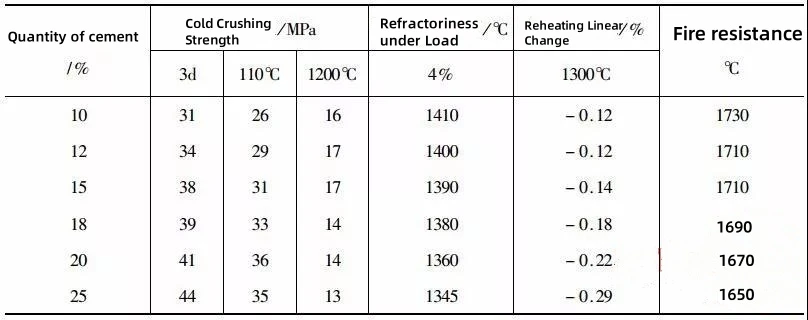
Table 1 Effect of CA-50 cement dosage on the performance of castables
water consumption
Different varieties of aluminate cements are used to formulate different refractory castables. The same kind of cement can also be formulated into many kinds of refractory castables. In the refractory castable proportion and process conditions are the same, the amount of water on the refractory castable performance influence law is basically the same. Now take CA-50 cement high alumina refractory castables as an example, the influence of its water consumption on the performance of the castables, as shown in Table 2. Refractory aggregate and powder are all secondary alumina clinker, aggregate is <15mm 70% of the total material, powder and cement is 15% each. The mould was dismoulded after the initial setting of the moulding with moist curing for 1d, and then standard curing was carried out23 to check the various properties.
As seen from the table, the castables with the increase in the amount of water, a variety of properties generally have a greater decline: room temperature compressive strength decreased by 27% to 35%, drying compressive strength decreased to 19.1MPa, post-burning compressive strength decreased by about 40%, high-temperature compressive strength decreased by 57% or so; loaded softening temperature decreased from 14001 to 12501, post-burning line change from -0.38% to - 0.96%, apparent porosity from 19% to 23%, bulk density from 2.29g/cm3 to 2.17g/cm3. This means that, when formulating aluminate cement refractory castables, the water dosage (or water-cement ratio) selection is very important. When the amount of water is more, after heating, the water escapes, the pore space increases, the structure is loose, resulting in a variety of properties to reduce the overall. Therefore, under the condition of ensuring the ease of construction, the amount of water in the mix should be reduced as much as possible. Under the premise of not mixing water-reducing agent, the appropriate amount of water for aluminate cement refractory castables is 10%~13%.
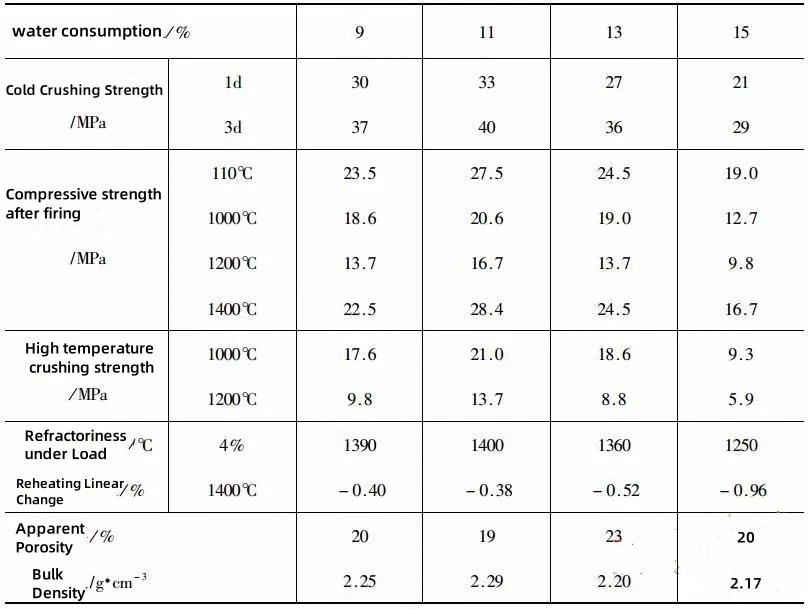
Table 2 Effect of water dosage on the properties of CA-50 cement castables
It should be pointed out that in the refractory castable proportion and production process is basically the same, the amount of water has an optimal value, such as Table 2, the amount of water 11% for the best, and other water than the amount of water, the best overall performance. Therefore, when the construction of aluminate cement refractory castables is made, it should be mixed first, choose the best flow degree, compare the size of the room temperature strength, determine the best water dosage, and then it can be produced and constructed.
Refractory Powder
Aluminate cement refractory castables are generally mixed with suitable refractory powder, its role:
(1) reduce the amount of cement, can reduce the cost and improve the use of temperature;
(2) refractory powder can play the role of barrenness, high temperature and can participate in the reaction and the formation of high-temperature resistant minerals, improve the performance of refractory;
(3) refractory oxides of ultra-fine powder mixing, can reduce the amount of water, high temperature formation of high-temperature resistant minerals or to enhance the sintering properties, so it can Improve the performance of castables. Refractory powder varieties, fineness and its dosage, is an important factor affecting the performance of the castables.
In CA-50 cement refractory castables with the same ratio, respectively, with secondary bauxite clinker and electrofused corundum for refractory powder, the latter than the former load softening temperature increased by 100 ~ 200 ℃, 1600 ℃ after burning line change from contraction to expansion, the use of temperature can be increased by about 100 ℃; a-Al2O3 powder on the strength of electrofused alumina cement refractory castable strength, shown in Figure 1.

Fig. 1 Effect of α-Al2O3 powder on the strength of corundum castables
1 - of pure clinker cement; 2 - of pure clinker cement doped with α-Al2O3 powder
The fineness of refractory powder directly affects the strength, bulk density and porosity of refractory castables. Generally speaking, the finer the refractory powder, the better the performance of the refractory castables; when the use of ultra-fine powder instead of part of the refractory powder, the bulk density increases, the apparent porosity decreases, and the strength is significantly improved.
Figure 2 shows the effect of powder dosage on the performance of the castables. The cement dosage of refractory castables is 14%. As seen in the figure, there is an optimal value of refractory powder dosage; that is, 15%-18%, the bulk density is relatively large, and the compressive strength is better at room temperature and 1350 ℃ after burning. When the refractory powder dosage is small, and the amount of cement, not enough to wrap the refractory aggregate, resulting in the organisational structure is not close, so the performance is reduced; when the amount of refractory powder dosage is more than the amount of cement, wrapped in refractory aggregates, resulting in an increase in the amount of water, high-temperature sintering shrinkage, so the performance is also reduced.

Fig. 2 Effect of powder dosage on the properties of castables
1 a bulk density;, 3- the compressive strength after firing at room temperature and 1350 # respectively
If you are interested you can click on the links below to be redirected to the appropriate product.