


Refractory Aggregates
Refractory aggregate is one of the important components of refractory castables, and its variety, grade, maximum particle size and particle gradation are the main factors affecting the performance.
Refractory aggregate grade, impurity content and sintering advantages and disadvantages, also affects its performance.
For example, when using bauxite clinker as refractory aggregate, with the increase of Al2O3 content, that is, the grade increases, the refractoriness of the casting material and the loaded softening temperature increases, and the post-firing line change decreases; when the material is not burned or impurity content, its refractoriness and loaded softening temperature decreases, and the post-firing line shrinkage is large.
Therefore, according to the varieties of aluminate cement, choose the suitable refractory aggregate with good sintering and high purity to form a high-performance refractory castable.

Table 3 Effect of aggregate particle gradation on the properties of castables
Table 3 shows the effect of aggregate particle gradation on the performance of the castables. 20% of CA-60 cement as a binding agent, the mix has the same mobility, i.e., the amount of water is different. From the table, No. 1 and No. 2 of the aggregate particle gradation is better, so the water consumption is less, the bulk density is large, the apparent porosity is small, the room temperature and the post-firing compressive strength is higher; when there are more fine aggregates, such as No. 4, the surface area of the particles increases, more cement and powder are needed to be able to encapsulate the aggregates and the aggregates are not dense, resulting in an increase in the amount of water, and a decrease in the performance of the refractory castables.
Refractory aggregate particle grading is generally three-stage grading, two big middle small, sand rate of 0.45 ~ 0.55. Preparation of excellent refractory castables, should be used in multi-level grading; the use of low-temperature and unimportant parts of the refractory aggregate is allowed to use the natural grading particles that is, the aggregate. In the production of refractory aggregate, should also control the proportion of large, medium and small particles, to prevent too large particles of segregation, in order to formulate a good quality refractory castables.
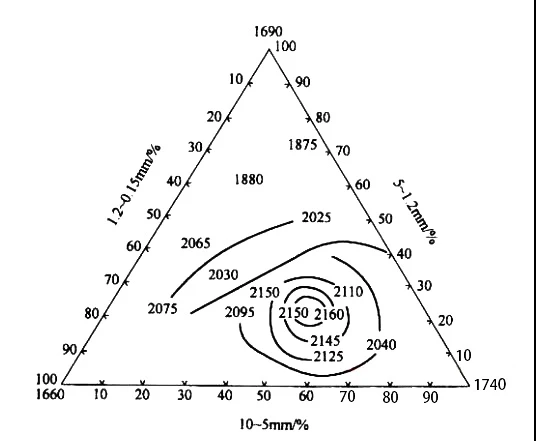
Fig. 3 Effect of aggregate particle gradation on its packing density
Additive
 Aluminate cement refractory castables commonly used additives, generally divided into water reducing agent (plasticizer), coagulant and retarder, in addition to sintering agent and expansion agent.
Sintering agent has soft clay, lithium feldspar, bentonite and silicon metal, etc., the purpose is to improve the refractory casting material of the medium-temperature strength; expansion agent has bluecrystalline stone, silica and silica, etc., at high temperatures to produce expansion to compensate for the contraction of the casting material to improve the performance; coagulant promoter NaOH, Na2CO3, triethanolamine, sodium silicate, lithium salts and silicate cement, etc., generally used in special circumstances.
For example, the preparation of spray paint, the use of CA-50 cement 70% and silicate cement 30 'mixed into a composite binding agent, when the material to reach the sprayed surface can be faster coagulation and hardening; Retarder NaCKAlCk boronic acid, carboxymethyl cellulose, sodium gluconate, isopropyl alcohol and lignosulfonate, etc., the majority of the water reducing agent also has a retarding effect.
For example, CA-50 cement refractory castables mixed with 0.1% AlCl3, setting time from 4h to more than 6 hours, 1 day compressive strength from 50MPa to 56MPa; water reducing agent is the most widely used admixture, also known as the surface activator, mainly: sodium methylene di-naphthalene sulfonate (brand NNO), β-naphthalene sulfonate formaldehyde condensation (brand JN, NF), polyimide, polymerization, polymerization, polymerization, polymerization and polymerization. ......), sodium polymethylene sulfonate polymer (brand MF), lignin sulfonate (divided into M type, wood calcium and wood sodium, etc.), sulfonated tar, sodium alkyl sulfonate, sulfonated melamine formaldehyde condensate (i.e., honey glue resin), hydroxylamine hydrochloride, urea, hydroxycarboxylic acid and its salts (including tartaric, citric, and gluconic acid and its sodium salt, etc.), carbonic acid and its sodium salt. sodium salt, etc.), sodium bicarbonate, boric acid, sodium tripolyphosphate and sodium hexametaphosphate, etc., the dosage of which accounts for 0.005% to 1.0% of the mass of cement. As we all know, when the aluminate cement refractory castables are mixed with water, a kind of flocculation structure is formed between the cement particles, a part of the mixed water forms a water film, and the other part is surrounded by a water film of free water, which does not improve the role of slurry fluidity.
In order to improve the fluidity of the castables, it is necessary to increase the amount of water, thus reducing its performance. When the water reducing agent is added, the hydrophobic groups of the water reducing agent are directed to adsorb on the surface of the cement mass, and the hydrophilic groups are directed to the aqueous solution, which constitutes a single molecule or a multimolecular adsorption membrane. Due to the directional adsorption of the water reducing agent molecules, the cement surface with the same sign of the charge, under the action of electrical repulsion, so that the flocculation structure between the cement particles dispersed and disintegrated, releasing free water, and played a water reducing effect. At the same time, the water reducing agent can wet and lubricate the cement particles to facilitate the flow, but also reduce the amount of water. In short, the water reducing agent can disperse, wet and lubricate the cement particles to achieve the purpose of water reduction and enhancement, which itself is generally not involved in the reaction, and can not improve the strength of the castables.

Table 4 Effect of water reducing agents on the properties of refractory castables
Table 4 for the effect of water reducing agent on the performance of refractory castables. CA-50 cement refractory castables ratio (%) for the cement: one, two alumina clinker mixed powder: a clay clinker aggregate = 15:15:70; tartaric acid or citric acid and sodium bicarbonate composed of composite water reducing agent (known as CB-type), and then added to the mass of the cement accounted for 0.1% to 0.05% of the water reducing agent of calcium wood (then known as the CBM type), the two dosages in the table as a percentage of the total material mass; TNH is a soluble honey amine resin. The dosage of the two in the table is the percentage of the total material mass; TNH is water-soluble honey amine resin. These water reducing agent is used for electrofused aluminate cement corundum refractory castables. From the table, add a very small amount of water-reducing agent, its water reduction rate of 10% ~ 39%, for CA-50 cement refractory castables at room temperature 3d and 10007 burnt compressive strength were increased by 7% ~ 22% and 24% ~ 47%; for the electrofused aluminate cement corundum refractory castable at room temperature 1d and 1000 ℃ burnt compressive strength, respectively, to increase the 52% ~ 65% and 61% ~ 75%. 75%. That is to say, the use of composite water reducing agent is better than a single water reducing agent, in general, all have the role of water reduction and enhancement.
Tests show that in the aluminate cement refractory castables, mixed with MF, wood sodium, alkyl sulfonic acid, etc., has a better water reduction effect, but retardation is heavier, affecting the early strength; when alone with tartaric acid, citric acid and sodium tripolyphosphate, etc., urinary is larger, and it can improve the densification of the castables, but the water reduction effect is not great. Therefore, water-reducing agent should be composite use of the best.

Fig. 4 Effect of water reducing agent dosage on the performance of refractory castables
α-sulfonated washing oil dosage versus strength and water reduction rate; b-JF water reducing agent dosage versus strength
1-Water reduction rate; 2-3d room temperature compressive strength; 3-drying compressive strength;
4-1000℃ post-burning compressive strength; 5-1000℃ high temperature compressive strength
Figure 4 shows the effect of water reducing agent dosage on the performance of refractory castables. α in the figure is CA-50 cement clay refractory castables, with the same fluidity and water reduction rate of 6%~10%; b in the figure is CA-60 cement refractory castables, with basically similar fluidity and water reduction rate of about 25%. From the figure, there is an optimal value of water reducing agent, the appropriate amount of sulfonated washing oil is 0.5%~2.0%, and JF is 0.225%~0.300%, at this time, there is a large increase in various properties.
CA-70 cement refractory castables ratio: less than 7mm clay clinker 60%, Al2O3 75% of the alumina clinker powder 25%, soft clay powder 3% and CA-70 cement 12. not add water reducing agent, the amount of water in the castables is 11.5%; mixed with NNO, MF, sodium tripolyphosphate and sodium citrate water reducing agent, there are water-reducing effect, the first two kinds of effects than the last two kinds of more obvious. The former two have more obvious effect than the latter two, and the water reduction rate can be more than 20%.

Fig. 5 Effect of water reducing agent dosage on the properties of CA-70 cement castables
1 a sodium citrate; a sodium tripolyphosphate; a MF; 4-NNO
At the same time, with the increase of water reducing agent dosage, there is an optimal value of water reducing rate (see Fig. 5a); from the drying flexural strength, there is also an optimal value of water reducing agent dosage (see Fig. 5b). From the comprehensive performance of CA-70 cement refractory castables, the optimal amount of water reducing agent: NNO is 0.5%; MF, sodium brown citrate and sodium tripolyphosphate is 0.2%. When the amount of water reducing agent, not only can not reduce water, but also reduce its performance.
It should be pointed out that the refractory castables with different varieties of aluminate cement, the choice of admixture and its dosage also makes a difference, generally should be determined by the test; in order to ensure that the original performance of the aluminate cement refractory castables under the premise of mixing water reducing agent can be appropriately reduce the amount of aluminate cement, that is, can save cement. This can reduce the cost of refractory castables, because of the low melting point material into the less, so can improve the performance.
Conservation Regime
The maintenance system is divided into standard maintenance, natural maintenance, damp maintenance, steam maintenance, water maintenance and dry maintenance. Standard maintenance is in the temperature (20 ± 3) ℃ and humidity greater than 90% of the conditions of maintenance. Aluminate cement refractory castables molding after the initial set, placed in what kind of maintenance system maintenance, is very important, see table 5.
As seen in Table 5, after the initial setting of aluminate cement refractory castables, with the different maintenance system, the room temperature and drying compressive strength is different, which is due to the different hydration products and crystalline transformation of cement. In general, due to the heat of hydration generated by the cement in contact with water in 2~3h is more concentrated, up to about 80%, the strength rises very quickly, so 1 day room temperature strength is higher, 3 days room temperature strength growth is not much. The drying strength is better in humid maintenance and steam maintenance.

Table 5 Effect of maintenance system on the performance of refractory castables
It should be noted that aluminate cement refractory castables with reasonable material selection and proper mixing ratios can be maintained under any maintenance regime, and good performance can be obtained. After drying, the hydration products are generally transformed into C3AH6 and AH3 crystals, so the strength is basically similar. In the production and construction, due to a variety of factors, while preventing the early loss of water to produce carbonization and make the surface of the castables loose, so the aluminate cement refractory castables molding after the initial condensation, it should be in the wet drenching environment, ambient temperature of 15-25 ℃, maintenance time of 2 ~ 3d.
We are a refractory material supplier integrating R&D, production, processing, construction, warehousing and commerce.
We have invested two manufacturing plants: Liaoning Xinfeng Refractory Plant and Liaoning Yixing Refractory Technology Co.,Ltd.
