


As an indispensable core thermal processing equipment in modern industry, the rotary kiln has a development history of more than 100 years since its invention in the 19th century.
Initially used for cement production, rotary kilns are now widely applied in many fields including Building Materials, Metallurgy, Chemical Industry, Environmental Protection and New Energy. With their unique thermal performance and advantages of continuous operation, rotary kilns have always served as the most reliable production medium for various high-temperature physical and chemical reactions.
With the global manufacturing industry transforming toward intelligence and green development, rotary kiln technology keeps evolving. Integrated with artificial intelligence control, energy-saving design and interdisciplinary innovation, it presents renewed vitality.
Rotary Kiln is a continuous thermal processing equipment used for high-temperature heat treatment of solid materials.Simply put, it is an inclined cylinder rotating at low speed. Materials are fed from the elevated end (kiln tail). Inside the cylinder, materials tumble continuously with rotation and move axially toward the lower end (kiln head). During this process, physical and chemical changes such as drying, calcination and roasting take place.
General Requirements for Refractory Lining Configuration
1) For areas with stable coating in the burning zone and transition zones on both sides, magnesia-chrome bricks or magnesio-ferrite spinel bricks are recommended. For projects with a capacity of 5000 t/d and above, imported magnesia-chrome bricks are preferred if the price difference is insignificant. Domestic bricks shall be adopted for projects below 5000 t/d.
2) Spinel bricks or silicon-mullite-red bricks shall be used in transition zones with unstable coating or frequent brick exposure. Spalling-resistant high-alumina bricks are applied in the calcining zone. Where certain sections suffer rapid corrosion and short service life, basic bricks such as spinel bricks or magnesia-chrome bricks may also be adopted.
3) For preheater, precalciner system and tertiary air duct, where the lining surface temperature is below 1200℃, clay-based alkali-resistant bricks and alkali-resistant castables shall be used. For static equipment, an insulation layer shall be added in addition to the working layer, and calcium silicate boards shall be uniformly selected as the insulation material.
4) High-alumina castables are used for brick supports, cone sections of the precalciner and high-temperature zones of the grate cooler. High-strength alkali-resistant castables are adopted for medium and low-temperature zones of the grate cooler. Coating-resistant castables are applied at the kiln outlet shrinkage and smoke chamber slope sections.
5) For the kiln hood during major overhaul, high-alumina low-cement castables shall be used if the curing period can reach more than 24 hours. For emergency repair of the kiln hood, PA80 high-alumina or wear-resistant castables shall be adopted to shorten the curing time.
6) High-heat wear-resistant castables shall be selected for locations with high temperature and high wear resistance requirements, including the front wall of the grate cooler, tertiary air duct outlet from the grate cooler, and bends of tertiary air duct entering the precalciner. Meanwhile, spalling-resistant bricks or waste high-wear-resistant bricks can be laid at the section where the tertiary air duct feeds into the precalciner.
7) High-purity magnesia-alumina spinel castables are selected for the coal burner pipe castable lining. For kiln outlet castables in major overhaul, high-purity magnesia-alumina spinel castables are used to guarantee a service life of over 8 months. For emergency repair of the kiln outlet, PA80 mullite castables are adopted to ensure service life of more than 4 months.
8) For castables used at other high-temperature sections under emergency repair or when the curing condition cannot meet the minimum required 24 hours, castables bonded with PA80 binder (general PA80 series products) shall be used. PA80 binder is phosphate-based binder. PA-80 (Series 1, 2, 3) corresponds to high-alumina, wear-resistant and corundum-mullite materials respectively.
9) New materials and new technologies may be trialed to improve the cost performance of refractories, fulfill environmental protection requirements of refractories through chromium-free innovation and reduce refractory consumption cost, in accordance with the development of new materials and technologies.
10) Scrapped magnesia-chrome bricks, spinel bricks and spalling-resistant bricks with chipped edges and corners recovered from rotary kilns are recommended as the primary consumable material for straight walls of the grate cooler, constructed with brick-concrete frame structure.
For large-area castable construction on low walls and slopes of the grate cooler, it is encouraged to fill crushed recycled bricks mainly consisting of spalling-resistant bricks recovered from rotary kilns.
Reference Configuration Table of Refractories inside Rotary Kiln
| No. | Location | Refractory Grade | Service Period (Month) | Remarks |
|---|---|---|---|---|
| 1 | Kiln Burner | Corundum / Mullite Wear-resistant Castable | 8-10 | |
| 2 | Kiln Outlet | Corundum / Mullite Wear-resistant Castable | 8-12 | 0-0.6m |
| Silicon Carbide High Wear-resistant Brick | 12-24 | 0.6-(1.6~2.6m) | ||
| 3 | Lower Transition Zone | Magnesia-Alumina Spinel Brick / Magnesia-Ferrite Spinel Brick / Silicon-Mullite Brick | 12-18 | |
| 4 | Burning Zone | Magnesia-Ferrite Spinel Brick, Imported Magnesia Brick | 18-30 | |
| 5 | Upper Transition Zone | Magnesia-Alumina Spinel Brick / Silicon-Mullite Brick (Series) | 10-18 | |
| 6 | Safety Zone | Silicon-Mullite Brick (Series) | ≥24 | |
| 7 | Calcining Zone | Silicon-Mullite Brick (Series), High Strength Alkali-resistant Brick | ≥36 | |
| 8 | Feed Cone | High Alumina / Mullite Castable | 24-36 |
Working Principle
The rotary kiln shell is installed at an inclined angle to the horizontal plane (normally 3.5%~4%). Raw materials are fed into the kiln from the kiln inlet (elevated end). During normal operation, the main drive motor drives the pinion through a reducer. The pinion meshes with the girth gear to rotate the entire kiln shell at a low speed. Owing to the inclination and rotation of the shell, materials tumble circumferentially and travel axially from the elevated end to the lower end.
Meanwhile, fuel is injected and combusted at the kiln outlet. The generated heat exchanges with the materials. As the materials move forward, they undergo physical and chemical reactions such as calcination and sintering to form clinker, which is discharged from the kiln outlet. The flue gas generated by combustion is exhausted from the kiln inlet.
Industries of Rotary Kiln Applications
Classified by treated materials and process characteristics, rotary kilns are mainly applied in the following fields:
Building Materials Rotary Kiln
Used for the production of main or auxiliary building materials, this is the most traditional application field of rotary kilns.
Cement Rotary Kiln: Core equipment for calcining cement clinker. It is divided into dry process (energy-saving, high efficiency, mainstream technology) and wet process (homogeneous slurry). Pengfei Group can supply cement rotary kilns to meet different capacity requirements of 8000 t/d, 6000 t/d, 5000 t/d, 3500 t/d and 2500 t/d. Pengfei cement rotary kilns have been awarded "Famous Brand of China Building Materials Machinery Industry" and "Jiangsu Provincial Famous Brand".
Lime Rotary Kiln (Active Lime Kiln): Specially for calcining active lime and lightly burned dolomite. Its products are mainly used for slag formation in iron and steel smelting, calcium carbide production and construction mortar.

2 × 1000 t/d Lime Kilns for Baosteel Zhanjiang
Metallurgical Rotary Kiln
Used for extraction, roasting and pelletizing of ferrous and non-ferrous metals, it generally operates at relatively high temperatures.
Nickel Ore Rotary Kiln: Core roasting equipment for the RKEF (Rotary Kiln-Electric Furnace) process of lateritic nickel ore. Pengfei rotary kilns for lateritic nickel ore roasting have been exported worldwide to more than 80 countries.
Lithium Iron Phosphate Rotary Kiln: Key equipment in the new energy sector for continuous calcination of lithium iron phosphate precursors, the cathode material for lithium-ion batteries. Pengfei lithium ore roasting rotary kilns serve as the flagship product for strategic transformation.
Rare Earth Rotary Kiln: Applied for sulfuric-acid roasting or decomposition of rare earth concentrates to extract rare metal elements such as neodymium, praseodymium and lanthanum.
Oxidized Pellet Rotary Kiln: It roasts and consolidates green iron ore pellets at high temperature to produce high-strength oxidized pellets.
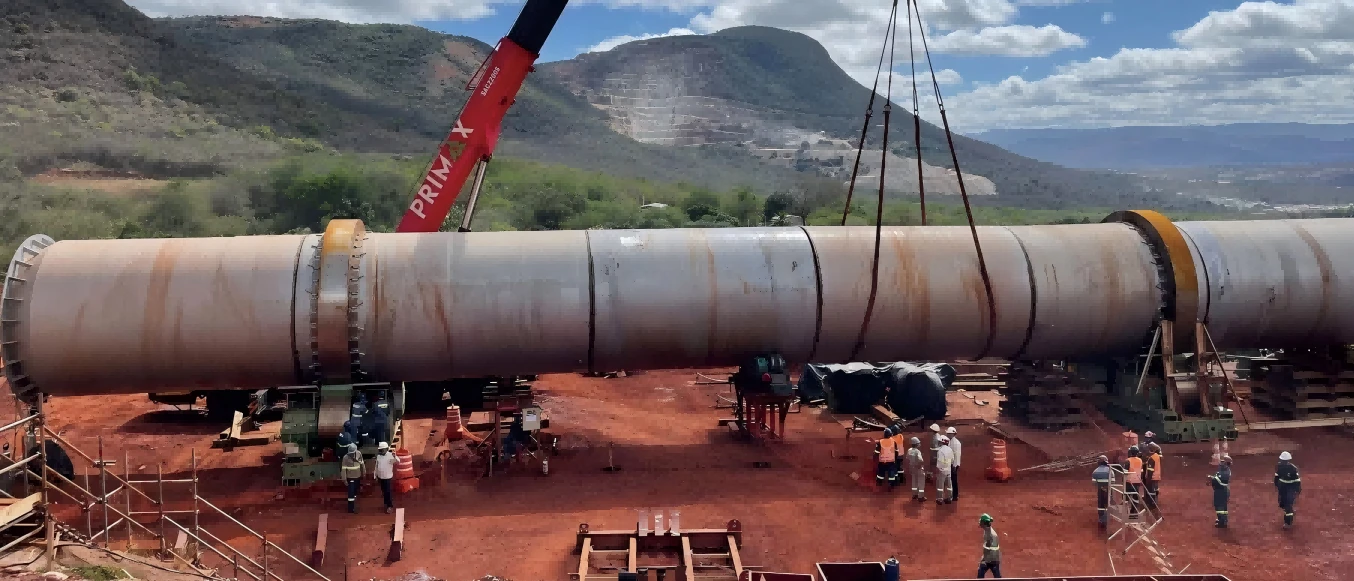
Brazil Magnesite Rotary Kiln