


Cyclic enrichment of heavy metals in cement kiln systems
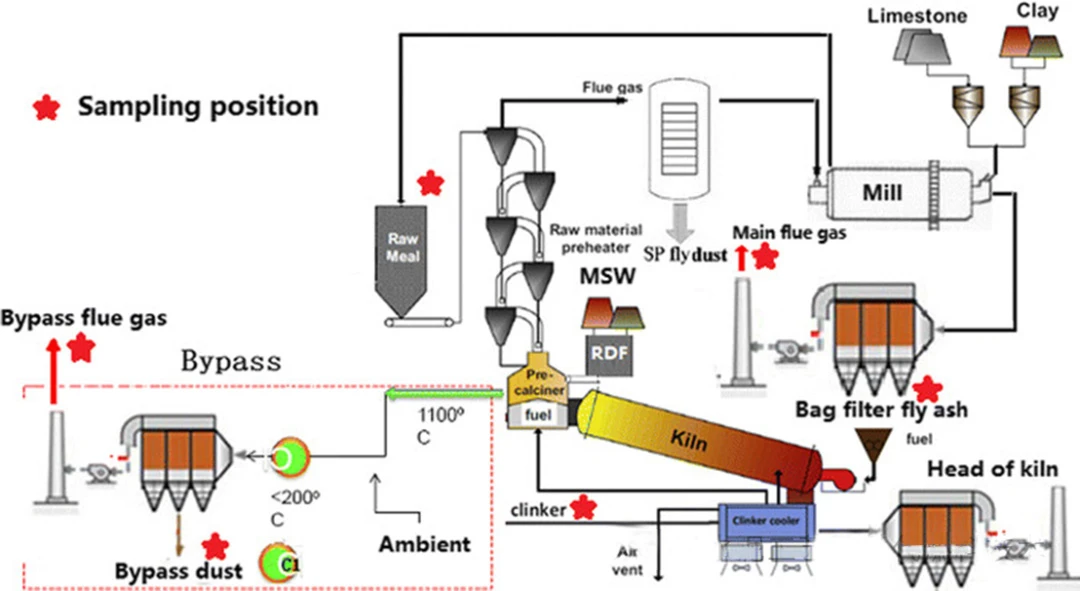
The cyclic enrichment of heavy metals in cement kiln systems is closely related to their physico-chemical properties (especially volatile and semi-volatile compounds) and the characteristics of the cement production process. The mechanisms of heavy metal cycling in cement kiln systems, the characteristics of volatile and semi-volatile heavy metals, and the key control points are outlined below.
1. Mechanisms of Cyclic Enrichment of Heavy Metals
Cement kiln systems (including preheaters, decomposition furnaces, rotary kilns, etc.) operate under high-temperature conditions and involve complex thermal and chemical reactions. Heavy metals become cyclically enriched in the system through the following pathways:
Volatilization and Condensation Cycle in the Kiln System:
Heavy metals (especially volatile and semi-volatile elements such as mercury [Hg], cadmium [Cd], lead [Pb], thallium [Tl], etc.) are thermally volatilized into a gaseous or vapor state in high-temperature regions (e.g., in rotary kilns or decomposition furnaces, where material temperatures can exceed 1,450°C), and are carried with the flue gas into the preheater system.
In the lower-temperature region of the preheater (300–800°C), these gaseous heavy metals condense into solid particles or are adsorbed onto raw material or dust particles.
The condensed heavy metals and dust are captured by the cyclone preheater and re-enter the raw material stream, returning to the high-temperature zone where they volatilize again-forming an "inner cycle."
Raw Meal Dust Reuse and Enrichment:
Some heavy metals with low condensation temperatures can be discharged from the preheater, condense in the raw mill and baghouse dust collector, and become incorporated into the raw meal. In cement kiln systems, kiln dust is typically captured by baghouses and either returned to the raw meal system or directly reused in the kiln.
These dusts are enriched with condensed heavy metals, leading to the accumulation of heavy metals within the system, particularly in the preheater and raw mill sections.
Material Input Sources:
Heavy metals are mainly derived from raw materials (e.g., limestone, clay), fuels (e.g., coal, alternative fuels), and waste materials (e.g., RDF, waste tires, sludge, etc.).
When alternative fuels are used, if the waste contains high concentrations of heavy metals (e.g., waste electronic products, sludge, etc.), it can significantly increase the heavy metal input into the system and intensify their enrichment.
Clinker Fixation and Emissions:
Some heavy metals (non-volatile or low-volatility metals, such as chromium [Cr] and nickel [Ni]) are incorporated into the clinker crystal structure at high temperatures and are removed from the system with the final product.
Volatile and semi-volatile heavy metals, which are not easily immobilized in clinker, tend to circulate between the gas and solid phases or exit the system through flue gas emissions.
2. Characterization of Volatile and Semi-Volatile Heavy Metals
Based on volatility temperature and chemical properties, heavy metals can be classified as volatile, semi-volatile, and non-volatile. Volatile and semi-volatile heavy metals are particularly significant in cyclic enrichment:
Volatile Heavy Metals (e.g., Mercury [Hg]):
Characteristics: Mercury has a low boiling point (approximately 357°C) and is readily volatilized into the gaseous state in the high-temperature zone of a cement kiln. It is difficult to fix in the clinker.
Cyclic Behavior: Mercury mainly enters the preheater in gaseous form along with the flue gas, condenses at lower temperatures, adsorbs onto dust or raw meal particles, and then cycles back into the kiln with returned material.
Emission Risk: Due to its high volatility, nearly all mercury may be released into the atmosphere through the flue gas, especially in the absence of efficient dust collection or adsorption systems.
Sources: Mercury typically originates from coal, sludge, or waste materials that contain mercury.
Semi-Volatile Heavy Metals (e.g., Thallium [Tl], Lead [Pb], Cadmium [Cd], Zinc [Zn], Arsenic [As]):
Characteristics: These metals are partially volatilized at high temperatures (e.g., Tl at around 1,473°C, Pb with a boiling point of approximately 1,740°C, Cd at about 767°C), forming gaseous species or compounds (such as oxides or chlorides). However, they tend to condense into solid form in the lower-temperature regions of the preheater.
Cycling Behavior: After volatilizing in the high-temperature zone, these heavy metals enter the preheater with the flue gas, condense into particles at 300–600°C, adsorb onto dust, and recirculate with returned material. A small portion may be immobilized in the clinker, but the overall fixation rate is low.
Emission Risk: Semi-volatile heavy metals are repeatedly recycled through the dust reuse process, resulting in gradual accumulation and enrichment within the system. This can lead to heavy metal concentrations exceeding acceptable levels or being released into the environment through dust emissions.
Sources: These metals are commonly found in alternative fuels such as waste tires, RDF, and industrial wastes. Thallium may also originate from specific ores or industrial waste streams.
3. Factors Influencing Enrichment
Raw Material and Fuel Composition:
High concentrations of heavy metals in raw materials or fuels (e.g., mercury-containing coal, lead-containing waste) increase the risk of heavy metal enrichment in the kiln system.
Process Conditions:
The number of preheater stages, the temperature gradient within the system, and the dust reuse ratio all affect the efficiency of the volatilization–condensation cycle of heavy metals.
Chlorine Content:
Chlorides (e.g., KCl, NaCl) can react with heavy metals to form low-boiling-point chlorides (e.g., HgCl₂, PbCl₂), which enhance volatilization and intensify the internal recycling of heavy metals.
Exhaust Gas Treatment System:
High-efficiency dust collectors (e.g., baghouses) can capture dust containing heavy metals. However, if the collected dust is improperly reused, it can worsen heavy metal accumulation. Tail gas treatment technologies (e.g., activated carbon adsorption) can help reduce emissions to the environment.
4. Key Measures to Control Cyclic Enrichment
The following measures can be taken to reduce the cyclic enrichment of volatile and semi-volatile heavy metals:
Screening of Raw Materials and Fuels:
Strictly test the heavy metal content of raw materials and alternative fuels, and prioritize materials with low heavy metal concentrations.
Process Optimization:
Adjust the temperature distribution in the preheater to reduce the likelihood of condensation and backflow of volatile heavy metals.
Control the chlorine content to minimize the formation of chlorides and reduce heavy metal volatility.
Dust Management:
Reduce the proportion of dust reused by treating dust containing high concentrations of heavy metals as hazardous waste, rather than reintroducing all of it into the system.
Regularly clean accumulated dust in the preheater and pipelines to prevent heavy metal buildup.
Tail Gas Treatment:
Install activated carbon injection or adsorption systems to capture volatile heavy metals such as gaseous mercury.
Use high-efficiency bag filters to collect particles containing heavy metals and ensure proper disposal.
Monitoring and Management:
Continuously monitor heavy metal concentrations in the flue gas and clinker to track cyclic enrichment.
Establish a heavy metal mass balance model to evaluate input, output, and accumulation, and to develop targeted control strategies.
5. Summary
Volatile heavy metals (e.g., mercury) and semi-volatile heavy metals (e.g., lead, cadmium, thallium) are continuously enriched in the cement kiln system through gas-phase to solid-phase cycling, due to their tendency to volatilize at high temperatures and condense at low temperatures. This enrichment primarily occurs in the preheater and dust reuse system and is influenced by factors such as raw materials, fuels, process conditions, and chlorine content.
Through strict raw material screening, process optimization, dust management, and tail gas treatment, the cyclic enrichment of heavy metals can be effectively controlled to reduce both environmental and production risks.
Schedule: Melting and boiling points of heavy metals, their oxides and chlorides:
| Heavy Metals | Mercury (Hg) | Thallium (Tl) | Lead (Pb) | Cadmium (Cd) | Zinc (Zn) | Arsenic (As) | Chromium (Cr) | Nickel (Ni) |
|---|---|---|---|---|---|---|---|---|
| Melting Point of Element (°C) | -38.8 | 303.5 | 327.5 | 321 | 419.5 | 817 (Sublimation) | 1857 | 1453 |
| Boiling Point of Element (°C) | 356.7 | 1457 | 1740 | 767 | 907 | - | 2672 | 2732 |
| Volatilization Temperature of Oxide (°C) | HgO: ~500 (Decomposes into gaseous Hg) | Tl₂O₃: 700 - 800 (Partially converted to Tl₂O) | PbO: 800 - 1000 | CdO: 700 - 900 | ZnO: 1000 - 1200 | As₂O₃: 400 - 600 (Sublimation point ~315) | Cr₂O₃: >2000 | NiO: >2000 |
| Chloride | HgCl₂ | TlCl | PbCl₂ | CdCl₂ | ZnCl₂ | AsCl₃ | CrCl₃ | NiCl₂ |
| Melting Point of Chloride (°C) | 276 | 430 | 501 | 568 | 283 | -77 | 1152 | 1001 |
| Boiling Point/Volatilization Temperature of Chloride (°C) | 304 | ~720 | 950 | 960 | 732 | 130 | 1300 | 973 |
| Condensation Temperature (°C) | 200 - 350 | 300 - 500 | 300 - 600 | 200 - 500 | 300 - 600 | 200 - 400 | - | - |
| Characteristics | Extremely volatile. HgCl₂ has a low boiling point, and is easily emitted with flue gas. High risk of cyclic enrichment. | Strong volatility. The volatility of TlCl increases, and it is easy to cycle and enrich. | Semi-volatile. The boiling point of PbCl₂ is low, significantly enhancing volatility and easy to enrich. | Relatively high volatility. CdCl₂ has strong volatility, and is easy to cycle after being adsorbed on dust. | Semi-volatile. The boiling point of ZnCl₂ is low, enhancing cycling, and partially fixed in clinker. | Strong volatility. AsCl₃ is extremely volatile and easy to migrate with flue gas. | Non-volatile. The volatility of CrCl₃ is low, mainly fixed in clinker. | Non-volatile. The volatility of NiCl₂ is limited, fixed in clinker, and low risk of cycling. |
Table Description:
Monomers Melting/Boiling Points: Melting and boiling points of heavy metal monomers, indicating their volatilization potential in the high-temperature zone.
Oxide Volatilization Temperature: The decomposition or volatilization temperature of oxides in the high-temperature zone of the cement kiln.
Chlorides: List of major chloride forms (e.g., HgCl₂, PbCl₂), as chlorides significantly enhance volatilization in the presence of chlorine compounds (e.g., KCl, NaCl).
Chloride Melting/Boiling Points: Melting and boiling (or volatilization) temperatures of chlorides, reflecting their volatilization behavior in the kiln.
Condensation Temperature: The temperature range at which gaseous heavy metals or their compounds condense or adsorb onto dust in the low-temperature zone (200–800°C) of the preheater.
Characteristics: Summary of the volatilization, cycling, and emission behaviors of each heavy metal and its compounds within the cement kiln system.