


Silicon nitride-bonded silicon carbide refractories (Si₃N₄-SiC) feature excellent properties such as high strength, high temperature resistance, high thermal conductivity and low thermal expansion coefficient. They can be applied in components subjected to severe thermal shock in marine supercharged boilers, including tuyere bricks, sight-hole bricks and wall bricks. However, owing to the irregular shape of furnace refractory bricks, uneven local pressure transfer occurs during conventional mechanical pressing, resulting in non-uniform density distribution of the products. Where low-density regions overlap with areas of concentrated thermal shock stress, the overlapping zones become weak points and crack initiation sources of the refractory bricks, reducing their thermal shock resistance. Therefore, achieving structural homogenization of irregularly shaped refractory bricks and improving their thermal shock resistance is of great significance for extending service life and enhancing operational safety of the products.
At present, there are two main methods to evaluate the thermal shock resistance of materials. The first method records the number of thermal cycles until a specified failure state (crack generation, 20% mass loss, etc.). This evaluation method suffers from a long test period and high data dispersion. The second method compares and analyzes the retention rate of certain properties (flexural strength, elastic modulus, etc.) before and after thermal shock. This method reduces the required number of thermal cycles and evaluates the material as a whole, offering higher data reliability. In this study, Si₃N₄-SiC specimens were fabricated via vacuum vibration casting and conventional mechanical pressing, respectively. Their properties including bulk density, thermal conductivity and room-temperature mechanical strength were tested, and their density distributions were compared. A testing scheme combining water quenching method and residual fracture toughness measurement was designed to analyze the fracture toughness retention rate of the two groups of specimens before and after thermal shock, which provides a new approach for evaluating thermal shock resistance of refractories.
1.Experiment
1.1 Raw materials and specimen preparation
The main raw materials used in the experiment include industrial-grade SiC particles (purity >98 wt%), industrial-grade Si powder (purity >99 wt%) and high-purity nitrogen gas (purity ≥99.999 wt%). The formulation of specimens is shown in Table 1. According to the ingredient list, Si₃N₄-SiC specimens were prepared by vacuum vibration vibration casting and conventional mechanical pressing, respectively.
| Raw Material | w/% | |
|---|---|---|
| SiC particles | 1.1 ~ 0.5 mm | 45 |
| 0.5 ~ 0.088 mm | 20 | |
| ≤0.088 mm | 15 | |
| Si powder | ≤0.104 mm | 20 |
| Additive (extra addition) | 5 |
Table 1 Specimen Mix Proportion
The schematic diagram of the vacuum vibration casting device is shown in Figure 1. The mixed slurry (water addition of 8 wt%) was placed in the funnel of the device. Vacuum was applied to −0.09 MPa and held for 30 min. The vibration table was turned on at a vibration frequency of 60 Hz. After the slurry fully flowed into the mould, vibration was continued for another 1 min, then the vibration was stopped and air was admitted.
Process of mechanical pressing forming: The green body raw material (moisture content of 8 wt%) was loaded into the mould of the brick press, and held under a pressure of 200 MPa for 90 s.
After forming by the two processes, all green bodies were dried at 100 ℃ for 72 h, followed by nitriding sintering at 1400 ℃ for 8 h.
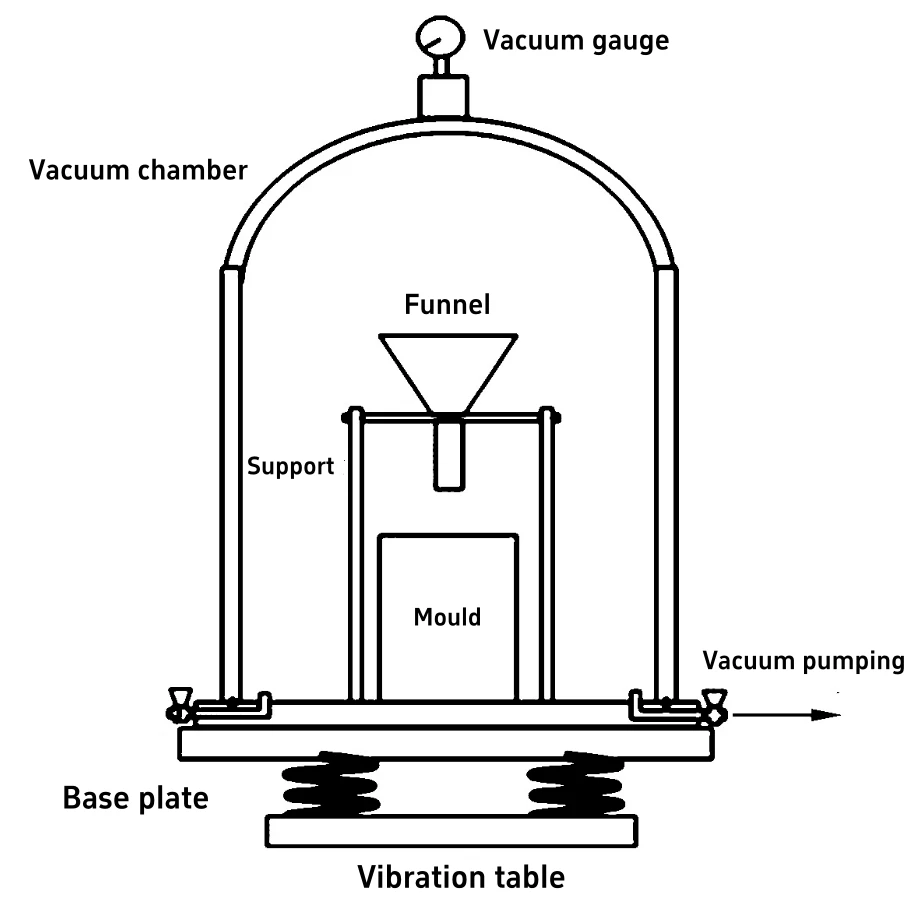
Figure 1 Schematic diagram of vacuum vibration casting device
1.2 Performance Test
Bulk density and apparent porosity of specimens were tested in accordance with GB/T 2997-2000. The cold modulus of rupture and cold crushing strength were measured according to GB/T 3001-2000 and GB/T 5072-2008, respectively. The hot modulus of rupture (soaked at 1400 ℃ for 0.5 h) was determined following GB/T 3002-2004. Thermal conductivity was tested per GB/T 5990-2006, and thermal expansion coefficient was measured in accordance with GB/T 7320.1-2000. The microstructure of fractured surfaces of specimens was observed using a scanning electron microscope (Phenom XL, the Netherlands).
A thermal shock resistance evaluation scheme combining thermal shock test and residual fracture toughness was designed for Si₃N₄-SiC refractories. The water quenching method was adopted for thermal shock test. Si₃N₄-SiC specimens were placed in a muffle furnace and held at different temperatures (1200, 1400, 1600 ℃) for 20 min. Subsequently, the specimens were quickly taken out and quenched in flowing water at 25 ℃.
Fracture toughness was tested based on GB/T 23806-2009 (single-edge pre-cracked beam method). The dimension of specimen bars was 180 mm×30 mm×15 mm, with a pre-crack depth of 15 mm, span of 150 mm, and loading rate of 0.5 mm·min⁻¹. The ratio of fracture toughness of thermally shocked specimens to that of non-shocked specimens was defined as the fracture toughness retention rate at the corresponding temperature. All test results were the average values of five specimens.
2.Results and Discussion
2.1 Conventional Properties
The conventional properties of specimens prepared by vacuum vibration casting and mechanical pressing are listed in Table 2. During the vacuum vibration casting process, the raw materials are distributed more uniformly and the internal gas is fully discharged compared with the mechanical pressing method, which is conducive to the densification of the samples. Therefore, the specimens fabricated by vacuum vibration casting exhibit a lower apparent porosity and a slightly higher bulk density. Meanwhile, compared with the mechanically pressed specimens, the cold modulus of rupture, hot modulus of rupture and cold crushing strength of the vacuum vibration cast specimens are increased by 26.0%, 24.7% and 33.2%, respectively. The thermal conductivity at room temperature is improved by 7.6%, while the thermal expansion coefficient is reduced by 13.3%. Overall, the vacuum vibration casting process endows the specimens with better comprehensive conventional properties than the mechanical pressing process.
| Item | Specimens by vacuum vibration casting | Specimens by conventional mechanical pressing |
|---|---|---|
| Apparent porosity /% | 12.3 | 13.3 |
| Bulk density /(g·cm⁻³) | 2.76 | 2.73 |
| Cold modulus of rupture /MPa | 61.4 | 48.7 |
| Hot modulus of rupture /MPa | 63.6 | 59.0 |
| Cold crushing strength /MPa | 305 | 229 |
| Thermal conductivity at room temperature /(W·m⁻¹·K⁻¹) | 19.8 | 18.4 |
| Thermal expansion coefficient ×10⁶ /℃ | 3.9 | 4.5 |
Table 2 Conventional properties of specimens
2.2 Density Distribution
Specimens (160 mm×160 mm×100 mm) fabricated by the two forming methods are shown in Figure 2. Each specimen was cut into 20 regions (marked as Region 1# to 20#) as illustrated in Figure 2, and the density distributions of the two types of specimens were compared and analyzed.
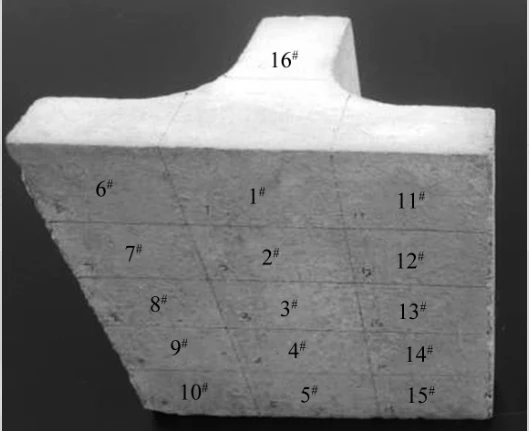
(a) Front view
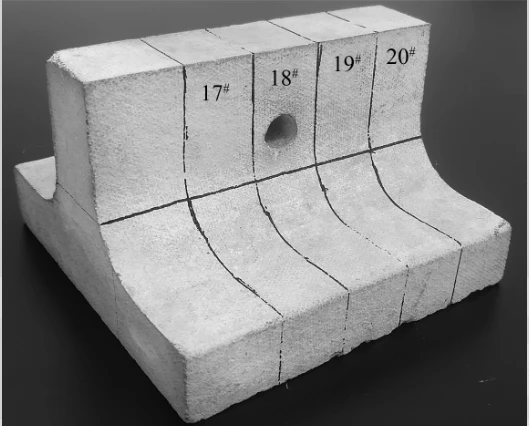
(b) Side view
Figure 2 Cutting scheme of the two specimens
The bulk density distribution of the two specimens is shown in Figure 3. As illustrated in Figure 3(a), the bulk density at different positions of the vacuum vibration cast specimen ranges from 2.68 to 2.72 g·cm⁻³ with a small difference, indicating high structural uniformity in all parts of the specimen and fewer crack source regions. Figure 3(b) shows the bulk density distribution of the mechanically pressed specimen. Its density varies from 2.52 to 2.76 g·cm⁻³. The density in the central bottom area corresponding to Region 1#–5# is obviously lower than that of the side regions represented by Region 6#–20#, which becomes the weak zone of the specimen. This leads to stress concentration in the central bottom area under abrupt temperature change, acting as the crack source. During practical service, the fracture mode of mechanically pressed specimens is that initial cracks originate from the central area and eventually propagate to cause fracture of the brick body[9], which is consistent with the analysis results of density distribution.
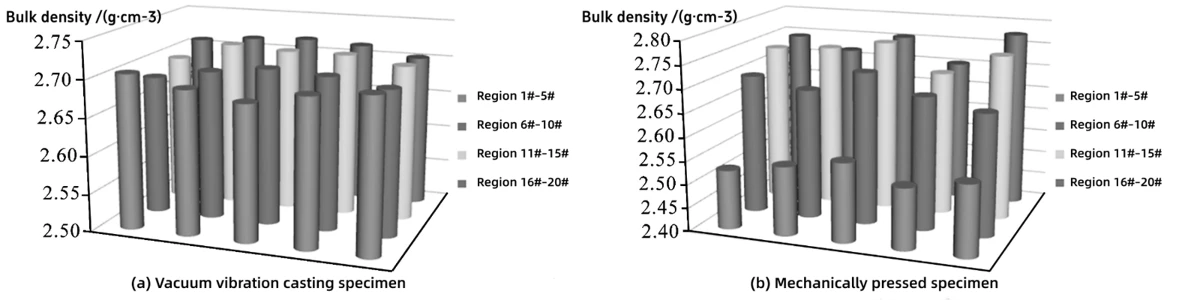
Figure 3 Bulk density distribution of 20 regions of the two specimens
2.3 Thermal Shock Resistance
The fracture toughness and retention rate of specimens before and after thermal shock are listed in Table 3. It can be seen from Table 3 that the fracture toughness of both types of specimens decreases with the increase of thermal shock temperature difference. Especially after water quenching at 1600 ℃, the decline of fracture toughness retention rate increases significantly. At this temperature, the fracture toughness retention rate of vacuum vibration cast specimen reaches 63.7%, while that of mechanically pressed specimen is only 30.8%. In addition, the data dispersion of fracture toughness for vacuum vibration cast specimens is lower than that of mechanically pressed specimens, which is more beneficial to the quality control of products in industrial production. Therefore, the vacuum vibration cast specimens possess better thermal shock resistance than mechanically pressed specimens.
| Item | Vacuum casting specimen | Mechanically pressed specimen | |
|---|---|---|---|
| Fracture toughness /(MPa·m 1/2) | Before thermal shock | 7.88±0.64 | 6.38±1.62 |
| After thermal shock at 1200 ℃ | 7.35±1.41 | 5.84±1.95 | |
| After thermal shock at 1400 ℃ | 6.39±1.66 | 4.68±3.15 | |
| After thermal shock at 1600 ℃ | 5.02±1.27 | 1.97±0.59 | |
| Retention rate /% | After thermal shock at 1200 ℃ | 93.2 | 91.5 |
| After thermal shock at 1400 ℃ | 81.1 | 73.3 | |
| After thermal shock at 1600 ℃ | 63.7 | 30.8 |
Table 3 Fracture toughness and retention rate of specimens before and after thermal shock
2.4 Fracture Surface Analysis
For Si₃N₄-SiC refractories, SiC acts as the reinforcing phase with a high mass fraction (>70%), while the Si₃N₄ phase mainly serves as the binder. When the bonding strength at the interface between the two phases is sufficiently high, transgranular fracture dominates in the SiC phase during crack propagation, consuming more fracture energy. After the thermal shock test, the specimen interfaces suffer from oxidation and thermal stress damage, which reduces the bonding strength between the two phases and increases the proportion of intergranular fracture of the SiC phase. Crack propagation in the Si₃N₄ phase consumes less fracture energy, resulting in the decrease of residual fracture toughness.
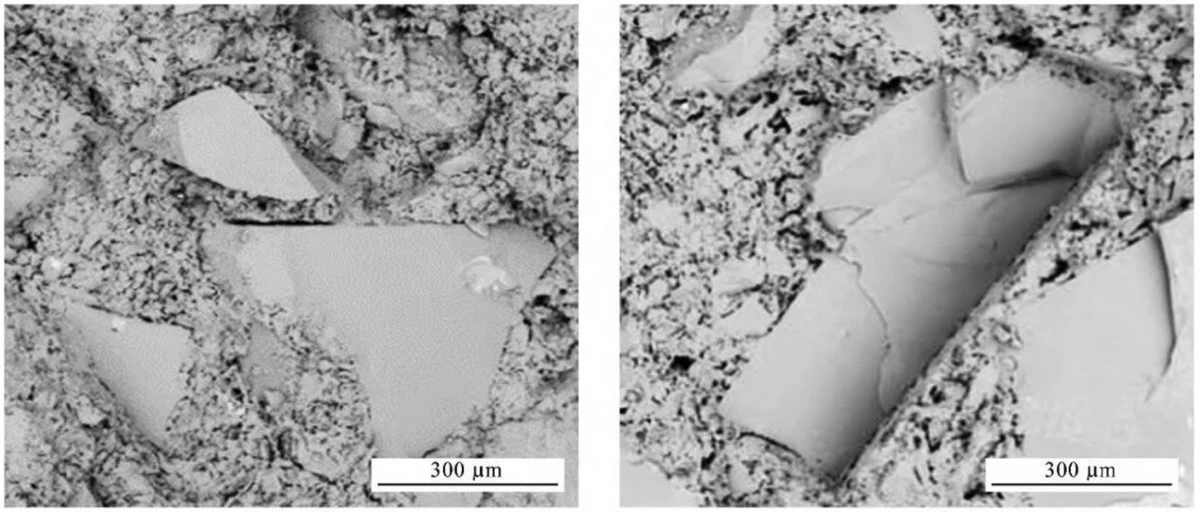
The micro-morphologies of fracture surfaces of vacuum vibration cast specimens before and after thermal shock are shown in Figure 4. The glass phase content on the fracture surface can reflect the oxidation degree of specimens. It can be observed from Figure 4 that the oxidation traces are not obvious when the thermal shock temperature is below 1400 ℃. When the thermal shock temperature reaches 1600 ℃, SiO₂ glass phase precipitates on the fracture surface and the oxidation degree of the specimen increases significantly.
The micro-morphologies of fracture surfaces of mechanically pressed specimens before and after thermal shock are presented in Figure 5. As shown in Figure 5, the oxidation degree of the specimen deepens with the rise of thermal shock temperature. After thermal shock at 1600 ℃, the mechanically pressed specimen suffers more severe oxidative corrosion, and the SiO₂ glass phase covers the entire fracture surface, indicating that the internal structure of the specimen has been seriously damaged.
(a) Before thermal shock (b) After thermal shock at 1200 ℃

(c) After thermal shock at 1400 ℃ (d) After thermal shock at 1600 ℃
Figure 4 Fracture surface morphologies of vacuum vibration cast specimens before and after thermal shock
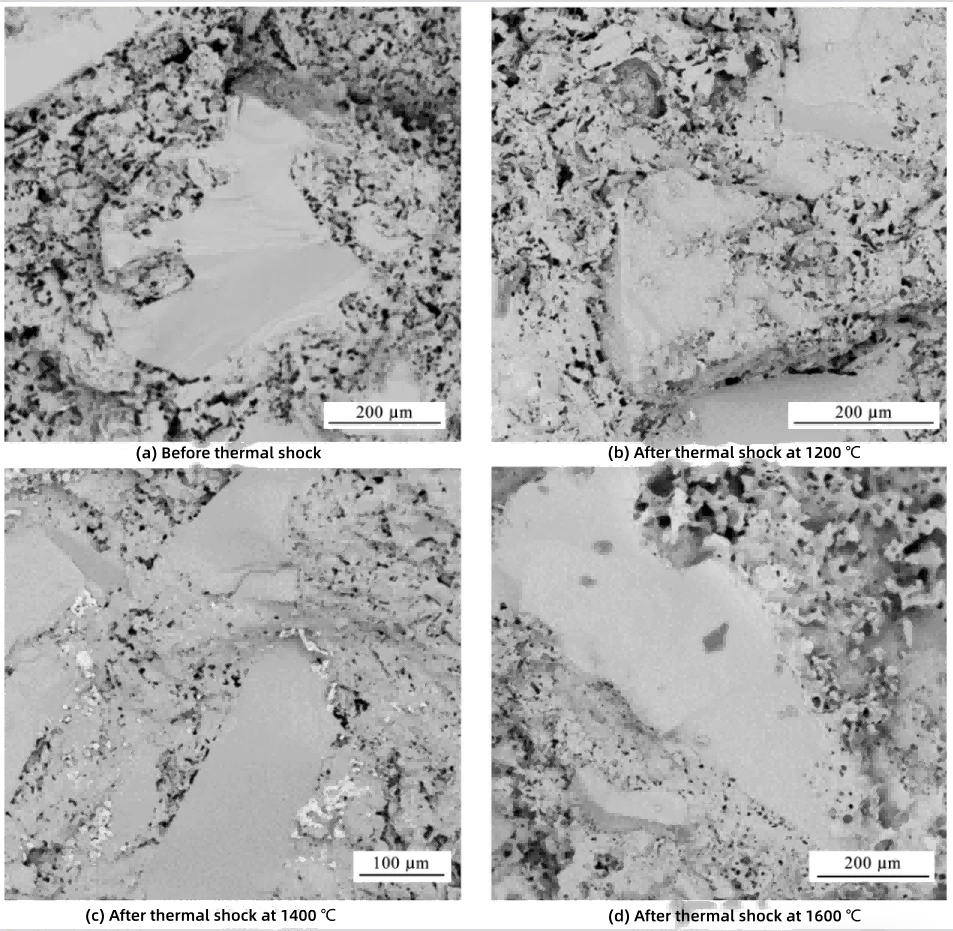
Figure 5 Fracture surface morphologies of mechanically pressed specimens before and after thermal shock
3.Conclusions
(1) Si₃N₄-SiC refractories were prepared by vacuum vibration casting forming and conventional mechanical pressing forming. The general properties of vacuum vibration cast specimens are superior to those of mechanically pressed specimens.
(2) The vacuum vibration cast specimens exhibit uniform bulk density distribution in all regions and high strength. In contrast, mechanically pressed specimens show non-uniform bulk density distribution. The density in the central bottom area is obviously lower than that on both sides, which becomes the weak zone and crack source of the product, leading to lower strength.
(3) The residual fracture toughness of both types of specimens after thermal shock decreases with the increase of thermal shock temperature. At the same thermal shock temperature, the residual fracture toughness and fracture toughness retention rate of vacuum vibration cast specimens are significantly higher than those of mechanically pressed specimens, so their thermal shock resistance is better