


Approximately 85% of magnesia refractories in China are consumed by the iron and steel industry. During steelmaking, basic magnesia refractories not only resist attack by alkaline slag but also absorb impurities from molten steel and help purify it. Consequently, in modern industrial production, the quality and performance requirements for magnesia refractories are becoming increasingly stringent. Binders for magnesia refractories determine, to a certain extent, the yield, microstructure and high-temperature performance of the products. Accordingly, the selection of single or composite additives in the production of magnesia refractories has become a key research focus. This paper reviews the basic classification of binders for magnesia refractories and their applications in both unshaped magnesia refractories and shaped magnesia refractory products.
Binders for Magnesia Refractories and Their Classification
A binder for magnesia refractories is a substance that cements refractory aggregates and fines of specified particle sizes together, developing sufficient cold bonding strength or high-temperature bonding strength; it is also called a cementing agent or bonding agent. According to its chemical nature, binders are classified into two major groups: inorganic binders (silicates, aluminates, phosphates, sulfates, chlorides, etc.) and organic binders (pitch, starch, lignosulfonates, phenolic resins, epoxy resins, etc.).
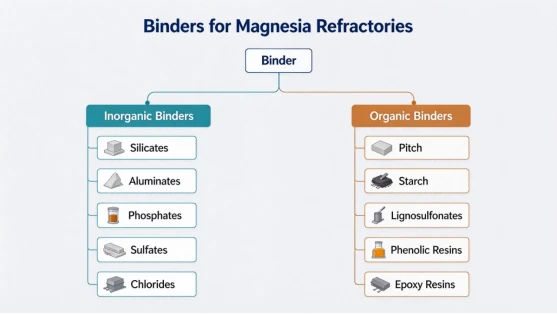
Figure Classification of binders used in magnesia refractories.
Applications of Binders in Unshaped Magnesia Refractories
2.1 In magnesia castables
Binders for magnesia castables are mainly composed of oxide micropowders combined with magnesia cement, sodium polyphosphate and the like.
It has been reported that using aluminum chloroxide as a binder for magnesia-based basic castables prevents strength degradation in the medium-temperature range and enhances the structural stability of the castable after calcination at 1,500 °C.
Studies on magnesium chloride hexahydrate, SiO2 micropowder and ρ-Al2O3 as binders for magnesia castables show that specimens bonded with SiO2 micropowder and MgCl2·6H2O exhibit higher cold compressive strength and better hydration resistance than those bonded with ρ-Al2O3; however, the compressive strength of castables bonded with MgCl2·6H2O and ρ-Al2O3 decreases markedly after heat treatment at 1,100 °C for 3 h.
Using magnesium oxychloride cement as a binder offers the advantages of no impurity introduction and good slag resistance; it also avoids the reaction with raw materials under high temperature to form low-melting phases that would damage the internal structure and impair high-temperature performance, and it significantly enhances the cold flexural strength of magnesia castables.
Investigations into brown fused alumina fines as an additive show that at an addition of 5 wt%, the specimens achieve the highest strength and best slag resistance.

Figure Microstructure of a magnesia refractory showing periclase (MgO) crystals, matrix phases and ceramic bond formed by the binder.
2.2 In magnesia dry vibrating mixes
Traditional magnesia dry vibrating mixes use phenolic resin as binder, but their baking and curing process releases NH3 and other pollutants, and resin carbonization causes carburization of molten steel. To address these problems, metasilicate has been investigated as a binder, with an additive that "melts" into the metasilicate; as the calcination temperature rises, the bonding mode shifts from adhesive bonding to ceramic bonding, resolving the environmental pollution and steel carburization issues while maintaining good bonding strength.
To meet the demand for smelting low-carbon steels, inorganic salts have been adopted as binders for magnesia dry vibrating mixes; comparison shows that a composite additive of metasilicate, phosphate and borate provides better corrosion resistance, with strength and service life both meeting operational requirements.
When fused magnesia (≤0.088 mm) is mixed with five low-temperature binders and six medium-temperature binders respectively, characterization shows that dry mixes bonded with phenolic resin, pitch and rosin exhibit higher low-temperature strength; boric acid, borax decahydrate and borate glass significantly promote high-temperature sintering and improve high-temperature strength; a rosin–borate glass binder yields a magnesia dry mix with excellent cold physical properties and environmental benefits.
Using glucose to replace phenolic resin and sodium silicate as a composite binder in magnesia dry mixes produces markedly less fume than phenolic resin alone, meeting environmental requirements.
2.3 In magnesia gunning mixes
Magnesia gunning mixes, also known as magnesia gunning refractories, have high refractoriness and good resistance to alkaline slag; commonly used binders include sodium silicate, phosphates, resins and pitch.
Using sintered and fused magnesia as main raw materials, sodium hexametaphosphate serves as both binder and dispersant; it promotes sintering and reduces water demand. Results show that at an addition of 2 wt%, the high-temperature performance and corrosion resistance are optimal.
By carefully selecting fused and sintered magnesia, optimizing particle size distribution, and adding a composite binder consisting mainly of silicate with a small amount of phosphate, a slag-line gunning mix for VOD ladles has been developed, achieving a maximum ladle life of 16 heats.
Using spent magnesia–chrome bricks from RH as raw material, sodium hexametaphosphate as binder, with added slaked lime and silica fume, a new
magnesia gunning material has been developed; at 0.2 wt% sodium hexametaphosphate, it achieves the best service performance.
For producing high-quality low-phosphorus steel, the commonly used phosphate binder was replaced by a slaked lime–silicate composite binder to prepare a phosphorus-free magnesia gunning mix for electric furnaces; at 3 wt% binder, the hardening time is optimal, with good adhesion, workability and corrosion resistance, and the highest strength, meeting the demand for clean steel production.
While research on magnesia gunning mixes is encouraging, their poor corrosion resistance and short service life remain. Magnesia–carbon gunning mixes address these problems. Using magnesia as aggregate, magnesia fines as matrix, and 5–7 wt% pitch as binder, a magnesia–carbon gunning mix with good flowability and long service life has been prepared, with service life extended by 30%. Using sintered magnesia as aggregate, fused magnesia as matrix, and a phenolic resin–pitch composite as binder, a magnesia–carbon gunning mix free of cracking or spalling after service has been produced, with an average service life exceeding 45 h. Using intermediate-grade magnesia as raw material and a phosphate–silica fume composite as binder, a magnesia gunning repair material has been successfully developed; at 4–5 wt% phosphate, it exhibits good penetration resistance, effectively extending the service life of induction furnace crucibles and enabling large-scale industrial application.

Figure Gunning repair of a steel ladle with magnesia refractory material - a typical application of magnesia gunning mixes.
2.4 In magnesia coating compounds
Magnesia coating compounds have good wear resistance, and the residual coating after service is easily peeled off from the permanent lining, enabling long service life and multi-heat continuous casting; they are applied to various thermal equipment, typically using industrial-grade sodium tripolyphosphate as binder.
Using sodium tripolyphosphate as binder for tundish coating compounds, the resulting ultra-lightweight magnesia coating plays an important role in tundish insulation and continuous casting stabilization, while reducing material consumption and cost. Using spent magnesia–chrome bricks to partially replace sintered magnesia, with CA-70 cement and silica fume as composite binders, the CA-70 cement provides rapid hardening and high strength, while silica fume improves slurry flow and workability, producing a coating compound that meets practical requirements.
Using sodium polyphosphate as binder, an erosion-resistant and corrosion-resistant magnesia tundish coating has been prepared; after hardening, sodium polyphosphate does not undergo severe dehydration, and during reaction with MgO it releases the harmful Na2O, reducing damage to high-temperature performance, and the resulting coating has good spalling resistance.
Using high-purity magnesia as aggregate and fused magnesia powder as matrix, with a composite of low-temperature and medium-temperature binders, a magnesia–calcia coating compound with excellent properties has been developed.
Using silica fume–resin as binder to replace traditional clay and cement, the resulting lightweight coating meets strength requirements while increasing viscosity and yield stress for ease of application.
2.5 In magnesia ramming mixes
Binders for magnesia ramming mixes are typically brine, phenolic resin and pitch. Using brine as binder, the prepared magnesia ramming mix can replace siliceous ramming mix; during construction it achieves rapid setting even under natural curing and exhibits good compactness. Using fused magnesia as raw material and solid phenolic resin as binder, a magnesia dry ramming mix for tundishes with excellent performance has been successfully developed; compared with magnesia coating compounds, it reduces heat loss and prevents steel shell creep.
Applications of Binders in Shaped Magnesia Refractory Products
3.1 In magnesia bricks
Magnesia brick is a basic refractory product with MgO as the main chemical component and periclase as the main crystalline phase. In production, the commonly used binders are sulfite pulp liquor and brine. Using pulp liquor as binder, sintered magnesia bricks with good thermal shock resistance have been successfully prepared; through the bonding action of sulfite pulp liquor, the bricks achieve excellent strength and thermal stability.
3.2 In magnesia–calcia bricks
Magnesia–calcia brick is a basic refractory using MgO and CaO as main raw materials, with the function of purifying molten steel; however, its hydration resistance is poor. Therefore, water-free binders with high carbon content should be selected, typically anhydrous resin or paraffin wax. Using magnesia–calcia sand and sintered magnesia as raw materials, a water-resistant agent K-96, anhydrous resin and sodium hexametaphosphate mixed in proportion as a new binder, magnesia–calcia bricks with ideal comprehensive properties have been prepared. Using paraffin wax and 3 wt% magnesium titanate as binders added to sintered magnesia–calcia sand and high-calcium fused magnesia, low-cost magnesia–calcia bricks have been prepared; increasing the CaO/SiO2 ratio promotes the formation of high-melting compounds, thereby improving high-temperature performance and corrosion resistance. Using dolomite sand, fused magnesia–calcia sand and fused magnesia as raw material, with anhydrous resin of 84 wt% solid content as binder and carbon content ≤42%, unfired magnesia–calcia bricks containing 25–35 wt% CaO have been produced; these perform well in ladle bottom working lining, preventing cracking and steel penetration.
3.3 In magnesia–alumina spinel bricks
Traditional cement kiln transition zones and sleeve kiln arch bridges often use magnesia–chrome bricks, but chrome-containing refractories have poor corrosion resistance; magnesia–alumina spinel bricks offer excellent corrosion resistance and are commonly used as substitutes. Commonly used binders are pulp liquor or brine. Using high-purity magnesia, fused magnesia and fused spinel as main raw materials, with maltodextrin as binder, a periclase–spinel brick has been prepared; under the bonding action of maltodextrin, the spinel phase is uniformly distributed, facilitating improved high-temperature performance. Using fused spinel, fused magnesia, intermediate-grade magnesia and α-Al2O3 as raw materials, with sulfite pulp liquor as binder, a new magnesia–alumina spinel brick for sleeve lime kilns has been developed through forming and firing.
3.4 In forsterite bricks
Forsterite brick is a refractory made from olivine rock (calcined or uncalcined) or calcined serpentinite, with low thermal conductivity and good chemical stability, showing great potential for lightweight insulating refractories. Selecting an appropriate binder is therefore critical. To develop basic refractories for glass furnaces, magnesia olivine sand and magnesia were used as main raw materials; three binders - MgCl2·6H2O, sulfite pulp liquor and QH - were compared, and results show that 7.5 wt% QH produces excellent lightweight forsterite bricks for glass furnaces. Another study compared carboxymethyl cellulose, silica sol and MgCl2·6H2O; when MgCl2·6H2O is used, the lightweight forsterite brick achieves a bulk density of 1.15 g/cm3 and a compressive strength of 3.58 MPa.
3.5 In magnesia–carbon bricks
Magnesia–carbon bricks are widely used in iron and steel metallurgy due to their excellent performance; binder properties significantly affect high-temperature performance, and modification of the commonly used phenolic resin binder has been a key research focus in recent years.
Experiments on the phenolic resin addition level for regenerated magnesia–carbon bricks from ladle slag lines show that the optimal addition is 3.5–4 wt%. Using a phenolic resin–pitch blend as binder for magnesia–carbon bricks, the effect of mixing ratio on residual carbon yield was investigated; as pitch content increases, residual carbon content rises, but pitch causes environmental pollution.
Researchers have therefore sought to improve residual carbon yield through phenolic resin modification. Using a sol–gel and in-situ growth method, a novel nano-SiO2 modified phenolic resin has been developed for magnesia–carbon bricks; adding organosilicon to phenolic resin creates a network structure that cross-links with the resin, giving the bricks good high-temperature performance.
Directly incorporating nickel oxide into phenolic resin reduces it to metallic nickel during resin decomposition, which then precipitates slowly in whisker-like and flaky forms, optimizing the properties and structure of pyrolytic carbon, though its dispersion efficiency is low. Transition metal (Fe, Co, Ni) sol precursors have been used to blend with phenolic resin to improve dispersion; the modified phenolic resin binder significantly improves oxidation resistance, thermal shock stability and compressive strength of magnesia–carbon bricks.
Conclusion
With the continuous advancement of industrial production in China, the demand for magnesia refractories is growing. Although a wide range of binders is available, the ultimate goal is to achieve long service life, environmental friendliness and low cost. The following recommendations are proposed:
(1) Most inorganic binders contain harmful impurities (e.g., CaO, Na2O, K2O) that degrade high-temperature performance. To avoid this, binder purity and melting point should be improved and impurity content minimized. The wettability and adhesion between binder and magnesia raw materials should also be considered, avoiding aggressive flash-setting reactions.
(2) Composite binders or newly formulated binders should be used more widely, transitioning the bonding mechanism of unshaped magnesia refractories from hydraulic/chemical bonding to ceramic bonding, so that uniform strength is achieved across all temperature ranges.
(3) For organic binders, bonding strength, cost and environmental pollution are limiting factors, especially under the "low-carbon" initiative in refractories. New environmentally friendly binders beyond pitch and phenolic resin should therefore be continuously developed.