



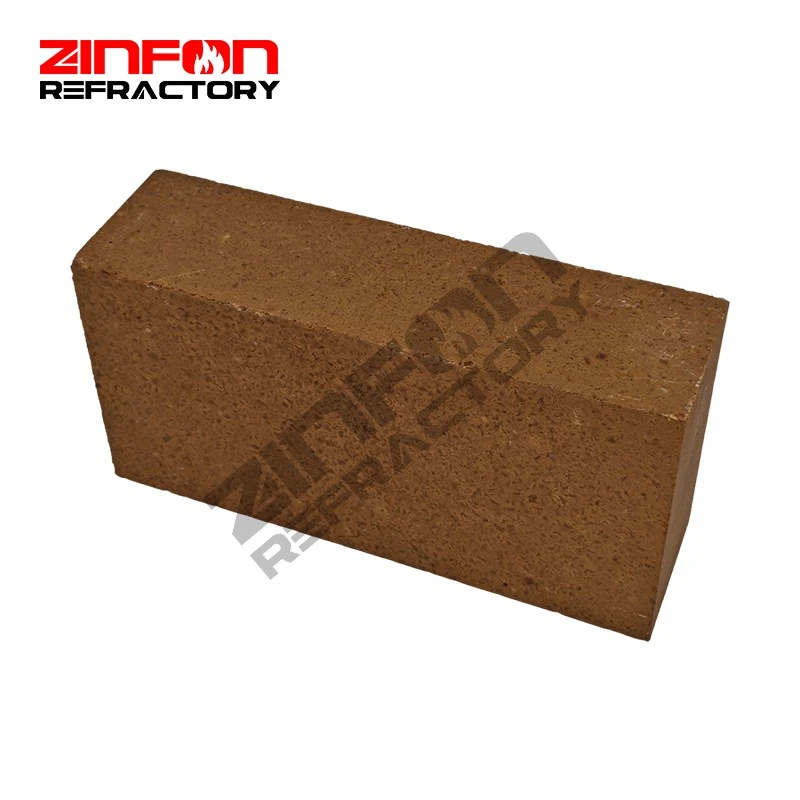


Magnesia brick is a basic refractory material with periclase as the main crystalline phase. It uses magnesite as the primary raw material. After the magnesite is calcined at high temperature to produce magnesia clinker, binders are added for shaping, followed by final firing.
Magnesia bricks feature extremely high refractoriness, excellent resistance to alkaline slag erosion, and high refractoriness under load. They serve as important lining materials for high-temperature industries including metallurgy, building materials, and chemical engineering.
However, magnesia bricks have relatively poor thermal shock resistance. They are suitable for continuously operated kilns with stable temperatures and are not recommended for high-temperature equipment with intermittent operation, frequent start-up and shutdown, or large temperature fluctuations.


ZINFON Magnesia Brick Classification
(1) Classification by Bonding Method: Fired Magnesia Bricks and Unfired Magnesia Bricks
Fired magnesia bricks are refractory bricks manufactured by crushing, batching, mixing, and shaping magnesite raw materials, followed by high-temperature firing at 1,550–1,600°C. High-purity products are generally fired at temperatures above 1,750°C. This process promotes direct bonding and the grain growth of periclase crystals, reduces the adverse effects of the silicate glass phase, and thereby achieves excellent high-temperature performance.
Unfired magnesia bricks, also known as chemically bonded magnesia bricks, are formed and dried at low temperatures using binders such as brine, sulfite spent liquor, or organic resins, without high-temperature firing. They feature short production cycles and low energy consumption; however, their strength is generally lower than that of fired magnesia bricks.
(2) Classification by Purity and Raw Materials: Standard Magnesia Bricks, Medium- and High-Grade Magnesia Bricks, High-Purity Magnesia Bricks (Direct-Bonded Magnesia Bricks), and Fused Magnesia Bricks (Rebonded Magnesia Bricks)
Standard magnesia bricks are manufactured from ordinary sintered magnesia clinker and are commonly referred to as fired magnesia bricks, or simply magnesia bricks. The MgO content generally ranges from 85% to 92%.
| Item | Main Chemical Composition (%) |
Apparent Porosity(%) ≤ |
Bulk Density (g/cm³) ≥ |
Cold Crushing Strength (MPa) ≥ |
Refractoriness Under Load (0.2MPa)Onset Temperature (℃) ≥ |
||
| MgO ≥ | SiO₂ ≤ | CaO ≤ | |||||
| ZFMZ-89 | 89 | - | 2.5 | 18 | 2.90 | 50 | 1480 |
| ZFMZ-90 | 90 | - | 2.5 | 18 | 2.90 | 50 | 1520 |
| ZFMZ-92 | 92 | 3.0 | 2.0 | 18 | 2.92 | 50 | 1550 |
| ZFMZ-93 | 93 | 2.5 | 2.0 | 18 | 2.92 | 50 | 1560 |
Medium & High Grade Magnesia Bricks: The firing temperature for high-grade magnesia bricks is below 1750 ℃.
| Item | Main Chemical Composition (%) |
Apparent Porosity(%) ≤ |
Bulk Density (g/cm³) ≥ |
Cold Crushing Strength (MPa) ≥ |
Refractoriness Under Load (0.2MPa)Onset Temperature (℃) ≥ |
||
| MgO ≥ | SiO₂ ≤ | CaO ≤ | |||||
| ZFMZ-94A | 94 | 2.0 | 2.0 | 18 | 2.95 | 50 | 1620 |
| ZFMZ-94B | 94 | 2.0 | 2.0 | 18 | 2.95 | 50 | 1620 |
| ZFMZ-95 | 95 | 2.0 | 2.0 | 18 | 2.95 | 50 | 1620 |
| ZFMZ-96 | 96 | 1.0 | 2.0 | 18 | 2.96 | 50 | 1680 |
| ZFMZ-98-1 | 97 | 0.8 | 0.6 | 16 | 3.00 | 60 | 1700 |
| ZFMZ-98-2 | 95 | 0.8 | 2.0 | 16 | 3.00 | 60 | 1700 |
| ZFMZ-97 | 97 | 0.8 | 1.0 | 17 | 2.98 | 60 | 1700 |
High-purity magnesia bricks are manufactured from high-purity magnesia clinker (MgO > 96%) through processes such as two-stage calcination. They feature superior slag resistance, excellent high-temperature performance, and strong hydration resistance. They are mainly used in critical areas of steelmaking furnaces and in the checker chambers of glass furnace regenerators.
| Item | ZFMZ-97 | ZFMZ-95 | ZFMZ-92 |
| MgO (%) ≥ | 97 | 95 | 92 |
| CaO (%) ≤ | 1.2 | 1.5 | 2.0 |
| SiO₂ (%) ≤ | 0.6 | 2.0 | 3.0 |
| Fe₂O₃ (%) ≤ | 0.8 | 1.0 | 1.0 |
| Bulk Density (g/cm³) ≥ | 2.96 | 2.95 | 2.92 |
| Apparent Porosity (%) ≤ | 17 | 17 | 17 |
| Cold Crushing Strength (MPa) ≥ | 50 | 50 | 50 |
| Refractoriness Under Load (0.2MPa) Onset Temperature (℃) ≥ | 1700 | 1650 | 1650 |
| Thermal Shock Stability (1100℃, Air Cooling) ≥ | 4 | 4 | 4 |
Fused magnesia bricks are made from fused magnesia clinker and are therefore also referred to as rebonded magnesia bricks.
| Item | ZFDMZ-98A | ZFDMZ-98B | ZFDMZ-97 | ZFDMZ-96 |
| MgO (%) ≥ | 97.8 | 97.5 | 97 | 96 |
| CaO (%) ≤ | 1.2 | 1.2 | 1.2 | 1.5 |
| SiO₂ (%) ≤ | 0.5 | 0.6 | 0.8 | 1.2 |
| Fe₂O₃ (%) ≤ | 0.7 | 0.7 | 0.8 | 0.8 |
| Bulk Density (g/cm³) ≥ | 3.15 | 3.10 | 3.10 | 2.97 |
| Apparent Porosity (%) ≤ | 15 | 15 | 15 | 15 |
| Cold Crushing Strength (MPa) ≥ | 60 | 60 | 60 | 60 |
| Refractoriness Under Load (0.2MPa) Onset Temperature (℃) ≥ | 1700 | 1700 | 1700 | 1700 |
| Thermal Shock Stability (1100℃, Air Cooling) ≥ | 3 | 3 | 3 | 3 |
ZINFON Supports Full-Spec Customization of Magnesia Bricks

We provide customized solutions for standard magnesia bricks, non-standard sizes, and special-shaped magnesia bricks. According to customers' furnace drawings, on-site operating conditions, and masonry requirements, we can precisely tailor custom dimensions and shapes to meet the lining construction requirements of various industrial furnaces. This effectively solves problems such as poor fitting of standard bricks, large masonry gaps, and insufficient adaptability to different furnace structures.
application
Iron and Steel Metallurgy Industry (Core Application Area): Widely used as refractory linings for the working linings and hearths of steelmaking converters and AC electric arc furnaces, as well as for critical lining areas of open-hearth furnaces. They maintain a stable lining barrier during long-term service under continuous erosion by high-temperature molten steel and alkaline steel slag.

Glass Industry (Long-Service-Life Protection for Regenerators): Widely used in the high-temperature zones of regenerators in large-capacity float glass melting furnaces. Offering excellent resistance to alkaline dust erosion and corrosion by high-temperature volatile gases, it maintains the structural integrity of regenerator checker systems during long-term operation.

Non-Ferrous Metal Smelting: Widely used in the critical bath areas and below-slag-line sections of reverberatory furnaces and flash furnaces for smelting copper, aluminum, lead, nickel, and other non-ferrous metals. It effectively resists severe chemical penetration by high-temperature non-ferrous metal melts and complex slags.

ZINFON Magnesia Bricks – Unsuitable Application Scenarios
Steelmaking Converter Linings and Slag Line Areas of Ladles
Each ladle contains molten steel at approximately 1600°C. After tapping, the lining cools rapidly when exposed to air, resulting in repeated thermal cycling. Ordinary magnesia bricks are prone to severe spalling within a short service period under such conditions.
Magnesia-carbon bricks are widely used as an alternative in this application.
Intermittently Operated Vacuum Refining Furnaces and Bath Areas of Small Electric Arc Furnaces with Frequent Start-Stop Cycles
Intermittent operation results in frequent heating and cooling cycles with large temperature fluctuations, which can easily cause cracking of magnesia bricks.
Burning Zones of Cement Rotary Kilns with Frequent Kiln Startups and Shutdowns
Frequent kiln startups and shutdowns subject the lining to severe thermal shock. Under such conditions, traditional magnesia-chrome bricks generally perform better than ordinary magnesia bricks, while magnesia-spinel bricks have become the mainstream choice in modern cement rotary kilns.
Why Choose ZINFON Magnesia Refractory Bricks
1.Premium Raw Material Advantages & Stable Supply of High-Purity Materials
Our factory is located in the industrial cluster known as "China's Magnesium Capital." We select high-grade magnesia clinker to consistently produce sintered magnesia bricks with MgO contents ranging from 89% to 98%, while maintaining strict control over impurity levels.
2.Full In-house Production with Strict Process Control
Automatic batching, high-pressure forming, and temperature-controlled tunnel kiln firing are adopted. Integrated management from raw materials to finished products ensures minimal variation in physical and chemical properties between batches.
3.Professional Refractory Technical Team & Operating Condition Solutions
We have extensive experience in applications such as steel reheating furnaces, lime kilns, and electric arc furnace (EAF) permanent linings. Suitable magnesia brick grades can be recommended based on your furnace temperature, slag conditions, and operating requirements.
4.Customized Sizes & Grade-Based Production Available
Standard bricks are kept in stock. We also undertake orders for various special-shaped magnesia bricks. Products with customized MgO grades can be manufactured according to your technical requirements.
5.Rigorous Pre-delivery Inspection & Complete Documentation
Each batch is supplied with complete physical and chemical test reports. Third-party inspections are accepted to meet the requirements of overseas project bidding and long-term procurement programs.

Hot Tags: magnesia refractory brick, China magnesia refractory brick manufacturers, suppliers, factory, magnesia brick making, magnesia brick for glass industry, magnesia refractories, magnesia brick for chemical industry, Magnesia Carbon Brick for Steel Ladle Furnace, magnesium oxide material