


|
55 – 65% MgO content |
12 – 18% Cr₂O₃ content |
≥ 2.65 – 2.80 g/cm³ Bulk density |
≥ 1450 – 1550 °C RUL 0.2 MPa |
1650 – 1750 °C Max. service temp. |
None Free water added |
Magnesia-chrome ramming mass is an alkaline monolithic (unshaped) refractory. It is batched from sintered magnesia, fused magnesia and chromite / pre-reacted magnesia-chrome spinel as aggregate and fines, combined with a composite binder and a sintering aid.
The mix is supplied dry or near-dry. Nothing is added at the job site: the material is compacted directly with hand tools or pneumatic rammers until the layer is dense, then heated up and sintered in service.
After the first heat-up the compacted layer forms a periclase – magnesia-chrome spinel structure. That structure is the whole point of the product: it is what carries sustained contact with strongly basic slag together with mechanical wear.
Grade chemistry, grading size and recipe are adjusted to the furnace, the lining zone and the target campaign life after a technical review with our engineers.
Core Characteristics - and Why They Matter
1. Dense after ramming - shallow slag penetration
Ramming compacts the layer to a lower porosity than the same chemistry reaches when it is cast. The periclase – spinel matrix is also poorly wetted by basic slag. Against a magnesia-chrome castable of comparable chemistry, the rammed layer lets slag penetrate less deeply, so the working face erodes instead of being destroyed from behind.
2. Volume stability under load
Refractoriness-under-load starts at 1450 °C (0.2 MPa) across the grade range. Under long-term load the lining does not swell or creep into the working space, so furnace geometry and clearance are kept.
3. Resistance to wash and impact
The compacted, interlocked grain structure resists the abrasive action of moving molten metal, slag and charge - the wear mode that removes linings in launders and converter bottoms.
4. Tolerates thermal cycling
Start-stop operation, tapping and charging repeatedly expand and contract the lining. The rammed structure absorbs this movement instead of developing the through-cracks typical of a rigid brick lining in the same zone.
5. Almost no free water - safer dry-out
Because the mix is supplied dry or near-dry, there is little free water to flash during heat-up. Thick sections can be dried without the steam spalling risk that a castable of the same thickness carries, and the dry-out schedule is shorter.
Application Areas
Non-ferrous metallurgy - primary application
Copper, nickel and lead smelting: flash smelting furnace settler and slag line, converter bottom and walls, slag fuming furnace, shaft furnace hearth lining, slag notch and matte / slag launders.
Iron and steel
AOD and VOD converter bottoms, ladle slag line, electric arc furnace hearth bottom and heavily eroded banks, tapping spouts and runners.
Selection factors we review before quoting
Working temperature; furnace atmosphere; slag and dust chemistry; abrasion; thermal cycling; installation method (ramming vs. vibration); and how the monolithic layer connects to the existing brick or castable lining.

Non-ferrous smelting furnace - slag line and bath zones

Molten iron handling - bottoms, launders and slag lines
What It Solves in Each Zone
Furnace bottoms - AOD / VOD, copper converters, submerged-arc furnaces
A bottom sees static melt and slag for the whole campaign plus metal movement at every tap. A dense, low-porosity rammed layer resists slag penetration and creep, which keeps melt away from the shell (the breakout scenario) and stretches bottom campaign life.
Slag lines - ladles and non-ferrous smelting furnaces
The slag line is the only zone under continuous slag attack. The low-porosity, spinel-bearing structure slows the corrosion rate, which is what decides whether the rest of the lining outlives the slag line or not.
Slag notches and melt launders
Here the failure mode is wash-out and impact, not chemical attack. A rammed monolithic lining has no brick joints to open up, and localised damage can be cut back and re-rammed in layers without a full rebuild - repair stops stay short.
Technical Data
|
Item |
MC-65 |
MC-60 |
MC-55 |
Unit |
|
MgO, min |
65 |
60 |
55 |
% |
|
Cr₂O₃, min |
12 |
16 |
18 |
% |
|
SiO₂, max |
3.0 |
2.5 |
2.0 |
% |
|
Bulk density, 110 °C dried |
≥ 2.65 |
≥ 2.70 |
≥ 2.80 |
g/cm³ |
|
Refractoriness under load, 0.2 MPa |
≥ 1450 |
≥ 1500 |
≥ 1550 |
°C |
|
Maximum service temperature |
1650 |
1700 |
1750 |
°C |
How to read the grade table
Within this range, raising Cr₂O₃ raises bulk density and refractoriness-under-load, and improves resistance to basic slag - at a higher raw-material cost. In practice: MC-55 / MC-60 go to slag-line and bath zones where corrosion decides the campaign; MC-65 goes to bottom and backup zones where the load is mechanical and cost per tonne matters more.
Values above are typical values for the fired and dried lining, not guaranteed minimums. Guarantee values, sampling plan and test standards are fixed in the technical agreement for each order.
Grades, Packaging & Customisation
Supply form
Supplied dry, ready to ram. Maximum grain size and grading curve are set per zone and per section thickness and confirmed at order stage.
Packaging
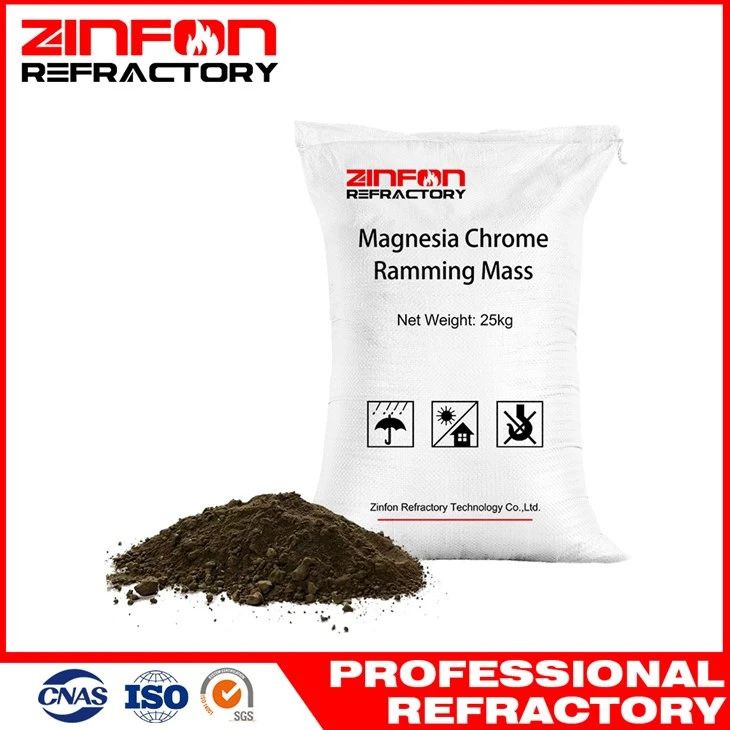
Standard options: 25kg woven bags, then loaded into 1000kg FIBC (jumbo bag) for sea freight. Alternative packing methods can be negotiated.
Samples and MOQ
Sample quantity and minimum order quantity are confirmed case by case with our sales team, depending on grade and destination.
Custom grades
For a tailored formulation, provide: furnace type, lining zone, working temperature, dominant failure mechanism, current lining material and target campaign life. Our engineers review these and propose a grade with test data.
Quality documentation
Every batch is checked for chemical composition and key physical properties before dispatch, and a test report travels with the goods. Third-party inspection at loading can be arranged where the contract requires it.
Share your equipment type, application zone, working conditions, required dimensions and annual/one-time quantity. ZINFON can review the information and recommend a suitable grade for quotation.
Hot Tags: magnesia-chrome ramming mass, China magnesia-chrome ramming mass manufacturers, suppliers, factory