


Al2O3-SiO2 Raw Materials
Your Professional Aluminum Silicon Supplier!
Zinfon Refractory Technology Co.,Ltd is a comprehensive enterprise integrating R&D, design, production, sales, and service, and is one of the world's large-scale production bases for magnesium refractory materials. the products cover all kinds of alumina refractories, including: high alumina series, mullite series, siliceous series, phosphate series, lightweight heat preservation series and other stereotyped products; castables, self-flowing materials, malleable materials, prefabricated blocks and other non-stereotyped products, as well as all kinds of refractory raw materials and chemical products.
-
![Dense Fused Alumina]() Dense Fused AluminaDense Fused Alumina is a high-grade refractory material produced by melting high-purity alumina with a certain proportion of reducing agent in an electric arc furnace.read more
Dense Fused AluminaDense Fused Alumina is a high-grade refractory material produced by melting high-purity alumina with a certain proportion of reducing agent in an electric arc furnace.read more -
![Brown Fused Alumina]() Brown Fused AluminaBrown Fused Alumina is made from high-quality abrasive-grade bauxite as the raw material, combined with auxiliary additives, and refined in an electric arc furnace at temperatures above 2250°C. It...read more
Brown Fused AluminaBrown Fused Alumina is made from high-quality abrasive-grade bauxite as the raw material, combined with auxiliary additives, and refined in an electric arc furnace at temperatures above 2250°C. It...read more -
![White Fused Alumina]() White Fused AluminaWhite Fused Alumina is produced from high-quality alumina powder as the raw material through smelting at a high temperature of 2050 ℃. It features high purity, good self-sharpening ability, low...read more
White Fused AluminaWhite Fused Alumina is produced from high-quality alumina powder as the raw material through smelting at a high temperature of 2050 ℃. It features high purity, good self-sharpening ability, low...read more -
![Tabular Alumina]() Tabular AluminaTabular alumina is a pure, additive-free sintered alumina with a coarse-grained, well-developed α-Al₂O₃ crystal structure. Under SEM, it exhibits a plate-like crystalline structure,...read more
Tabular AluminaTabular alumina is a pure, additive-free sintered alumina with a coarse-grained, well-developed α-Al₂O₃ crystal structure. Under SEM, it exhibits a plate-like crystalline structure,...read more -
![Light Sintered Mullite]() Light Sintered MulliteLight Sintered Mullite is widely used in industrial and specialized applications due to its low density, high refractoriness, good thermal insulation, and excellent resistance to thermal shock.read more
Light Sintered MulliteLight Sintered Mullite is widely used in industrial and specialized applications due to its low density, high refractoriness, good thermal insulation, and excellent resistance to thermal shock.read more -
![Sillimanite]() SillimaniteSillimanite is a non-metallic mineral material with high thermal stability, resistance to deformation, and slag resistance. It is widely used in high-grade refractories, acid-resistant materials,...read more
SillimaniteSillimanite is a non-metallic mineral material with high thermal stability, resistance to deformation, and slag resistance. It is widely used in high-grade refractories, acid-resistant materials,...read more -
![Cordierite]() CordieriteCordierite is a silicate mineral that is primarily used in the petrochemical industry, metallurgy, iron and steel, glass, cement, and kiln-building materials industries.read more
CordieriteCordierite is a silicate mineral that is primarily used in the petrochemical industry, metallurgy, iron and steel, glass, cement, and kiln-building materials industries.read more -
![Andalusite]() AndalusiteAndalusite is a natural, high-quality, energy-saving, high-alumina refractory mineral raw material, mainly used in the production of refractory materials for iron and steel metallurgy.read more
AndalusiteAndalusite is a natural, high-quality, energy-saving, high-alumina refractory mineral raw material, mainly used in the production of refractory materials for iron and steel metallurgy.read more -
![Mullite]()
-
![Kyanite]()
-
![Homogenized Bauxite]() Homogenized BauxiteHomogeneous bauxite, often also referred to as homogenized bauxite, refers to the specific homogenization process to achieve uniformity and consistency of bauxite in terms of chemical composition,...read more
Homogenized BauxiteHomogeneous bauxite, often also referred to as homogenized bauxite, refers to the specific homogenization process to achieve uniformity and consistency of bauxite in terms of chemical composition,...read more -
![Bauxite]()


Why Choose Us
Rich Experience
With more than 20 years of experience, the company has its own R&D team and has supplied products to many traders.
Production Capacity
We have invested in two production lines equipped with 120-meter ultra-high-temperature tunnel kilns and a fully automatic crushing and grinding workshop for raw materials. With more than 100 employees, we achieve an annual output of 100,000 tons of various refractory products.
Our Qualification
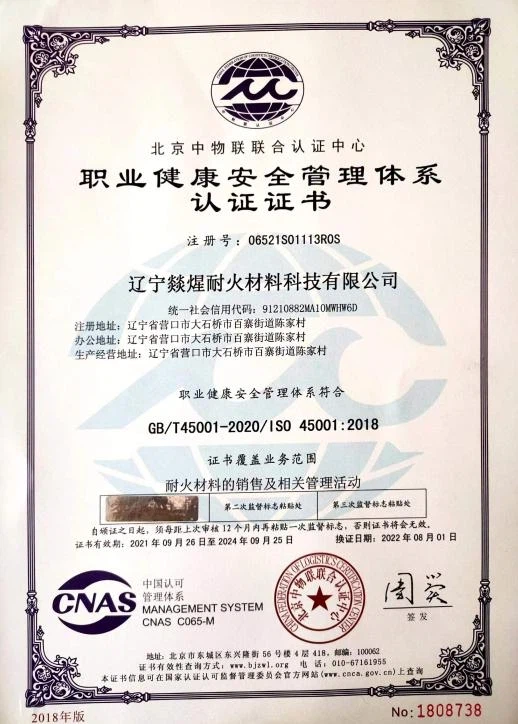
We have passed through ISO9001, ISO14001, ISO45001 cerifications, as well as other national and local qualificaitons, such as Reliable Quality & Service Certification and Enterprises Credit Eveluation Cerfitification.
Product Specification
We provide the Sillimanite specifications:
|
Detection Items |
Detection Results |
|
Al₂O₃(%) |
60.9 |
|
SiO₂(%) |
37.05 |
|
Product Specific Gravity |
3.24 |
|
Refractoriness |
1850℃ |
|
Service Temperature |
<1700℃ |
|
Mohs Hardness |
7.5 |
Common types
High-alumina refractories: These refractories are quite common in the aluminium industry. This is mainly because of their easy availability and enhanced thermal insulation properties.High alumina contains around 50-99% alumina. They can easily protect the furnaces from high temperatures, chemical attacks, and abrasion. High alumina also offers excellent thermal conductivity. It can protect the furnace from cryolite attack.
Silicon carbide refractories: Silicon carbides are used to line the holding furnaces and crucibles. They offer excellent thermal resistance and high protection against abrasion and oxidation. The material also has high mechanical strength and chemical inertness. These refractories are produced from raw silicon carbide, which is synthesised at temperatures exceeding 2500°C through the reaction of silica with carbon.
Mullite refractories: These are formed by the reaction of alumina and silica and offer good resistance to thermal shock and chemical corrosion. They have outstanding thermo- mechanical properties and a high stability level, making them appropriate for lining the ladles and furnaces. Mullite refractories have a high melting point of 1,840 °C.
Magnesia refractories: These are made from magnesia, graphite, antioxidants, and resin. They are primarily used in lining casting furnaces and ladles. They offer good thermal resistance to molten aluminium and slag but have poor thermal shock resistance. Magnesia refractories are also quite well-known for their high corrosion resistance properties.
Product features

-
High-Temperature Resistance
Can withstand extreme heat without significant degradation.
-
Thermal Insulation
Helps to maintain desired temperatures by minimizing heat loss.
-
Corrosion Resistance
Protects against the corrosive effects of molten metals, slags, and other reactive substances.
-
Mechanical Strength
Provides structural support and resistance to wear and abrasion.
Application
Iron and Steel Industry
Used in blast furnace hot-blast stove linings, steel ladle insulation, and as refractory baffles in the tundish of continuous casting machines. It resists erosion by molten iron while reducing heat dissipation.
Petrochemical and Coal Chemical Industries
Applied as high-temperature linings in catalytic cracking units (1100–1400 °C), offering resistance to oil and gas corrosion. Also used as insulating bricks in coal gasifiers, helping to reduce equipment weight and enhance operational safety.
Process of Light Sintered Mullite
Main materials: High-alumina bauxite, industrial alumina, silica, etc., proportioned according to the mullite composition (Al₂O₃:SiO₂ ≈ 3:1).
Pore-forming agents: Sawdust, starch, polystyrene spheres (EPS), magnesium carbonate, etc., which form pore spaces through high-temperature decomposition or volatilization.
Binding agents: Clay, silica sol, alumina cement, etc., used to ensure the strength of the green body during molding.
Raw material crushing → batching and mixing → addition of pore-forming agent → molding (pressing/pouring/extruding) → drying → high-temperature sintering (1450–1650 °C) → finished product.
Combustible material burnout method: Uses sawdust, starch, etc., which burn off at high temperatures to create pores. This method results in a more uniform pore size distribution and is suitable for small to medium pore sizes (10–100 μm).
Foaming method: Foam is introduced into the slurry to form interconnected pores. This method is suitable for preparing materials with high porosity (>60%).
Gas-phase method: Pores are formed by the release of CO₂ gas during the decomposition of carbonates. However, pore size control is relatively poor with this method.
Customization Process
Customized dimensions and shapes
Customized Brick Shape: Provide Sample Sheets--Mold Opening & Quotation--Mold Opening & Sample Making--Bulk Production Quotation--Contract Signing--Bulk Production.
Delivery cycle and logistics
Sea freight, land freight. Determine the mode of transportation according to the needs. About 30 days, customized products delivery time depends on the actual situation.
Customized packaging
Customize your brand: Logo customization, custom fonts, taglines and messages for packaging, signage, websites or printed materials. Take your brand to the next level, contact us today to discuss your project!
Certifications


Package & Delivery
Package: Standard export package or Customized Package.
Delivery: By air express, by sea.

FAQ
As one of the most professional aluminum silicon manufacturers and suppliers in China, we're featured by quality products and low price. Please rest assured to buy bulk customized aluminum silicon from our factory. Contact us for free sample.
silicon carbide suppliers, aluminum silicate, bauxite china