


Magnesite gunning mix is a refractory spray coating primarily composed of magnesium salts, with the addition of binders and fillers.
● Excellent high-temperature and corrosion...

Gunning Mix
Your Professional Monolythic Magnesia Refractory Supplier!
Zinfon Refractory Technology Co.,Ltd is a comprehensive enterprise integrating R&D, design, production, sales, and service, and is one of the world's large-scale production bases for magnesium refractory materials. the products cover all kinds of alumina refractories, including: high alumina series, mullite series, siliceous series, phosphate series, lightweight heat preservation series and other stereotyped products; castables, self-flowing materials, malleable materials, prefabricated blocks and other non-stereotyped products, as well as all kinds of refractory raw materials and chemical products.
Why Choose Us
Rich Experience
With more than 20 years of experience, the company has its own R&D team and has supplied products to many traders.
Production Capacity
We have invested in two production lines equipped with 120-meter ultra-high-temperature tunnel kilns and a fully automatic crushing and grinding workshop for raw materials. With more than 100 employees, we achieve an annual output of 100,000 tons of various refractory products.
Our Qualification
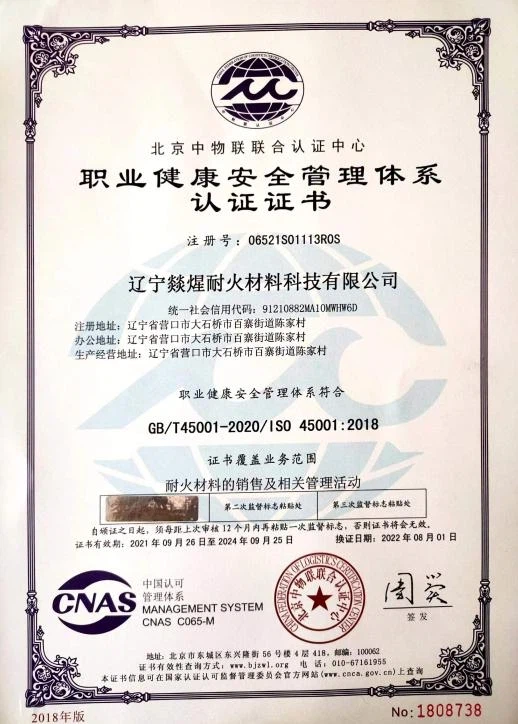
We have passed through ISO9001, ISO14001, ISO45001 cerifications, as well as other national and local qualificaitons, such as Reliable Quality & Service Certification and Enterprises Credit Eveluation Cerfitification.

Monolythic Magnesia Refractory - Overview
Monolithic magnesia refractories are a type of unshaped, or castable, refractory material primarily composed of magnesia (MgO), a basic oxide. They are used to line the interior of high-temperature industrial equipment, such as furnaces and kilns, providing a protective barrier against extreme heat and chemical attack. These materials are known for their high-temperature resistance, chemical inertness, and ability to be easily molded and shaped during installation.
Product Specification
We provide the Magnesia Ramming Mass specifications:
|
Item |
QD-1 |
QD-2 |
QD-3 |
QD-4 |
QD-5 |
|
MgO% ≥ |
80 |
76 |
88 |
90 |
58 |
|
Cr2O3% ≥ |
1 |
16 |
|||
|
CaO% |
6~9 |
12~16 |
|||
|
Fe2O3% |
3~6 |
3~6 |
4 |
||
|
SiO2% ≤ |
2.0 |
2.0 |
5.0 |
2.0 |
1.8 |
|
Grain Size(mm) |
0~6 |
0~6 |
0~5 |
0~5 |
0~5 |
|
Application |
EAF Bottom |
EAF Bottom |
Metallurgical Furnace Bottom |
Furnace Bottom/Mouth/Tap Hole |
RH Furnace Bottom |
|
Bonding Method |
Ceramic Bonding |
Ceramic Bonding |
Chemical and Ceramic Bonding |
Chemical and Ceramic Bonding |
Chemical and Ceramic Bonding |
Common types
Magnesia Ramming Mass
Magnesia ramming mix is an unshaped refractory material composed primarily of magnesia sand (MgO), supplemented with binders and additives, and compacted through manual or mechanical ramming. With a typical MgO content ≥85%, it exhibits excellent resistance to alkaline slag corrosion, making it ideal for high-temperature, strongly alkaline smelting environments.
Magnesia Gunning Mix
Magnesium-based refractory gunning material is a spray-applied refractory composed primarily of magnesium oxide (MgO, typically ≥85% content), combined with binders, additives, and aggregates. It exhibits excellent resistance to alkaline slag corrosion, making it suitable for high-temperature alkaline environments. With refractoriness usually ranging from 1500°C to 1700°C, it is widely used in areas exposed to alkaline atmospheres, such as cement kilns and glass kiln regenerators.
Advantages of Monolithic Refractories

-
Flexibility of Design
Monolithic refractories can be easily adapted to complex geometries and intricate shapes, making them suitable for a wide range of applications.
-
Ease of Installation
Monolithic refractories can be installed using various methods, such as casting, gunning, spraying, and ramming, allowing for efficient and cost-effective installation.
-
Stronger Monolithic Structure
Monolithic refractories form a continuous, seamless lining, eliminating the joints and gaps present in brickwork, which can be prone to cracking and erosion.
-
Improved Thermal Conductivity
Monolithic refractories can be engineered to achieve specific thermal conductivity properties, optimizing heat transfer and energy efficiency.
Application
Iron and Steel Metallurgy
Converters and electric furnaces: Used to repair furnace bodies and bottoms, resisting scouring by 1600–1700°C molten steel and alkaline slags.
Steel ladles: Spraying the slag line area extends service life to over 100 heats (compared to about 60 heats for traditional brick linings).
Cement and Building Materials Industry
Cement kiln firing zones: Withstands CaO-based clinker slag erosion at 1450–1600°C, replacing magnesia-chromite bricks and reducing chromium pollution.
Glass kiln regenerators: Prevents penetration of glass melt vapors and maintains heat exchange efficiency.
Non-Ferrous Metal Smelting
Nickel and copper smelting furnaces: Sprayed linings resist erosion from high-nickel slags, matte, and other strongly alkaline melts.
Mineral Composition of Magnesia Refractories
The raw materials used for the production of magnesia refractories consist essentially of the basic oxide magnesium (MgO). These raw materials are (i) chemically precipitated magnesium hydroxide, ii) the mineral magnesite, which is naturally occurring magnesium carbonate, and to a minor extent (iii) the mineral brucite, naturally occurring magnesium hydroxide. Chemically precipitated magnesium hydroxide, prepared by causing slaked lime or slaked calcined dolomite to react with magnesium-bearing brine, contains small quantities of accessory minerals derived from the limestone or dolomite, and from the brine. The natural mineral magnesite contains small quantities of accessory minerals, such as dolomite, serpentine, talc, chalcedony, and quartz. Iron carbonate, in solid solution with the magnesium carbonate, is present in several magnesites.
Raw magnesia containing materials are ‘dead-burned’ in rotary kiln or shaft kiln to prepare them for use. The dead-burning consists of a high temperature heat treatment which drives off chemically combined water and / or carbon dioxide, and converts the remaining product into dense grains or lumps resistant to atmospheric moisture and carbon dioxide. In dead-burning, additions such as iron oxide, alumina, silica, or lime can be made to achieve desired compositions.
The temperature of dead-burning varies from around 1,540 deg C to 1,850 deg C, depending upon the type and purity of the product. In the process of dead-burning, magnesia hydroxide dissociates to form magnesia and water vapour, magnesium carbonate dissociates to form magnesia and carbon dioxide gas. The water vapour and the carbon dioxide gas escape with the kiln gases. The dead-burned product, which is known commercially as ‘dead burned magnesia’ consists mainly of aggregates of periclase crystals, with a fine-grained crystalline ground mass normally composed of silicates of magnesium and to a minor extent of calcium.
The colour of dead-burned magnesia low in iron oxide varies from white to buff or tan. Dead-burned magnesia which contains several percent of iron oxide is normally chocolate-brown in colour, and its microscopic examination shows that the periclase crystals normally contain dark moss-like inclusions. These have been identified as magnesio-ferrite (MgO.Fe2O3).
The most desirable quantities of the accessory constituents, and their relative proportions, depend upon the purposes for which the product is to be used. Dead-burned magnesia used in furnace hearths in general has a higher content of accessory constituents than that used for making bricks. In recent years, ultra high purity dead-burned magnesia containing 99 % have gained wide spread use.
Customization Process
Customized dimensions and shapes
Customized Brick Shape: Provide Sample Sheets--Mold Opening & Quotation--Mold Opening & Sample Making--Bulk Production Quotation--Contract Signing--Bulk Production.
Delivery cycle and logistics
Sea freight, land freight. Determine the mode of transportation according to the needs. About 30 days, customized products delivery time depends on the actual situation.
Customized packaging
Customize your brand: Logo customization, custom fonts, taglines and messages for packaging, signage, websites or printed materials. Take your brand to the next level, contact us today to discuss your project!
Certifications


Package & Delivery
Package: Standard export package or Customized Package.
Delivery: By air express, by sea.

FAQ
As one of the most professional monolythic magnesia refractory manufacturers and suppliers in China, we're featured by quality products and low price. Please rest assured to buy bulk customized monolythic magnesia refractory from our factory. Contact us for sample.
Ramming mass for electric furnace, Magnesia Ramming Mass, Electric Furnace Gunning Mix