



Introduction
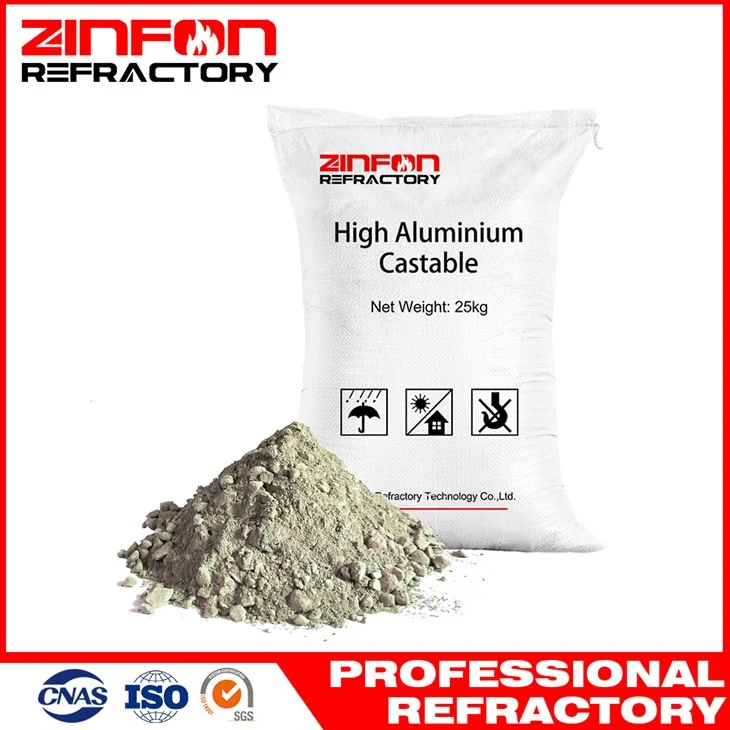
High-alumina castable is a type of monolithic refractory material formulated with high-alumina raw materials as the main component, along with a binding agent and a small amount of additives.
Its core feature is flexible construction-it can be formed into any shape through pouring, vibration, and other methods, creating a seamless refractory lining with better sealing and integrity than traditional refractory bricks. At the same time, it exhibits excellent high-temperature performance, including high strength at elevated temperatures, as well as abrasion and erosion resistance. It can withstand high-temperature environments ranging from 1200°C to 1800°C. Depending on the alumina content, it can be tailored to meet various temperature and working condition requirements.
In application, it is widely used as a lining material in high-temperature kilns across industries such as metallurgy (blast furnaces, ladles), building materials (cement rotary kilns), electric power (boiler hearths), and the chemical industry (high-temperature reaction equipment). It is an essential and critical refractory material for industrial high-temperature equipment.
Physical and Chemical Specifications
| Item | Index | |||||||
| NTJ-40 | NTJ-45 | GLJ-50 | GLJ-60 | GLJ-65 | GLJ-70 | GLJ-80 | ||
| Al₂O₃ / % ≥ | 40 | 45 | 50 | 60 | 65 | 70 | 80 | |
| Refractoriness / CN ≥ | 164 | 170 | 170 | 172 | 172 | 172 | 178 | |
| Bulk Density / (g/cm³) ≥ | 110℃×24h | 2.05 | 2.10 | 2.15 | 2.30 | 2.40 | 2.45 | 2.65 |
| Cold Modulus of Rupture / MPa ≥ | 4.0 | 4.0 | 4.0 | 5.0 | 6.0 | 6.0 | 7.0 | |
| Cold Crushing Strength / MPa ≥ | 25 | 25 | 25 | 30 | 35 | 35 | 40 | |
|
Permanent Linear Change (Test Temp. × 3h) / % |
±0.8 (1300℃) | ±0.8 (1350℃) | ±0.8 (1400℃) | ±0.8 (1500℃) | ||||
Advantage
Easy construction: The construction process of high-alumina refractory castables is relatively simple. You only need to place the mixed castable into a mold, after which it can be shaped and cured. This method greatly simplifies the operation process and improves construction efficiency.
Short construction period: Typically, the construction period for high-alumina refractory castables is short, often completed within two days. This helps shorten the project cycle and reduce construction costs.
Strong adaptability: High-alumina refractory castables can be shaped to match various hearth geometries. This strong adaptability to complex shapes gives them significant advantages in constructing furnace insulation layers with intricate designs.
Excellent high-temperature performance: With a refractoriness of ≥1700 °C and a high load softening temperature (1400–1600 °C), these castables can form ceramic bonds or mullite phases at elevated temperatures. Their strength increases with temperature-for example, compressive strength is ≥30 MPa after drying at 110 °C, and ≥50 MPa after firing at 1400 °C. The main component, aluminate, offers excellent resistance to high temperatures without expansion, cracking, or softening.
Good thermal shock resistance: Thanks to their dense structure, these castables can withstand rapid temperature changes, such as alternating heating and cooling. This ensures the stable operation of the furnace chamber.
Resistance to chemical erosion: The aluminate-based composition provides strong resistance to both acid and alkali corrosion, allowing stable operation in chemically aggressive environments.
High load-bearing capacity: The dense and stable structure enables the castables to withstand mechanical loads and vibrations without cracking or spalling, ensuring long-term, safe furnace operation.
High densification and low porosity: With low water consumption during mixing-typically around 6%–7%-the material achieves high density and low porosity.
Good volume stability: Although it is a non-fired refractory material, volume shrinkage is minimized after drying and calcination.
High strength: The material offers high curing strength at room temperature, and its strength does not decrease under medium or high-temperature treatment. In fact, its absolute strength is 3–5 times higher than that of traditional refractory castables.
Raw Materials
Aggregate: High-alumina bauxite clinker is used as both aggregate and fine powder, supplemented by corundum, mullite, and other high-grade refractory raw materials to improve the material's high-temperature strength and erosion resistance.
Binding agent: Commonly used binders include aluminate cement, sodium silicate, phosphoric acid and phosphates, and polymerized aluminum chloride. Their function is to enable the castable to set and harden after construction, forming a monolithic structure.
Additives:
– Water reducer (e.g., sodium tripolyphosphate, sodium hexametaphosphate): Improves fluidity and reduces water consumption.
– Coagulant promoter or retarder: Adjusts the setting time to meet construction requirements.
– Expansion agent (e.g., bluestone, silica): Compensates for high-temperature shrinkage and helps prevent cracking.
Application

RECOMMEND
– Al₂O₃ content: 45%–60% - Suitable for industrial kilns operating at lower temperatures (≤1200 °C), such as boilers and hot air furnaces.
– Al₂O₃ content: 60%–70% - Applicable in environments with temperatures between 1200–1400 °C, such as ceramic kilns and the heat storage chambers of glass kilns.
– Al₂O₃ content: 70%–85% - Offers high-temperature resistance up to 1400–1600 °C; commonly used in blast furnaces, rotary kiln firing zones, and other critical areas.
– Al₂O₃ content: ≥85% (mostly containing corundum) - Withstands temperatures over 1600 °C; suitable for electric arc furnaces used in steelmaking, non-ferrous metal smelting furnaces, and other extremely high-temperature environments.
Factory live shot


Construction and Maintenance Points
★ Pre-construction preparation: The mold should be cleaned and coated with a release agent. Ambient temperature should be maintained between 5–35 °C (insulation measures are required in winter).
★ Water addition ratio: Typically 6–8%. Excess water will reduce strength, while insufficient water will affect fluidity and make vibration difficult.
★ Curing process: Maintain at room temperature for 24–48 hours (for cement bonding), ensuring adequate humidity during this period.
★ Key baking stages:
– Heat to 100–150 °C to remove free water (hold for 24 hours).
– Then slowly raise the temperature to above 300 °C to remove crystalline water, and continue heating gradually to 600 °C.
Precautions:
– Strictly control the amount of water added. Too much reduces strength; too little results in poor workability.
– The baking process should be gradual to prevent rapid evaporation, which can cause structural spalling.
Why chooes us?
By choosing ZINFON as your supplier, you can access high-quality refractory bricks, a wide range of other refractory materials, and comprehensive support. Contact ZINFON Refractories immediately to discuss your specific requirements and obtain customized solutions!


7*24 hours online response
Provide professional after-sales protection
Our address
Qinghua Management Dist., Dashiqiao City, Yingkou City, Liaoning, China
Phone Number
+8613700131695
info@zinfon-refractory.com

Hot Tags: high-aluminium castables, China high-aluminium castables manufacturers, suppliers, factory, alumina castable refractory, gunning castable, low cement castable refractory, castable refractory, castable refractory adalah, furnace castable refractory