





Introduction
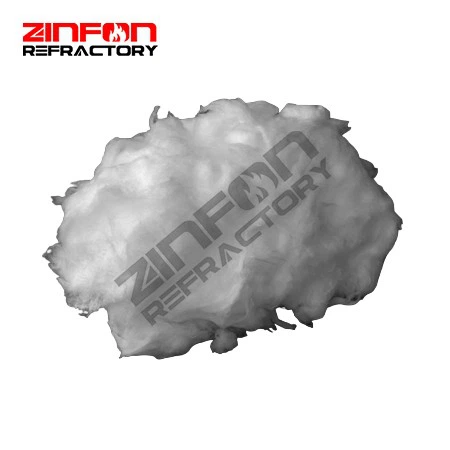
Ceramic fiber loose cotton is produced by melting high-purity raw materials-including clay clinker, alumina powder, silica powder, and chrome ore sand-in an industrial electric furnace to form a molten fluid. The melt is then blown into fibers using compressed air or spun by a centrifugal machine, collected by a fiber collector, and formed into ceramic fiber cotton. This fiber cotton can be further processed into blankets, boards, paper, cloth, ropes, and other products.
Ceramic fiber is a high-performance thermal insulation material, characterized by its lightweight, high strength, oxidation resistance, low thermal conductivity, flexibility, corrosion resistance, low heat capacity, and sound insulation properties.
Advantage
Physical Characteristics
Predominantly white in color, with precise dimensions for easy cutting, installation, and construction.
Fibers are soft, elastic, and flexible, allowing for straightforward processing.
Thermal Properties
Low heat capacity and thermal conductivity ensure excellent thermal insulation.
High refractoriness enables resistance to high temperatures, with classification temperatures ranging from 1000–1600°C across different types.
High thermal sensitivity ensures rapid response to temperature changes.
Chemical Properties
Exhibits good chemical stability, suitable for long-term use in neutral or oxidizing atmospheres.
Resistant to erosion from weak acids, weak bases, water, oil, and steam (except for reactions with strong acids and alkalis).
Excellent electrical insulation properties.
Mechanical Properties
Superior resistance to wind erosion and mechanical impact, with moderate mechanical strength.
Excellent sound absorption and fire-retardant properties.
Common Types and Specifications

Zinfon Refractory Technology Co.,Ltd.
We provide one-stop services from technical consultation to design, production, and after-sales support.


Raw Materials
High-purity raw materials include clay clinker, alumina powder, silica powder, chrome quartz sand, etc.
Physical and Chemical Specifications
|
Brand&Properties |
ZF-STD -B |
ZF-HP-B |
ZF-HZ-B |
|
|
Chemical Composition(%) |
Al₂O₃ |
≥44 |
≥45 |
≥34 |
|
SiO₂ |
≥52 |
≥54 |
≥50 |
|
|
Fe₂O₃ |
≤1.0 |
≤0.5 |
≤0.5 |
|
|
Na₂O |
≤1.0 |
≤0.2 |
≤0.2 |
|
|
ZrO₂ |
– |
– |
≥15 |
|
|
Specification Tem.(℃) |
1260 |
1260 |
1430 |
|
|
Shot content(%) |
≤15 |
≤15 |
≤12 |
|
|
Fiber Diameter(μm) |
3.5 |
|||
Process
Raw Material Proportioning → High-Temperature Melting (1500–1800°C) → Blowing/Spinning Molding → Dust Collection → Curing & Drying (150–200°C) → Loosening & Deslagging → Grading & Shaping → Quality Control & Packaging
Fiber Molding
Blow Molding (Mainstream Process)
Compressed Air Blowing:
The melt exits the furnace and is blown by high-speed compressed air (0.6–1.2MPa), tearing the liquid stream into 2–4μm diameter fibers.
Blowing angle is controlled at 30°–45° to ensure uniform fiber length (200–300mm).
Steam Blowing:
Applied to high-end products, using superheated steam (300–500°C, 0.8–1.5MPa) instead of air to minimize fiber surface damage.
Spinning Molding (for Coarse Fibers)
The melt drops onto high-speed rotating spinning rollers (3000–5000r/min) and is centrifugally spun into 5–8μm diameter fibers, used for refractory bricks and other coarse structural materials.


Application
Industrial Applications
Industrial Furnaces: Lining insulation for kilns, boilers, and heating furnaces; thermal insulation for heat equipment (e.g., steam engines, gas engines).
High-Temperature Systems: Flexible insulation for pipelines, high-temperature gaskets, and filtration media; thermal insulation for reactors.
Fire Protection: Fire-resistant insulation for industrial equipment and electrical components; heat insulation for incineration systems.
Raw Materials: Used in manufacturing modules, folded blocks, and veneer blocks.
Construction Applications
Fire Safety: Insulation for fire doors, walls, and shutters, providing heat resistance and fire retardancy.
Building Envelopes: Integrated into thermal insulation systems to improve energy efficiency.
Other Applications
Metallurgy & Casting: Linings for aluminum casting molds and gaskets for molten metal handling.
Glass Industry: Roof insulation for glass kilns and demolding aids for glass production.
Aerospace & Marine: Thermal insulation and sealing solutions for high-temperature environments.

Precautions
Storage
Store in a dry, ventilated area, protected from moisture and water. Avoid outdoor stacking.
Keep separate from strong acids and alkalis.
Store in sealed packaging, stacked neatly to prevent dust accumulation and direct sunlight.
Use
Wear protective gear (gloves, masks, goggles) during handling to prevent skin, respiratory, and eye irritation from fibers.
Select the appropriate grade based on the operational temperature environment.
Hot Tags: ceramic fiber cotton, China ceramic fiber cotton manufacturers, suppliers, factory, ceramic fiber blanket with foil, refractory ceramic fiber insulation, alumina oxide ceramic fiber, Ceramic Fiber Blanket for Tunnel Kiln, ceramic fiber gasket temperature, ceramic fire insulation