




Introduction
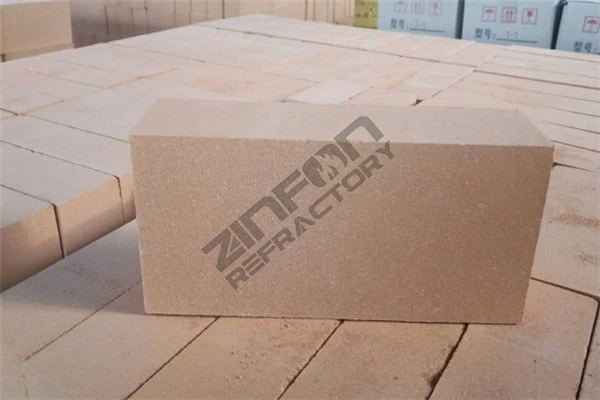
Clay refractory bricks are manufactured using clay clinker as the aggregate, refractory clay (soft clay or semi-soft clay) as the binder, formed by semi-dry or plastic molding methods, and fired at temperatures ranging from 1,250°C to 1,420°C.
The mineral composition of clay refractory bricks primarily consists of kaolinite (Al₂O₃·2SiO₂·2H₂O) and 6%–7% impurities (potassium, sodium, calcium, titanium, and iron oxides).
Clay refractory bricks are acidic refractory products, with their acidity increasing as the SiO₂ content rises. They exhibit certain resistance to acidic slag erosion but poor resistance to alkaline slag erosion. Therefore, clay products are suitable for use as linings in acidic kilns and are also applied in high-temperature furnaces such as blast furnaces, hot-blast stoves, glass kilns, and carbon roasters.
Advantage
(1) Low density:Bulk density typically ranges from 0.4 to 1.3 g/cm³, only 20–65% of common clay bricks (2.0–2.2 g/cm³), significantly reducing furnace weight.
(2) High porosity:Apparent porosity of 40–70% with a high proportion of closed pores (>60%), and pore sizes of 0.1–1 mm, forming a highly efficient thermal insulation network.
(3) Low thermal conductivity:Room-temperature thermal conductivity of 0.09–0.25 W/(m·K), only 1/5–1/3 that of dense clay bricks; thermal conductivity at 1,000°C ≤ 0.5 W/(m·K), effectively reducing heat transfer.
(4) Energy efficiency:As furnace linings, it reduces energy consumption by 15–30% and shortens heating time by 20–40%, suitable for intermittent heating equipment.
(5) Good thermal shock stability:High porosity buffers thermal stress, with a low thermal expansion coefficient (about 5–6×10⁻⁶/°C); withstands ≥10 water-cooling cycles at 1,100°C without cracking.
(6) Refractoriness:Al₂O₃ content of 30–48%, refractoriness of 1,580–1,750°C, and long-term service temperature up to 1,200–1,350°C (depending on Al₂O₃ content).
(7) High-temperature strength:Room-temperature compressive strength of 3–15 MPa-though lower than dense bricks, sufficient to support non-load-bearing furnace lining structures; high-temperature (1,000°C) strength retention rate >50%.
(8) Erosion resistance:Good resistance to acidic furnace gases (e.g., SO₂, CO₂), but unsuitable for direct contact with slag.
Zinfon Refractory Technology Co.,Ltd.
We provide one-stop services from technical consultation to design, production, and after-sales support.


Raw Materials
Fireclay
Physical and Chemical Specifications
|
Specfication |
B-1 |
B-2 |
B-3 |
B-4 |
B-5 |
B-6 |
B-7 |
C-1 |
C-2 |
C-3 |
|
Reheating Shrinkage Temperature ℃ |
900 |
1,000 |
1,100 |
1,200 |
1,300 |
1,400 |
1,500 |
1,300 |
1,400 |
1,500 |
|
Bulk density g/cm3 ≥ |
0.70 |
0.70 |
0.75 |
0.80 |
0.80 |
0.90 |
1.00 |
1.10 |
1.20 |
1.25 |
|
Compressive strength Mpa ≤ |
25 |
25 |
25 |
25 |
25 |
30 |
30 |
50 |
70 |
100 |
|
Thermal Conductivity W/m.k (350±25℃)≥ |
0.17 |
0.18 |
0.20 |
0.22 |
0.23 |
0.27 |
0.31 |
0.30 |
0.38 |
0.45 |
Process
Raw material preparation → batching → mixing → molding → drying → firing → finished product inspection and packaging
The firing temperature typically ranges from 1,200 to 1,400°C, with the specific value depending on the brick type and performance requirements.


Application
Heating Furnaces and Heat Treatment Furnaces:Used as linings for furnace walls, roofs, flues, etc., acting as thermal insulation layers to reduce heat loss while withstanding medium-to-low temperature loads (≤1,200°C).
Annealing Furnaces and Soaking Pits:As lining materials, they adapt to frequent start-stop temperature fluctuations (e.g., steel annealing cycles), preventing thermal shock-induced cracking and extending equipment lifespan.
Iron Pretreatment Equipment:In desulfurization and dephosphorization units, serves as a non-contact thermal barrier to isolate high temperatures and minimize heat dissipation.
Glass Kilns:Applied in non-critical zones (≤1,300°C) such as breast walls and regenerator checkerwork, providing insulation and resisting mild erosion from glass melt volatiles.
Ceramic Sintering Kilns:Functions as insulation layers or kiln furniture (e.g., saggers, setter plates), maintaining stable thermal environments (1,000–1,300°C) for ceramic billets while reducing kiln heat loss.
Cement Industry:Used in rotary kiln seals and cooler insulation to minimize operational heat loss and enhance thermal efficiency in cement production.
Chemical Reactors and Heating Furnaces:In ammonia synthesis or petrochemical cracking furnaces, lines furnace walls to prevent heat diffusion and resist corrosion from flue gases (e.g., CO₂, steam), as seen in non-core zones of coal gasifiers.
Refractory Chimneys and Pipelines:Lining materials for high-temperature flue gas systems, resisting acidic corrosion (e.g., SO₂, NOx) while lowering external surface temperatures for safety.
Fertilizer Production Equipment:Insulates heating units or reaction vessels in urea/phosphate production, withstanding medium-temperature (≤1,200°C) corrosive environments.
Boilers and Incinerators:Lines furnace walls, flues, and superheaters in power boilers and waste incinerators, insulating 800–1,200°C flue gases, reducing heat loss, and resisting fly ash erosion.
Nuclear Power Auxiliary Systems:Serves as non-critical insulation in nuclear reactors, meeting requirements for high-temperature stability and low radioactive contamination (specific grades required).
Kiln Repair and Temporary Insulation:Used as temporary linings during kiln maintenance or emergency insulation for high-temperature equipment (e.g., pipe wrapping), valued for lightweight and rapid installation.


Why chooes us?
01/Customized dimensions and shapes
-

Customized Brick Shape
Provide Sample Sheets--Mold Opening & Quotation--Mold Opening & Sample Making--Bulk Production Quotation--Contract Signing--Bulk Production
02/Delivery cycle and logistics
-
Sea freight, land freight. Determine the mode of transportation according to the needs
About 30 days, customized products delivery time depends on the actual situation.
03/Customized packaging
-
Customize your brand
Logo customization, custom fonts, taglines and messages for packaging, signage, websites or printed materials.
Take your brand to the next level, contact us today to discuss your project!


04/Purchase ZINFON refractory Bricks at Reasonable Prices
-
We recognize that pricing is a critical factor in our customers' purchasing decisions. Leveraging our proximity to abundant mineral resources and advanced manufacturing technologies, we offer competitive pricing without compromising on quality. Our strategic location minimizes raw material costs, while economies of scale achieved through state-of-the-art processes further reduce unit production expenses.
It is worth noting that while price is an important factor, it should not be the sole determinant of your purchasing decision. When buying refractory bricks from ZINFON, quality, reliability, and technical support are equally important considerations.
By choosing ZINFON as your supplier, you can access high-quality refractory bricks, a wide range of other refractory materials, and comprehensive support. Contact ZINFON Refractories immediately to discuss your specific requirements and obtain customized solutions!
7*24 hours online response
Provide professional after-sales protection
Our address
Qinghua Management Dist., Dashiqiao City, Yingkou City, Liaoning, China
Phone Number
+8613700131695
+8618540210631
info@zinfon-refractory.com

Hot Tags: light weight fireclay brick, China light weight fireclay brick manufacturers, suppliers, factory, Refractory for Flue Insulation, insulating bricks, high temperature furnace insulation, refractory insulation materials, insulating refractory brick, insulating castable refractory